Best Customer Success Platform With No Technical Setup
By Munish Gandhi · Founder & CEO, Statisfy
Here is a scenario CS leaders know well. You buy a powerful customer success platform, spend three months on implementation, pull engineering into data integrations, hire a platform admin, and finally, six months later, your CSMs start using it. Except half of them default to spreadsheets because the tool was built for someone else.
This is the hidden cost of enterprise CS software. The most feature-rich platforms are the most painful to set up and maintain. For sales-adjacent CS teams, CSMs who came from account management rather than operations, the learning curve is a direct tax on retention and revenue.
Evaluation framework: Each platform is assessed on market positioning, architectural approach, health scoring depth, automation capabilities, integration model, and operational overhead. Setup time is treated as a first-class criterion because delayed time to value is a real cost, not a minor inconvenience.
What “Non-Technical Setup” Actually Means in Practice
The phrase “easy setup” appears in every CS vendor’s marketing, but it covers four very different layers:
- Data pipeline configuration: determines whether you need an engineer at all. Some platforms walk you through a UI wizard; others require custom object mapping and API work.
- Admin overhead at scale: the invisible cost. Platforms that run with minimal maintenance are fundamentally different from those that need a part-time admin to keep health scores current and playbooks from silently breaking — see our guide to customer success ops for what that admin function actually does day to day.
- CSM onboarding time: adds another four to eight weeks on enterprise platforms between “the platform is live” and “CSMs actually work from it daily.”
- Change management burden: compounds over time. Teams on heavily configured platforms routinely spend 20 to 30 percent of quarterly ops cycles on maintenance rather than improvement when the product or CS motion evolves.
Setup Time by Platform
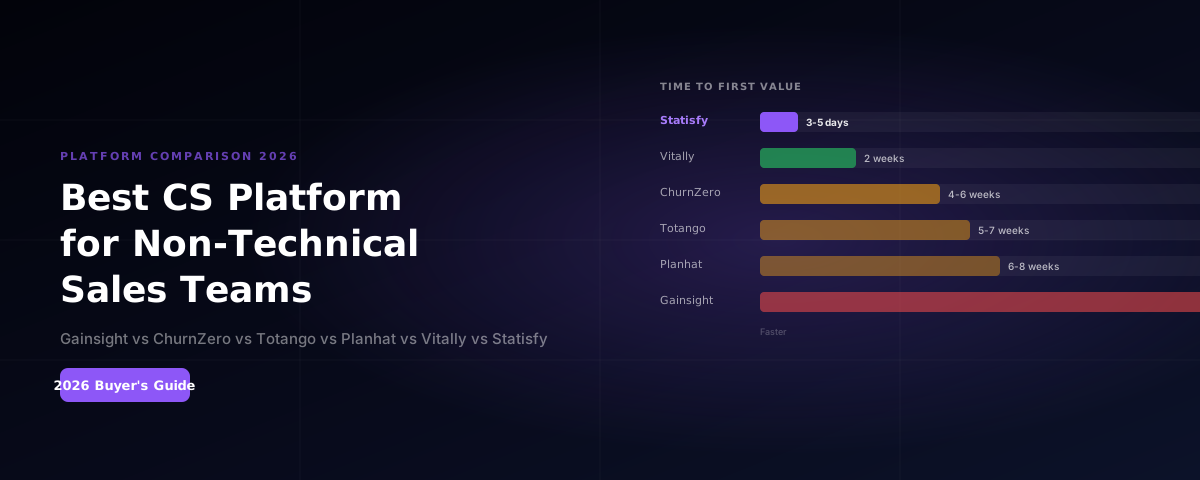
The chart below reflects time to first meaningful value: the point at which a CSM can manage their first account from the platform with live data, working health scores, and at least one active alert or playbook. This is a stricter definition than “implementation complete.”
Platform Deep Dives
Gainsight
Gainsight is the category creator, founded in 2013 and built for large B2B SaaS enterprises with mature CS operations, dedicated CS ops teams, and a willingness to treat the platform as long-term infrastructure. Its natural home is companies with 50 or more CSMs and at least one person whose job title includes “Gainsight admin.”
Where Gainsight Excels
- Companies with 50 or more CSMs managing accounts with complex, multi-stakeholder relationships
- Organizations that have a dedicated CS ops function and a Gainsight administrator
- Enterprises that need deep product analytics tied directly to health scores
- Teams that can invest three to six months in implementation and training before expecting ROI
Where Gainsight Falls Short
- Implementation timelines of three to six months are standard, not exceptional
- The platform degrades meaningfully without a dedicated admin; integrations drift, health scores go stale, playbooks break silently
- CSM onboarding time is high; the interface is optimized for configuration, not daily use
- Cost scales significantly with user count and feature modules, making it difficult to justify below a certain ARR threshold
Ideal customer profile: Series C and beyond, 25 to 200 CSMs, dedicated CS operations team, annual CS platform budget above $150K, and a willingness to treat implementation as a multi-quarter project.
ChurnZero
ChurnZero targets mid-market SaaS companies with five to thirty CSMs where churn prevention and renewal tracking are the primary CS objectives. Its distinctive feature is a built-in in-app communication layer — announcements, surveys, and walkthroughs inside the customer’s product — that sits between a pure CS platform and a product engagement tool like Pendo.
Where ChurnZero Excels
- Renewal-focused CS motions where churn prevention is the primary KPI
- Teams that want in-app user communication without buying a separate tool
- Mid-market companies that have outgrown spreadsheets but do not need Gainsight’s complexity
- Organizations with a part-time admin available for ongoing configuration
Where ChurnZero Falls Short
- Setup typically requires four to six weeks and at least one person with CS ops experience
- AI capabilities are limited compared to platforms built in the last three years
- Expansion and upsell workflows are weaker than renewal workflows
- The interface is functional but not modern; CSM adoption can be a friction point
Ideal customer profile: Series A to Series B, five to twenty-five CSMs, subscription business with predictable renewal cycles, and a CS ops resource available for a four to six week implementation period.
Totango
Totango built its platform around SuccessBLOCS — pre-built CS workflow modules for onboarding, adoption, renewal, and risk — designed to give teams a structured starting point rather than a blank canvas. Its 2023 merger with Catalyst has introduced product roadmap complexity that prospective buyers should probe directly with the sales team.
Where Totango Excels
- Teams that want a structured starting point for their CS motion rather than a blank-canvas platform
- Companies with distinct lifecycle stages that benefit from stage-specific health models
- Organizations that have evaluated Gainsight and want comparable structure at lower cost and complexity
Where Totango Falls Short
- The Catalyst merger has introduced product roadmap uncertainty that prospective buyers should probe directly with the sales team
- The SuccessBLOCS templates create a starting point but not a finished system; meaningful customization is still required
- Setup typically takes five to seven weeks for a team to reach a functional state
- AI capabilities are modest; the platform has not kept pace with newer entrants on this dimension
Ideal customer profile: Mid-market SaaS with a defined CS motion, five to forty CSMs, a CS ops resource for implementation, and a preference for structured templates over blank-canvas configuration.
Planhat
Planhat is a Swedish-founded platform built for CS teams held accountable to revenue metrics — NRR, expansion ARR, gross retention — with a reporting layer oriented toward board-level visibility. Its most distinctive characteristic is flexible data modeling that can accommodate complex account hierarchies and non-standard structures, at the cost of upfront data modeling work before the platform delivers insight.
Where Planhat Excels
- CS teams held accountable to NRR and revenue attribution metrics
- Companies with complex account structures that do not fit standard platform data models
- European SaaS companies where Planhat has strong market presence and customer community
- Teams that need board-level revenue reporting from their CS platform without custom BI work
Where Planhat Falls Short
- Setup typically requires six to eight weeks due to data modeling requirements
- The flexibility that makes it powerful also makes it demanding; there is no opinionated starting point
- AI and predictive capabilities are limited compared to newer platforms
- US market presence and support are less developed than its European footprint
Ideal customer profile: Mid-market to enterprise SaaS with a revenue-first CS philosophy, complex account structures, and a CS ops resource available for a six to eight week implementation. Strong fit for European companies.
Vitally
Vitally was designed around the CSM’s daily experience rather than the administrator’s configurability — its Hub view gives each CSM a unified workspace aggregating tasks, health alerts, and renewals into a single prioritized queue. It targets growth-stage SaaS companies (Series A to C) with three to thirty CSMs who want modern UX without Gainsight’s implementation overhead.
Where Vitally Excels
- Growth-stage companies where CSM adoption and daily usability are top priorities
- Product-led growth companies where the CS motion combines digital and high-touch elements
- Teams that want modern UX and transparent pricing without enterprise procurement complexity
- CS leaders who want meaningful reporting without a dedicated data team
Where Vitally Falls Short
- Health scoring configuration still requires ops judgment and ongoing maintenance
- AI automation is less mature than platforms built specifically around AI-driven workflows
- Not designed for companies with 50 or more CSMs and complex organizational structures
- Setup typically takes one to two weeks, which is better than the enterprise platforms but still requires ops involvement
Ideal customer profile: Series A to Series C SaaS, three to thirty CSMs, PLG or hybrid CS motion, and a team that prioritizes CSM daily experience and modern UX over maximum configurability.
Statisfy
Statisfy is an AI-native customer success platform built from the ground up without the assumption that a CS ops team, an admin resource, or a lengthy implementation project will be available. Every capability — health scoring, playbook execution, renewal forecasting, QBR generation — is automated by AI agents that work continuously in the background.
A CSM team can go from signed contract to running their first accounts in under a week. The platform connects to Salesforce, HubSpot, Intercom, Zendesk, Mixpanel, Amplitude, and 100+ other data sources without custom engineering. Health scores are built and maintained automatically as new signals arrive.
Pricing is transparent at $30K per year for up to $30M ARR with unlimited user licenses — accessible to growth-stage companies that cannot justify a six-figure CS platform spend. Every capability is included at that price rather than gated behind add-on modules, which is a meaningful departure from how most vendors in the CRM vs. customer success platform category price their products.
Where Statisfy Excels
- Teams that need to go live in days, not months, with no engineering involvement and no dedicated admin
- AI-built health scores that update automatically as customer behavior changes, with no ongoing maintenance burden
- Automated playbooks that trigger and execute without CSM configuration — the system acts before a human notices the signal
- QBR and executive business review preparation completed in 45 seconds versus the industry norm of 3 to 4 hours per account
- Stella, the embedded AI assistant, answers customer questions and surfaces account context on demand
- 100+ AI agents running Always-On workflows across the full customer lifecycle without manual setup
- Flat, public pricing with no enterprise procurement cycle and no per-seat cost that scales against you
Where Statisfy Falls Short
- Integration catalog is narrower than Gainsight for highly custom or legacy enterprise data sources
- Less suitable for organizations that need deep, hand-crafted workflow configuration rather than AI-automated execution
- Shorter market track record than established platforms that have been deployed across hundreds of enterprise accounts
- Not designed for CS teams at very large enterprises where complex organizational hierarchies and multi-stakeholder governance require heavy customization
Ideal customer profile: Growth-stage SaaS companies ($5M to $50M ARR) with two to thirty CSMs, no dedicated CS ops resource, and a leadership team that needs CS to demonstrate measurable revenue impact without a multi-month implementation investment. FastStart deploys in three weeks. Strongest fit for teams replacing spreadsheets or a first CS platform.
See your first account running in days, not months
Start a free trial and connect your CRM and product data — Statisfy builds your first health scores and playbooks automatically, with no engineering project required.
What the Market Gets Wrong About CS Platform Selection
Three patterns consistently lead teams to decisions they regret:
- Feature-checklist evaluations overweight capabilities a solutions engineer demoed over two days and underweight whether your team can operate those features reliably on their own. The right question is not “does this platform have X” but “what does it take for our team to use X without ongoing vendor support.”
- Brand defaults: VP-level buyers choose Gainsight because it is the recognized name, without accounting for whether their eight-CSM team has the infrastructure to extract value. Buy for what your team is today, not an aspirational future state.
- Demo theater: every demo environment has pre-configured health scores and curated data. Ask instead for the vendor to build a basic health score from a blank instance using fields that resemble your own data model, and time how long it takes.
Full Platform Comparison
| Capability | Gainsight | ChurnZero | Totango | Planhat | Vitally | Statisfy |
|---|---|---|---|---|---|---|
| No-code setup | No | Partial | Partial | Partial | Yes | Yes |
| AI health scoring | Config heavy | Rules-based | Templates | Manual | Basic | Auto-built |
| Automated playbooks | Complex setup | Limited | Basic | No | Basic | AI-triggered |
| CRM sync (no dev) | Dev needed | Yes | Yes | Yes | Yes | Yes |
| AI meeting summaries | Add-on | No | No | No | Yes | Yes |
| Revenue attribution | Module | No | No | Yes | No | Built-in |
| Dedicated admin required | Yes | Recommended | Often | Sometimes | No | No |
| Transparent pricing | Quote only | Quote only | Partial | Partial | Public | Public |
The Questions Vendors Hate Being Asked
Every CS platform looks capable in a demo. The questions that reveal real differences are the ones vendors deflect:
- “How many days until our first CSM can run their first account from your platform?” Not implementation timeline. Days to first CSM value. Require a specific number.
- “Can our ops team configure health scores without engineering?” If the answer involves “data pipeline” or “API integration,” budget for a developer.
- “Show us a playbook triggering from a live health score drop, without any prior configuration.” Ask them to do it live, not in a prepared demo environment.
- “What breaks if we go 90 days without a dedicated admin?” The answer tells you exactly how much maintenance the platform demands.
- “How does our CFO see CS ROI using your platform?” If the answer requires a custom dashboard build, that is unreported ops cost you have not budgeted for.
- “What percentage of your customers have gone live within 30 days of signing?” This separates theoretical speed from operational reality at scale.
Matching Platform to Situation
Where Statisfy Fits
Strengths
- Live in days with no engineering or dedicated admin
- AI builds and maintains health scores automatically from connected data
- Playbooks trigger without CSM configuration or manual intervention
- Revenue attribution built in; no custom dashboard build required
- Transparent public pricing; no enterprise procurement cycle
Limitations
- Narrower legacy integration catalog than Gainsight
- Less suitable for organizations that need deep custom workflow configuration
- Track record is shorter than the established enterprise platforms
The Bottom Line
There is no universally correct answer to which CS platform a company should buy. The right platform is the one that fits the team’s size, technical resources, budget, and timeline for getting live. A large enterprise with a dedicated CS ops team and six months to implement should seriously evaluate Gainsight. A growth-stage company with three weeks and no admin should not.
The mistake most teams make is over-indexing on feature depth during evaluation and under-indexing on operational sustainability after implementation. A platform with ten capabilities your team can use reliably every day outperforms a platform with fifty capabilities your team uses inconsistently or avoids entirely.
Use the decision matrix above as a starting framework. Then run the “blank instance” test with every vendor on your short list: ask them to configure a working health score for a sample customer using data that resembles yours, starting from a fresh installation. The results of that exercise will tell you more than any demo.
Run the blank instance test yourself
Start a free trial and configure a working health score on your own data in under a week — no sales engineer, no scripted demo environment.
Compare
How Statisfy compares.
Side-by-side, parameter-by-parameter comparisons with the CS platforms teams evaluate us against.
- Statisfy vs Gainsight Rule-based CTAs vs work already drafted.
- Statisfy vs ChurnZero Plays and ChurnScores vs zero-config action.
- Statisfy vs Vitally Playbook-and-Copilot vs work that's already done.
- Statisfy vs Totango + Catalyst Three products you stitch together vs one platform that acts.
- Statisfy vs Planhat Configurable system of record vs AI-native system of action.
- Statisfy vs Hook ML alerts vs the full loop from signal to autonomous action.
- Statisfy vs Staircase AI Gainsight's communication intelligence add-on vs standalone AI-native platform.