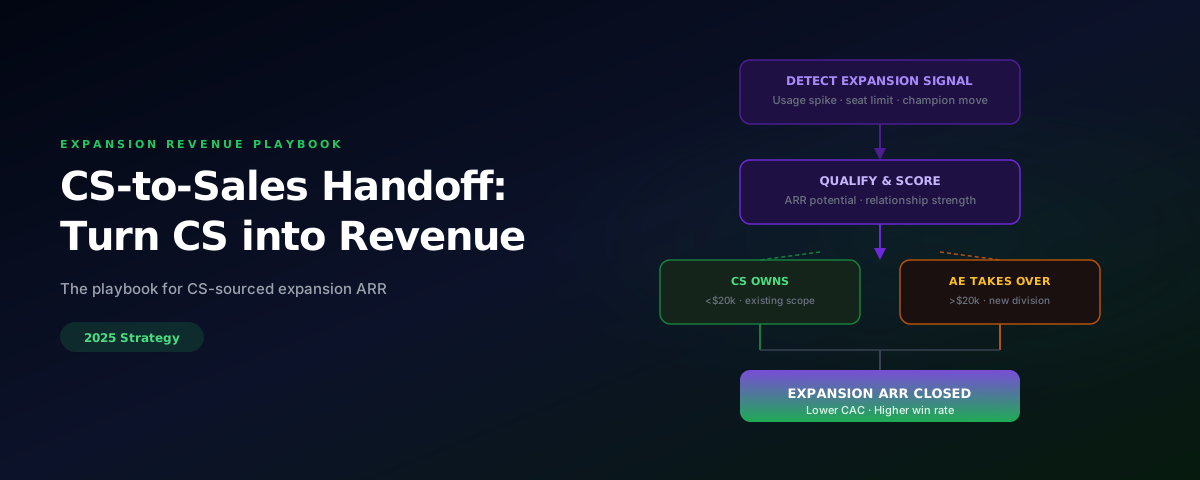
CS-to-Sales Handoff: Turn CS into Expansion Revenue
By Munish Gandhi · Founder & CEO, Statisfy
The most expensive pipeline in most SaaS companies is the one that never gets built: expansion revenue that exists inside the existing customer base but never reaches the sales team in time to close.
CS teams have daily access to the accounts with the highest purchase intent in the company. They see which customers are hitting usage limits. They know which champions just moved to a larger division. They can tell when a new VP started using the product and is asking questions that signal a potential expansion. And in most companies, none of this information reaches the sales team in any structured way.
“CS-sourced expansion opportunities have a 3–5x higher close rate than outbound prospecting into new logos, and an average sales cycle 40% shorter. Yet fewer than 30% of CS teams have a formal, documented CS-to-sales handoff process with defined signal triggers.” — OpenView 2025 SaaS Expansion Survey
The gap between what CS teams observe and what the sales team acts on is where expansion revenue disappears. This guide covers the three signals CS teams most commonly miss, the handoff structure that captures them, and how to measure the output.
Why CS Is the Most Underutilized Revenue Channel
Customer success teams interact with customers more frequently than any other function. A CSM managing 40 accounts typically has meaningful touchpoints with 20–25 of them in any given month. Sales development reps cold-calling the same company have near-zero context.
The reasons CS expansion goes uncaptured are structural, not motivational.
No defined signal triggers. CSMs know something looks like an expansion opportunity but are uncertain whether to act on it themselves, loop in the AE, or wait for the customer to ask. Without clear triggers, the default is to wait. Waiting means the opportunity ages out.
Compensation misalignment. In most CS compensation structures, there is no direct financial incentive for surfacing expansion opportunities. If the AE gets the commission on the upsell and the CSM gets nothing beyond their base, the rational CSM prioritizes retention (which is measured) over expansion (which is not).
Relationship preservation instinct. CSMs fear that introducing a commercial conversation will damage the trust they have built. This is a legitimate concern when the conversation is handled poorly. The fix is not to avoid the conversation — it is to train CSMs on how to handle it.
No handoff structure. When a CSM identifies an expansion opportunity and tells the AE, what happens next? In most companies, the answer is “it depends on the AE.” This inconsistency means opportunities fall through the gaps based on which AE happens to be attentive that week.
The 3 Expansion Signals CS Teams Most Commonly Miss
Signal 1: Champion Moves to a Larger Team or Business Unit
When your primary contact gets promoted, changes roles, or moves to a different division within the same company, this is simultaneously a churn risk and an expansion opportunity. As a churn risk: the account loses its internal advocate and the replacement may not be predisposed to renew. As an expansion opportunity: the champion is now in a new position and knows the product. If the product solved a problem in their previous role, they may want it in their new one.
What to do when you detect it: Within 5 business days of learning about the change, schedule a separate outreach to the champion in their new role. Ask how the new team is structured and whether the same problems exist at a different scale. This is a natural conversation that does not feel commercial.
Signal 2: Usage Hitting Plan Limits or Unusual Spikes
An account that is at 80–85% of their seat limit, API quota, or usage threshold is sending a clear commercial signal: the product is working well enough that the company needs more of it. This is not a churn risk — it is an expansion signal hiding in product telemetry.
The reason this goes uncaptured is that CSMs typically see usage data but do not have a defined threshold that triggers a commercial conversation. They see high usage and think “great, healthy account.” They do not automatically think “this account needs to talk to someone about expanding.”
What to do when you detect it: Define a threshold (80% of limits is a standard starting point) that automatically queues a CSM task: “Account X is at 83% seat capacity. Schedule a conversation about their growth trajectory and prepare a seat expansion proposal for review.”
Signal 3: New Stakeholder Onboards Organically Without CSM Involvement
When someone new starts using the product without being introduced by the CSM — a different department head, a colleague in another region, or a new VP who noticed their team using it — this is organic viral adoption. It is the strongest possible expansion signal because it means the product is solving a problem the company did not explicitly contract for.
What to do when you detect it: Reach out to the new user within 48 hours of their first session. Welcome them, ask how they found the product, and offer to set up a brief onboarding call. This conversation naturally surfaces whether they have a use case that extends beyond the current contract scope.
The CS-to-Sales Handoff Framework
Not every expansion opportunity should be handled by CS. Not every opportunity should go to the AE. The right answer depends on deal size, complexity, and relationship dynamics.
| Signal Type | ARR Potential | Recommended Owner | Handoff Trigger |
|---|---|---|---|
| Seat expansion (existing product) | < $15k | CS owns | CSM proposes in next touchpoint |
| Plan upgrade (tier change) | < $25k | CS owns | CSM sends proposal with AE CC’d |
| New department or division | $15–50k | Joint CS + AE | CS surfaces, AE runs the commercial conversation |
| New product line or module | $25k+ | AE leads, CS supports | CS creates intro, AE owns deal progression |
| Enterprise-wide rollout | $50k+ | AE + Solutions | CS flags and hands off immediately |
The Handoff Document
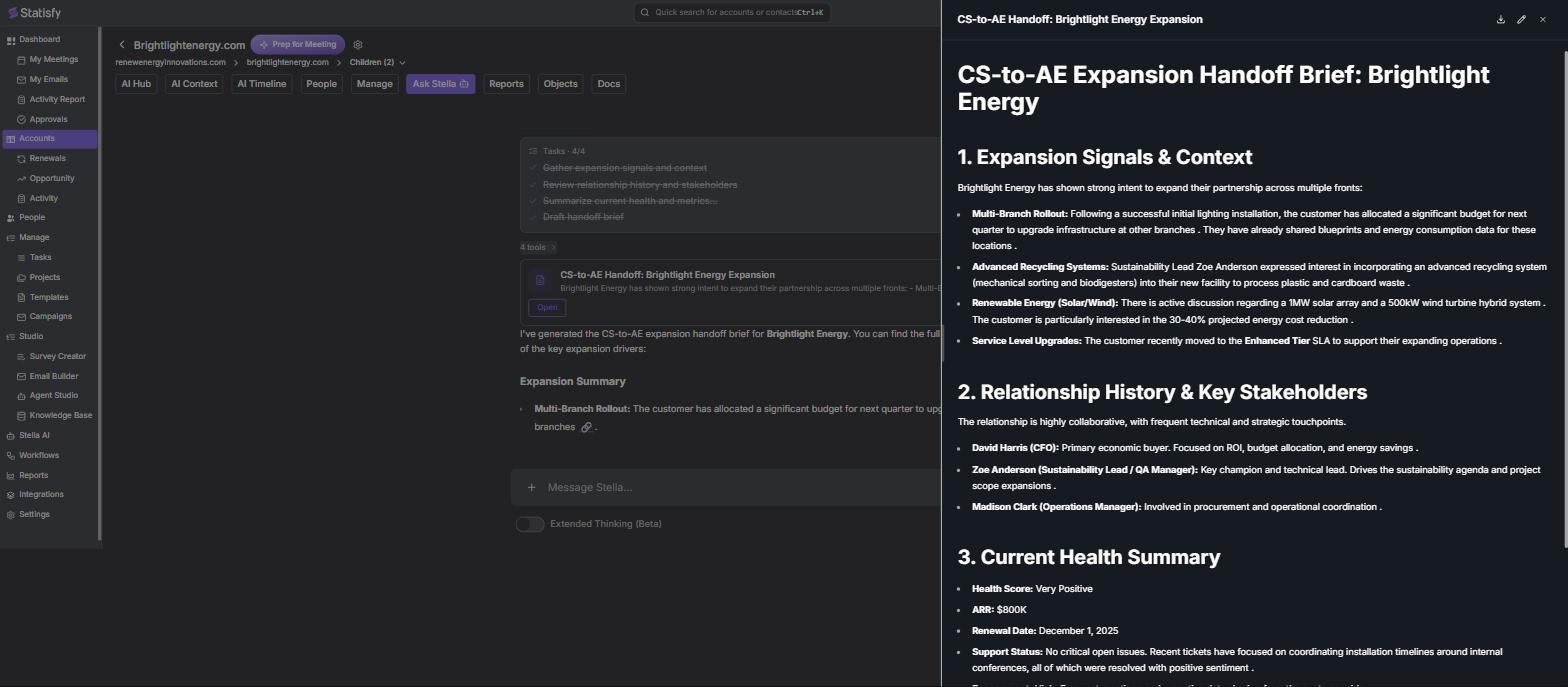
When CS passes an opportunity to the AE, the AE should receive a one-page account brief that answers five questions:
- What is the specific expansion signal? (Usage threshold / champion move / new stakeholder)
- What is the account relationship like? (Champion name, tenure, warmth to commercial conversations)
- What is the customer’s current business priority? (What are they trying to accomplish in the next 90 days?)
- What is the expansion opportunity in plain terms? (X more seats for team Y, or module Z for use case W)
- What is the CSM’s read on timing? (Is this a now conversation or a 60-day conversation?)
An AE who receives this brief can walk into an expansion conversation with the context of a CSM. Without it, the AE is starting from scratch and the customer notices. This is the same handoff logic behind Stage 3 autonomous AI in customer success — the signal only creates revenue once it reaches the person who can act on it.
Stop losing expansion signal in a Slack DM
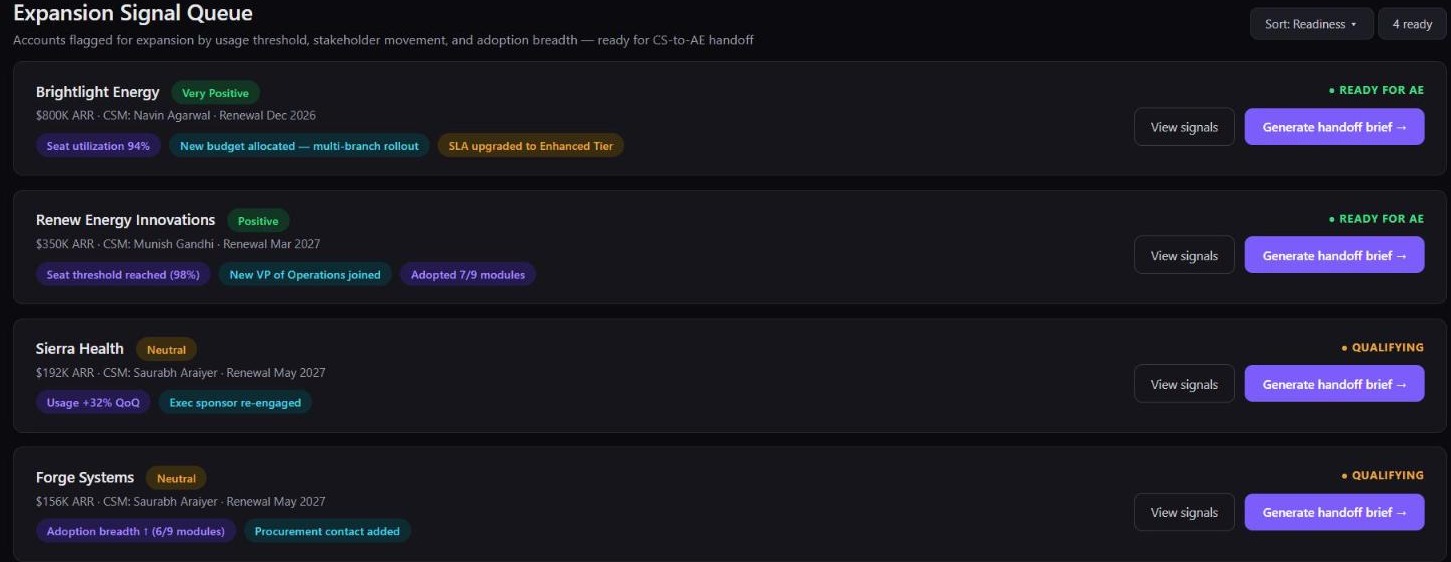
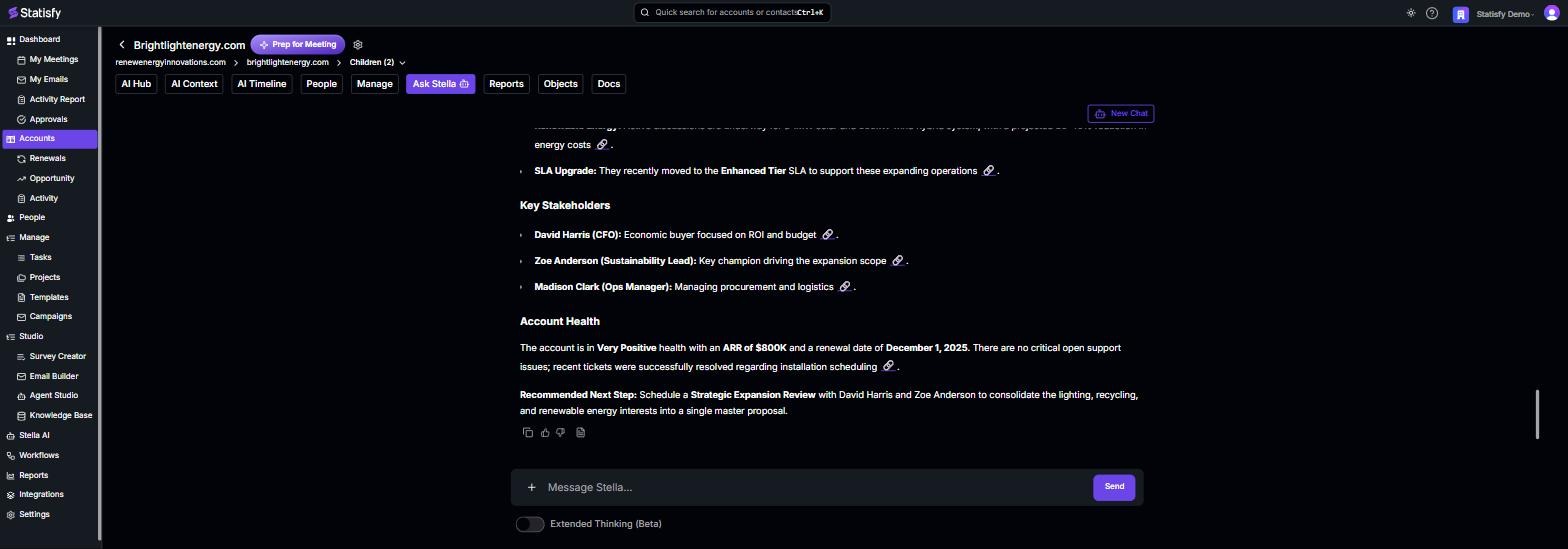
Start a free trial and Statisfy will flag usage-threshold and stakeholder-movement signals automatically, with a handoff brief ready for the AE — no manual tracking required.
How to Structure the Expansion Conversation
The mistake CS teams make in expansion conversations is leading with the product. “We now have a new module that does X” is a feature pitch. It puts the customer on the defensive.
The right structure is to lead with the customer’s business problem, not your product.
Open with the ROI they have already seen
Anchor the conversation in value already delivered. “Your team has driven X outcomes using the platform. I want to make sure we are capturing everything available.” This reframes expansion as continuing something that is working, not adding a new cost.
Identify the growth constraint
”I noticed your team is at 82% of your seat limit. Is that because the team has grown, or are there other people who should be using the platform who do not have access?” Let the customer describe the problem. Do not assume you know what it is.
Propose specifically, not generally
Come with a specific option, not a range. “Based on your team size and growth trajectory, I think adding 15 seats makes the most sense — that gives you room for the next 12 months without an awkward mid-year conversation.” Specific proposals close faster than open-ended ones.
Address the process proactively
At the end of any expansion conversation, address how they buy: “What does the approval process look like on your end? I want to make sure I give you everything you need to move this forward without unnecessary back-and-forth.” This surfaces the decision-maker and the timeline without being pushy.
Measuring CS-Sourced Expansion Revenue
Measurement creates accountability, and accountability creates behavior change. If you do not track CS-sourced expansion as a distinct pipeline category, you cannot improve it.
Metrics to track:
- CS-sourced expansion ARR per quarter: Total ARR from expansions where the original signal was identified by CS (vs. AE-sourced or inbound). Track as an absolute number and as a % of total expansion.
- Signal-to-close rate by signal type: What % of usage-threshold signals close into expansion vs. what % of champion-move signals close? This tells you which signals are highest-quality and where to focus detection.
- CS-to-AE handoff conversion rate: Of opportunities CS hands to AE, what % reach at least proposal stage? Low conversion signals either poor signal quality (CS is passing weak opportunities) or AE execution problems.
- Time from signal to first AE contact: The faster the AE engages, the higher the close rate. Track the average lag and set a target (48 hours is a strong standard for high-ARR opportunities).
On CS compensation for expansion: The question of whether to pay CS on expansion ARR is a valid one. The risk of not paying: CS has no incentive to source expansion. The risk of paying: CS prioritizes commercial conversations at the expense of relationship health. The most common successful model is a small spiff for CS-sourced expansion (not commission — a flat bonus per qualified opportunity that closes), with the larger payout going to the AE. This creates alignment without misaligning CS incentives.
Building the Flywheel
The CS-to-sales handoff is not a one-time process design. It is a flywheel that compounds over time.
In the first quarter, you will catch some signals you would have previously missed. In the second quarter, CSMs will start watching for signals proactively because they have seen the handoff process work. By the third quarter, the expansion pipeline has a new source with a higher win rate than new-logo prospecting, and the feedback loop between CS signal quality and AE close rates improves CS’s signal identification further.
The companies with the best NRR are not the ones with the most aggressive expansion motion. They are the ones with the most systematic one — where expansion revenue surfaces from observable customer behavior rather than quarterly outreach campaigns.
“Companies with a formal CS-to-sales handoff process with defined signal triggers report 35–40% more CS-sourced expansion ARR than companies with ad-hoc handoffs, with no meaningful difference in customer satisfaction scores or renewal rates. The expansion uplift comes entirely from capturing opportunities that previously went undetected.”
Statisfy automatically flags expansion signals — usage thresholds, stakeholder movements, adoption milestones — and generates handoff briefs for AEs. CS teams using Statisfy report an average 28% increase in CS-sourced expansion ARR within two quarters of deployment. That expansion motion is also one of the five levers behind what separates 130% NRR from 105% NRR.
Build your first handoff brief this week
Start a free trial and connect your CRM and product data — Statisfy flags the signal, drafts the brief, and routes it to the right owner.
Compare
How Statisfy compares.
Side-by-side, parameter-by-parameter comparisons with the CS platforms teams evaluate us against.
- Statisfy vs Gainsight Rule-based CTAs vs work already drafted.
- Statisfy vs ChurnZero Plays and ChurnScores vs zero-config action.
- Statisfy vs Vitally Playbook-and-Copilot vs work that's already done.
- Statisfy vs Totango + Catalyst Three products you stitch together vs one platform that acts.
- Statisfy vs Planhat Configurable system of record vs AI-native system of action.
- Statisfy vs Hook ML alerts vs the full loop from signal to autonomous action.
- Statisfy vs Staircase AI Gainsight's communication intelligence add-on vs standalone AI-native platform.