No more rule-based CTAs.
Gainsight hands your CSM a task that says "do something." Statisfy hands them the something — the QBR built, the email drafted, the reply ready to send. Zero setup to maintain. Live in 2–3 weeks.
Statisfy vs Gainsight
Parameter by parameter
Ratings reflect real product capability from vendor docs, reviews, and July 2026 research — not marketing claims.
Core verb
Logs and alerts. Cockpit CTAs surface tasks for a human to do; the work still happens outside the platform.
Acts. Drafts the email, builds the QBR, writes the reply — the work is done before the CSM opens the laptop.
Setup & time to value
3–9 months typical; professional services and a dedicated admin effectively required. Implementation fees commonly $10K–$120K.
Zero-config. Health live from day one, fully live in 2–3 weeks — no playbooks, fields, or health rules to build.
Config & maintenance burden
Health-score weights, connectors, playbooks and CTAs all hand-built and maintained by CS Ops.
Nothing to maintain. LLM-based health works from day one; agents replace the rule library.
Reads the conversation
Yes, via Staircase AI — but bolted on through a 2024 acquisition, layered onto a structured/usage/CRM core.
Native. Reads Granola, Gong, Slack, Gmail as the leading signal — the context is the product, not an add-on.
Predictive health
Health scoring plus Staircase sentiment detection; strong, but centered on the enterprise data warehouse.
Predictive from real conversations — sees risk coming months before renewal. 87.5% accuracy, <5% CSM override.
Generative + autonomous AI
Atlas AI agents (launched 2025) draft and run some outreach — new, and layered on a legacy CTA backbone.
Predict · Generate · Act is the product, not a 2025 add-on. QBR in 45 seconds; drafts and acts across Gmail and Slack.
The capability gap
What Gainsight can't do — and what Statisfy does
The head-to-head at a glance. Cross-referenced from vendor docs and July 2026 reviews.
Not with Gainsight
What you can't do
- Deploy without months of playbook and CTA configuration.
- Score health from real conversations without an added acquisition (Staircase).
- Draft the QBR outside a template engine — the CSM still assembles the deck.
- Serve mid-market teams without a dedicated CS Ops admin to maintain the rules.
- Run multi-CRM natively — deep Salesforce coupling with limited HubSpot depth.
- Ship autonomous, cross-system action without the 2025 Atlas add-on on a legacy CTA core.
With Statisfy
What you get on day one
- Live in 2–3 weeks with zero-config LLM health — no rules, playbooks, or CTAs to build.
- Reads across 8 meeting-recording integrations (Gong, Chorus, Fireflies, Attention, Avoma, Fathom, Zoom, Clari) as the leading signal.
- Drafts a finished QBR in 45 seconds — exec summary, scorecard, next-quarter plan.
- Multi-CRM native — Salesforce and HubSpot equally deep, no lock-in.
- 30+ self-serve integrations including bi-directional Salesforce custom-object writeback.
- Predict · Generate · Act as the core product — 35K+ workflows already running weekly.
Not another CSP
They inform. We do the work.
Legacy CSPs alert or track. Newer AI tools advise. Statisfy predicts, generates, and acts — with a human in the loop on every send.
PREDICT
Built on the customer knowledge graph
- AI-generated Health Scores
- Next-Best Actions
- Renewal & Expansion Forecast
- Churn signals from real conversations
GENERATE
PowerPoint decks & rich-text docs
- QBRs & Kick-off decks
- Account Plans & Meeting Briefs
- Customer Case Studies
- Executive summaries & scorecards
ACT
Autonomous agents execute at scale
- Personalized customer outreach
- Onboarding Agent
- Slack replies in-thread, ready to send
- CRM updates · Human-in-Loop approval
The three "no more" shifts
What changes on day one with Statisfy
No more 3–9 month rollouts.
Gainsight needs consultants, an admin, and months of health-rule and playbook config. Statisfy is zero-config — health from day one, live in 2–3 weeks.
No more CTAs that only point.
A Gainsight Cockpit CTA tells you to act. Statisfy hands you the action already drafted — email, Slack reply, meeting brief — you review and send.
No more platform to babysit.
We orchestrate a series of agents to get the work done — not a list of rules and fields for a dedicated admin to maintain.
How it works
Signal in. Work out.
Reads every signal from the customer stack. Delivers finished work products — reviewed by a human before they go.
Signals in
Conversation intelligence
Gong · Chorus · Fireflies · Fathom · Avoma · Attention
CRM
Salesforce · HubSpot
Product analytics
Mixpanel · Snowflake · BigQuery
Communication
Slack · Gmail · Outlook · Calendar
Support & PM
Zendesk · Intercom · Jira · Freshdesk
The AI CS platform
Work out
Detects churn signals early
Renewal risk spotted months before it dips
Sends proactive outreach
Personalized emails, drafted and ready to send
Prepares QBR summaries
Auto-pulled from calls, CRM, usage data
Runs onboarding + expansion
Playbook-free agents, human-in-loop approval
Updates health scores + CRM
Logs activity back automatically
The finished work
Real outputs — drafted before the CSM opens the laptop
Not just QBRs. Every daily CS output — meeting summaries, health scores, at-risk emails, account plans, exec dashboards — drafted, cited, ready for review. With customer proof from Observe.AI, Milestone, and Cerby.
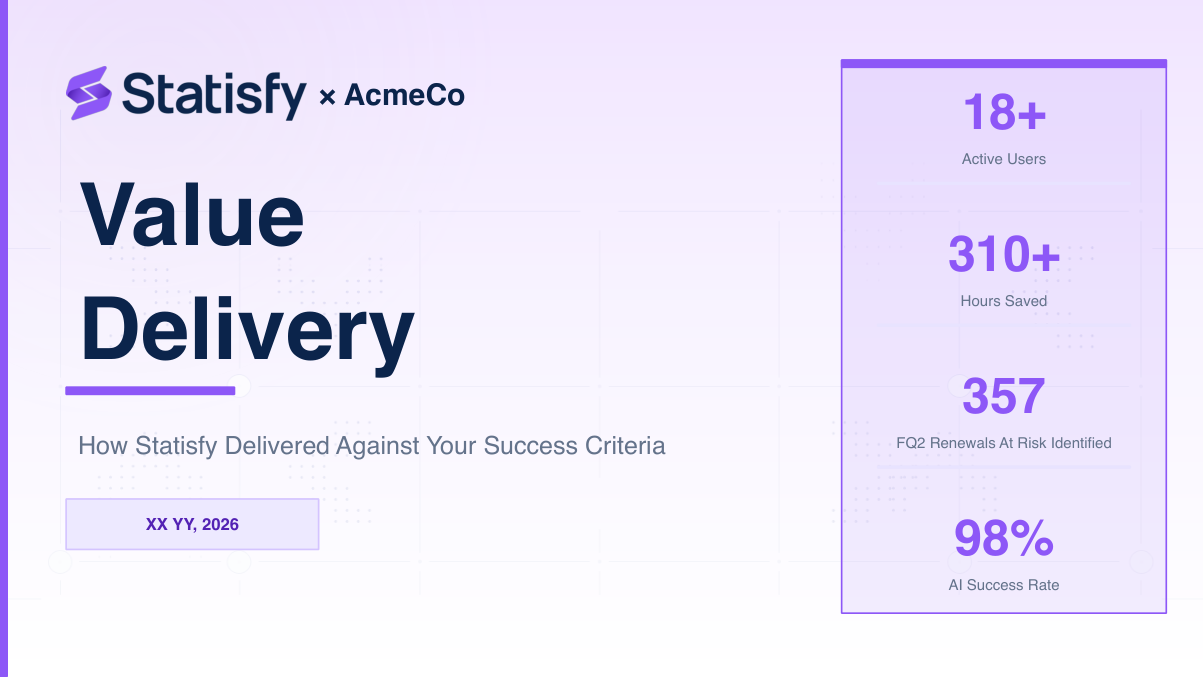
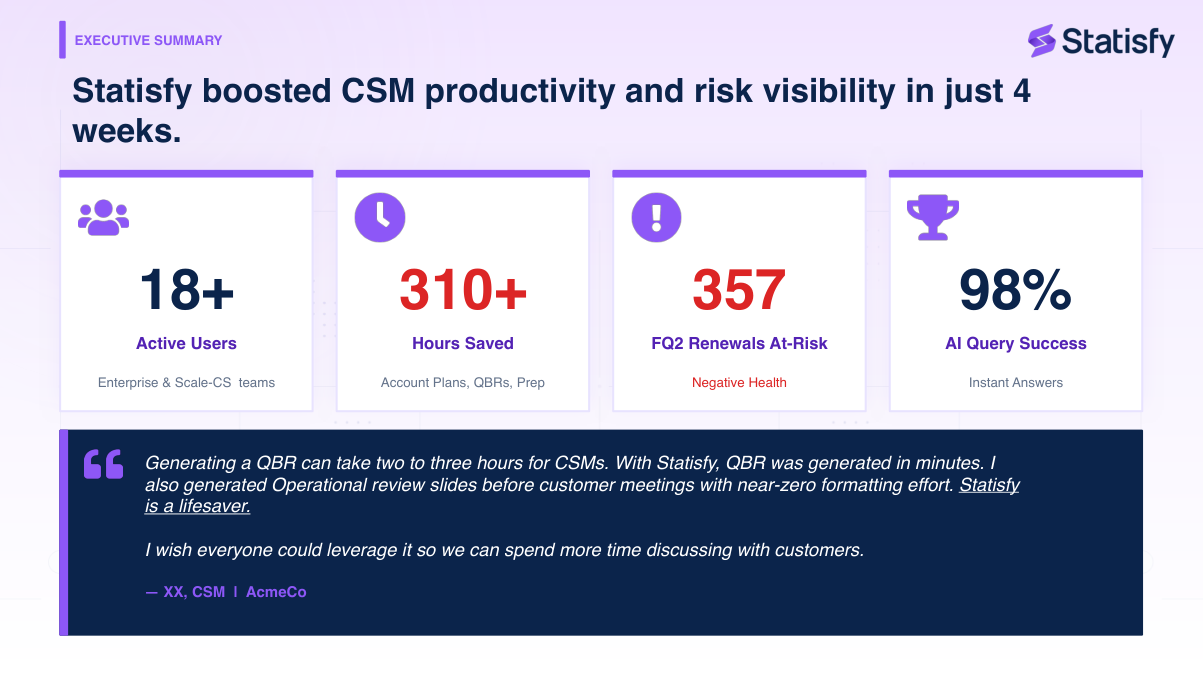
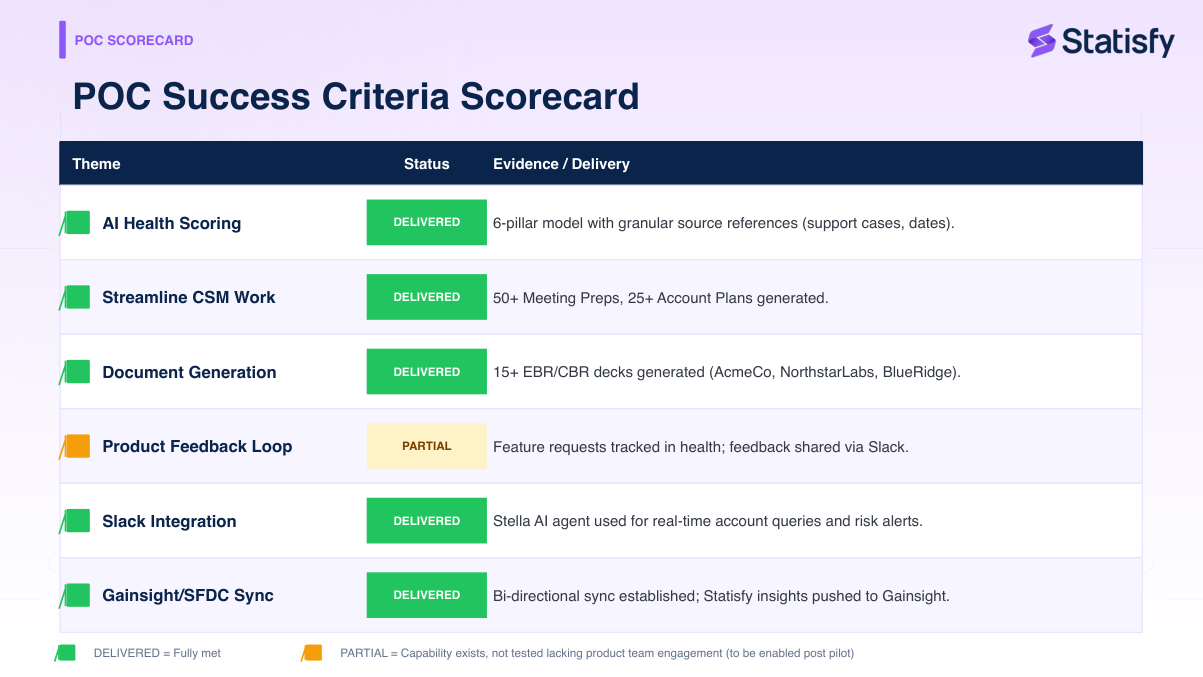
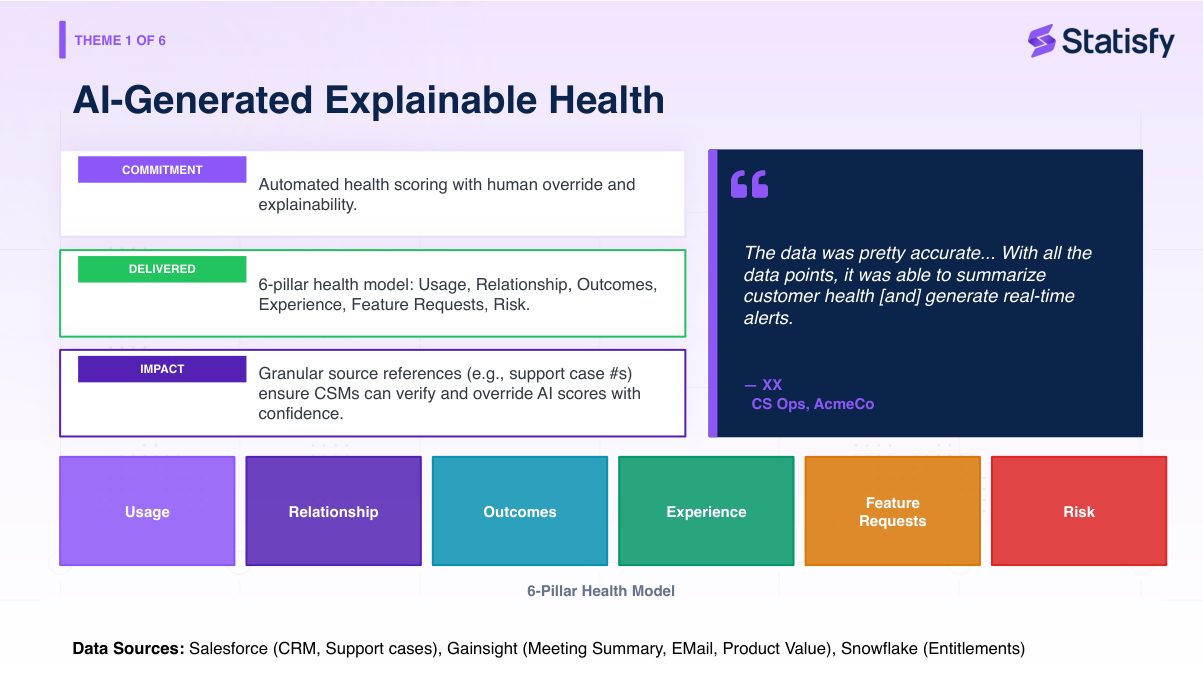
Example output · 45 seconds
A finished QBR deck — not a template
And also, every day
Six more outputs Statisfy delivers unprompted
QBR & EBR decks
Title, exec summary, scorecard, next-quarter plan. A finished deck — not a template — drafted while the CSM makes coffee.
45 seconds · 30–60 min of exec prep eliminated
Observe.AI
Meeting summaries in Slack
Every call auto-summarized and posted to Slack. Follow-up tasks created without a CSM opening the notes.
100% of meetings summarized
Cerby
Explainable health scores
AI-driven from real conversations, not lagging usage. Every factor visible and auditable — built for CFO review.
4× faster account reviews · 3% churn reduction
Cerby + Milestone
At-risk renewal outreach
The moment risk fires, the drafted email is waiting. The CSM reviews the context and sends — no blank page, no assembly.
+2% GRR in 2025
Observe.AI
Account plans & Customer 360s
One-page pre-call briefs on every account — pulled from calls, CRM, and product usage. Expansion signals surfaced, not searched for.
30% expansion booking target · 5–7× product-team value
Cerby + Observe.AI
Voice of Customer + exec dashboards
Real-time leadership visibility. Product, Engineering, and CS on the same signal — not a lagging quarterly report.
3 aligned teams · 7× ROI
Milestone
Speed and action — not rules and rollouts
Why teams pick Statisfy over Gainsight — in three lines.
Live in weeks, not quarters
2–3 weeks to zero-config health vs. 3–9 months of playbook config and $10K–$120K in implementation fees.
No CTAs to configure or babysit
Gainsight's most-hated feature is the CTA. Statisfy hands the CSM the finished action — email, Slack reply, meeting brief — ready to send.
Multi-CRM native, no lock-in
Gainsight's health, CTAs, and reporting are deeply coupled to Salesforce. Statisfy is multi-CRM native — Salesforce and HubSpot equally deep, with bi-directional custom-object writeback.
30+ native integrations
Reads every signal from tools you already use
The 8 meeting-recording integrations (Gong, Chorus, Fireflies, Attention, Avoma, Fathom, Zoom, Clari) turn calls into leading signal. All self-serve — no support engagement required for setup, no tracking code to install.













Shipped this year
Feb–Jul 2026
A steady release cadence — no waiting on a roadmap to catch up.
The proof
Numbers from Statisfy production, not marketing decks
Trusted by





SOC 2 Type 2 · GDPR · HIPAA
Where Gainsight is genuinely strong
The honest case for Gainsight
Gainsight is a Forrester Wave Leader and genuinely powerful at enterprise scale. We keep this section in because comparison pages that always show us winning aren't credible.
- A deep conversation-intelligence warehouse via Staircase AI, plus a mature Horizon AI / Atlas agent stack.
- Purpose-built for large enterprises that already run a full CS Ops function and have the headcount to run it.
- Broad integration marketplace and mature reporting for exec accountability.
- The knock is complexity, cost, and time — not capability. If you already own the CS Ops muscle, Gainsight can do a lot.
Objection handling
The two questions buyers ask
"We already own Gainsight."
You own a reporting tool your CSMs use for the boss. Statisfy is the surface they actually work in — it can run alongside Gainsight and does the daily work Gainsight only assigns.
"Gainsight has AI agents now too."
Theirs launched in 2025 on a CTA backbone that still needs months of config. For Statisfy, doing the work is the product — and there's nothing to set up.
FAQ
Statisfy vs Gainsight: common questions
Is there a truly AI-native Gainsight alternative?
How long does switching take?
Will I lose my Gainsight data and playbooks?
Further reading: How long does a customer success platform take to implement? .
Related comparisons
Statisfy vs the rest of the CSP category
Statisfy vs Vitally
Playbook-and-Copilot vs work that's already done.
Read →Statisfy vs ChurnZero
Plays and ChurnScores vs zero-config action.
Read →Statisfy vs Planhat
Configurable system of record vs AI-native system of action.
Read →Statisfy vs Totango + Catalyst
Three products you stitch together vs one platform that acts.
Read →Statisfy vs Hook
ML alerts vs the full loop from signal to autonomous action.
Read →Statisfy vs Staircase AI
Gainsight's communication intelligence add-on vs standalone AI-native platform.
Read →Stop assigning CTAs. Start shipping the work.
See the QBR drafted in 45 seconds, the risk flagged from real conversations, and the reply ready to send — all without a playbook to maintain.
Methodology and sources
Statisfy first-party numbers — 87.5% churn-prediction accuracy, <5% override, 2+ hrs saved per CSM per day, 150 hrs/week at Observe.ai (+2% GRR), 35K+ workflows and 750+ Stella queries per week — are drawn from Statisfy production deployments and documented on /product and /customers.
Claims about Gainsight are verified against Gainsight's current public documentation at the time of publish. We don't publish a comparison claim about a competitor we can't trace to their own page or a primary source. Competitive facts have a short shelf life — this page was last reviewed July 8, 2026.