How to Identify Customers at Risk of Churning
By Divya Singh · Customer Success Manager, Statisfy
The average B2B SaaS company finds out a customer is churning when they submit the cancellation request. By that point, the decision has been made for weeks. The champion stopped replying. Usage dropped. The internal budget conversation happened without you in the room.
Churn almost always telegraphs itself. There are quantifiable signals that appear 60 to 90 days before a customer cancels. CS teams that read those signals early have a decisive advantage in gross retention and NRR. This guide covers the signals, how to prioritize them, and the playbooks that actually stop churn.
9 Churn Warning Signals You Can Measure Right Now
Not all signals carry the same weight. Some predict churn with high confidence. Others matter when they cluster together. The strongest churn prediction comes from grouping signals, not tracking them in isolation.
Signals in isolation mislead you. A single usage dip might be a busy month. A usage dip combined with no QBR scheduled and a champion who has not replied in three weeks is a high-confidence churn risk that needs escalation today.
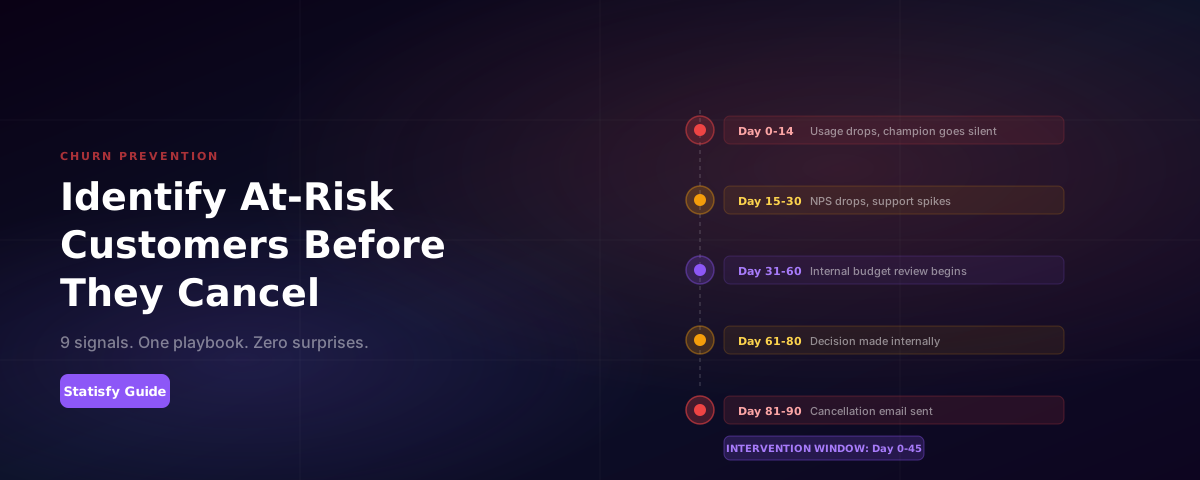
The Churn Timeline: When You Still Have Time
The intervention window is roughly days 0 to 45. After day 60, the internal budget decision is typically made, and even heroic save efforts face an uphill battle. This is why early signal detection outperforms any save play.
How Statisfy Catches Churn Before It Costs You
Most CS teams track these signals manually: checking dashboards, reviewing spreadsheet account lists, relying on CSMs to sense when something is off. This breaks at scale. A CSM managing 60 accounts cannot manually monitor every signal for every account. Signals get missed. Revenue walks out the door.
Composite Risk Scoring, Updated Continuously
Statisfy’s Predict agent calculates a composite churn risk score per account, updating in real time as new data arrives. Product usage, support volume, email engagement, NPS, stakeholder activity, and payment history are all weighted and combined into a single risk signal — see how to build a health score that actually predicts churn for the signal weighting behind this. When a score crosses a threshold, the CSM is notified immediately with the specific signals that drove the change.
Push Alerts, Not Dashboard Hunting
CSMs should never have to remember to check a dashboard. Statisfy pushes alerts directly via Slack, email, or in-app the moment an account risk score changes significantly. The alert includes the exact signals that moved the score and a suggested next action. The signal finds the CSM.
Playbooks That Run Automatically
When Statisfy flags a high-risk account, it launches a playbook. That might mean a personalized outreach email to the champion, a health check call request, or an escalation to the account executive. The right response fires automatically. The CSM reviews and approves, or lets it run.
See these signals flagged on your own book of business
Start a free trial and connect your CRM, product analytics, and support data. Statisfy will surface which of your accounts are showing these signals right now.
The Churn Intervention Playbook
Detecting risk is half the job. Here is the sequence that converts a flagged at-risk account back to healthy:
Diagnose before you reach out
Pull the last 30 days of activity. What specifically changed? Which features dropped? When did the champion last engage? Show up informed. A data-backed conversation signals competence. A “just checking in” call signals desperation.
Lead with value, not relationship
Open with a specific data point: “Your team has not used [feature X] in three weeks. Here is a use case that is driving strong results for similar teams.” Make it worth their time to respond.
Request a health check call, not a QBR
QBRs feel formal and low-urgency. A quick 20-minute health check is easier to accept and gets you the face time you need to surface the real objection before it becomes a decision.
Find champions you have not met
If your primary contact is quiet, identify other users in the account. Multi-threading is how you survive champion turnover and prevent one disengaged contact from killing the entire relationship.
Escalate leadership early, not as a last resort
Bring in your VP or account executive when the risk score is high, not after the cancellation email arrives. An executive touch paired with a specific ROI story can reset the relationship before the internal decision is final.
Prioritize by Revenue, Not Just Risk Score
A blanket intervention approach burns CSM time and can backfire with accounts that resent micromanagement. Prioritize by:
- ARR at risk: A $200K account at 60% risk score needs same-day escalation. A $4K account at 70% risk is handled with an automated email sequence.
- Renewal proximity: An at-risk account renewing in 30 days is a five-alarm situation. The same account renewing in nine months has a full quarter to recover.
- Signal reversibility: Usage drops are often recoverable. A champion who left the company requires a full re-engagement strategy at both the old and new organization.
The rule: Spend manual intervention time on accounts where ARR multiplied by risk score is highest. Let automated playbooks handle the rest. This is exactly how Statisfy’s priority queue works: it surfaces the accounts where human judgment has the most revenue impact.
The Bottom Line
Identifying at-risk customers before they cancel is not talent. It is process. The signals exist. The intervention window is real. What separates CS teams at 95% gross retention from those at 80% is not the quality of their CSMs. It is whether those CSMs have systems that surface the right accounts at the right moment with the right context to act.
Manual monitoring does not scale. The teams winning on retention use AI for signal detection and playbook execution, freeing CSMs to do what AI cannot: build the relationship, ask the hard questions, and be in the room when it matters. That same live account context is also what makes a QBR worth the customer’s time instead of a stale slide deck.
Stop finding out about churn from the cancellation email
Start a free trial and see which of your accounts are already showing these nine signals — before the next QBR, not after the renewal date.
Compare
How Statisfy compares.
Side-by-side, parameter-by-parameter comparisons with the CS platforms teams evaluate us against.
- Statisfy vs Gainsight Rule-based CTAs vs work already drafted.
- Statisfy vs ChurnZero Plays and ChurnScores vs zero-config action.
- Statisfy vs Vitally Playbook-and-Copilot vs work that's already done.
- Statisfy vs Totango + Catalyst Three products you stitch together vs one platform that acts.
- Statisfy vs Planhat Configurable system of record vs AI-native system of action.
- Statisfy vs Hook ML alerts vs the full loop from signal to autonomous action.
- Statisfy vs Staircase AI Gainsight's communication intelligence add-on vs standalone AI-native platform.