A blank slate, vs. a system that works on day one.
Cora hands your team a prompt box and near total flexibility. Someone still has to design every workflow, dashboard and document before it produces anything. Statisfy ships with health scoring, an action queue and a library of agents that work the moment your data connects.
Statisfy vs Cora AI
Parameter by parameter
Ratings reflect real product capability from vendor docs, reviews, and July 2026 research — not marketing claims.
Interface philosophy
Chat-first and single-player. Reporting, review and workflows all run through a prompt box each person builds for themselves.
Multi-player by default. Manager, CSM and cross-functional partner each land on the same account with the view their role needs.
Health scoring
Configured by conversation. The configuration step moved into chat rather than going away, and it still has to be done before the score means anything.
Zero-config across six dimensions, calibrating out of the box and recalibrating over time. 87.5% of negative-scored accounts churned within 90 days.
Dashboards and reporting
A genuine strength. Natural-language dashboard creation was fast, flexible and, in the customer's words, really nice looking.
Report builder with SQL assist. The same customer found it harder to use and we agree. Improving it is on the roadmap.
CSM daily workflow
Nothing by default. Daily briefings and meeting prep are prompt-based workflows the CSM authors. Rewards heavy LLM users and taxes everyone else.
Workbench puts a prioritized action queue in front of the CSM with the email already drafted. No prompt-building to get a usable day.
Generated document consistency
Agent evals exist, but the customer could not get consistent handover docs or project plans across repeated runs after a lot of tuning.
Usable out of the box with less back and forth, per that same customer's comparison of the two.
Documents and customer sharing
One global artifacts view at the time of the evaluation. No folder structure, no per-customer scoping, and no authenticated way to share a document with an end customer.
Documents scoped per account, shareable with the customer, with a customer portal available as a paid add-on.
Platform breadth
Not an apples-to-apples CSP replacement at the time of the evaluation: no projects, no dashboards as a system, no forecasting in the way a full platform has them.
Full platform: projects, dashboards, forecasting, surveys and renewals, with the agent layer on top rather than in place of it.
Who has to build it
Effectively a CS Ops function, or whoever volunteers. The design work does not disappear because the interface is a chat box.
Nobody, to get started. Agent Studio is there when you want something specific, not as a precondition for value.
The capability gap
What Cora AI can't do — and what Statisfy does
The head-to-head at a glance. Cross-referenced from vendor docs and July 2026 reviews.
Not with Cora AI
What you can't do
- Give a CSM a usable day without someone authoring the workflow first.
- Scope a document to one customer, or share it without exposing the workspace.
- Produce the same deliverable twice from the same inputs, consistently enough to ship unread.
- Serve a manager, a CSM and a product lead from one place without three separate builds.
- Replace a full CSP outright: projects, forecasting and dashboards-as-a-system were not there.
With Statisfy
What you get on day one
- Ship a working action queue, health score and agent library before anyone configures anything.
- Score health across six dimensions with the drivers and a recommended next step attached.
- Generate QBRs, account plans and handover briefs that need editing rather than re-rolling.
- Land every role in the same place, with the view that role needs.
- Hand CS Ops a builder when they want one, instead of requiring one on day one.
Not another CSP
They inform. We do the work.
Legacy CSPs alert or track. Newer AI tools advise. Statisfy predicts, generates, and acts — with a human in the loop on every send.
PREDICT
Built on the customer knowledge graph
- AI-generated Health Scores
- Next-Best Actions
- Renewal & Expansion Forecast
- Churn signals from real conversations
GENERATE
PowerPoint decks & rich-text docs
- QBRs & Kick-off decks
- Account Plans & Meeting Briefs
- Customer Case Studies
- Executive summaries & scorecards
ACT
Autonomous agents execute at scale
- Personalized customer outreach
- Onboarding Agent
- Slack replies in-thread, ready to send
- CRM updates · Human-in-Loop approval
The three "no more" shifts
What changes on day one with Statisfy
No more authoring tax.
In Cora, a daily briefing, a meeting prep or a book-of-business view is something each CSM builds for themselves out of prompts. Statisfy puts the book, the renewals and the account view on the screen when they land.
No more single-player tooling.
Customer intelligence is needed by people who do not share a workflow. A prompt-first tool asks each of them to build their own way in. Statisfy is multi-player by default: same account, same summary, different lens per role.
No more re-rolling the output.
A generated document that differs on every run is a draft you have to check line by line. That is the editing time back, not saved.
How it works
Signal in. Work out.
Reads every signal from the customer stack. Delivers finished work products — reviewed by a human before they go.
Signals in
Conversation intelligence
Gong · Chorus · Fireflies · Fathom · Avoma · Attention
CRM
Salesforce · HubSpot
Product analytics
Mixpanel · Snowflake · BigQuery
Communication
Slack · Gmail · Outlook · Calendar
Support & PM
Zendesk · Intercom · Jira · Freshdesk
The AI CS platform
Work out
Detects churn signals early
Renewal risk spotted months before it dips
Sends proactive outreach
Personalized emails, drafted and ready to send
Prepares QBR summaries
Auto-pulled from calls, CRM, usage data
Runs onboarding + expansion
Playbook-free agents, human-in-loop approval
Updates health scores + CRM
Logs activity back automatically
The finished work
Real outputs — drafted before the CSM opens the laptop
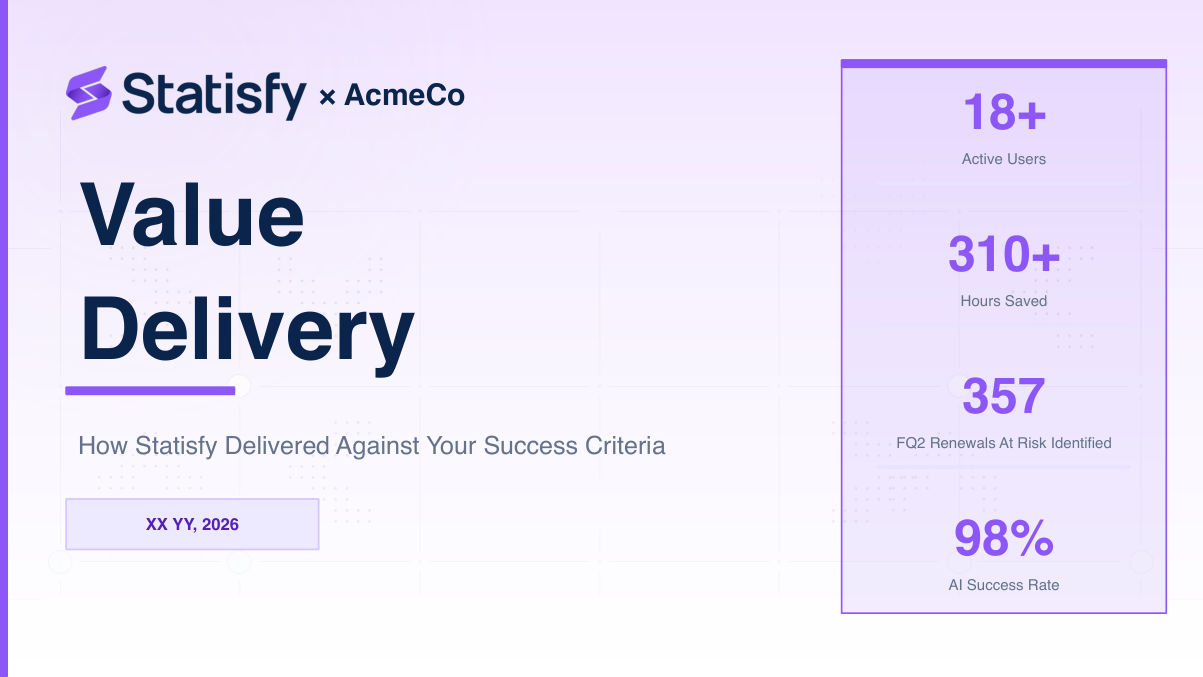
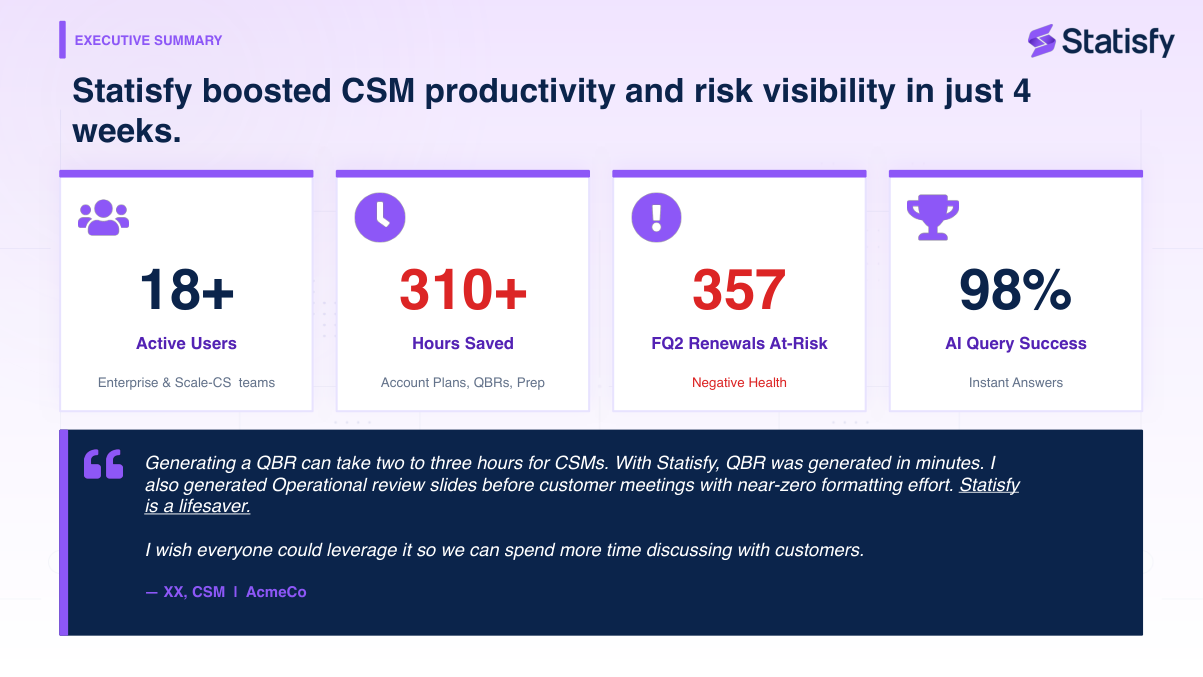
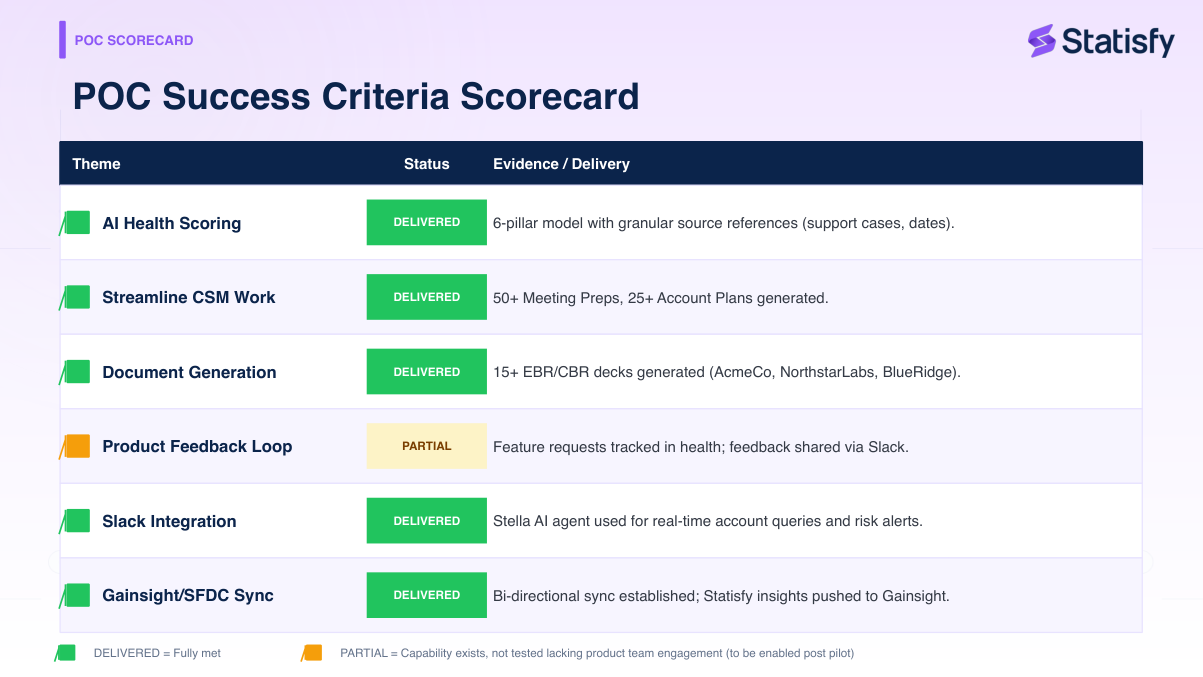
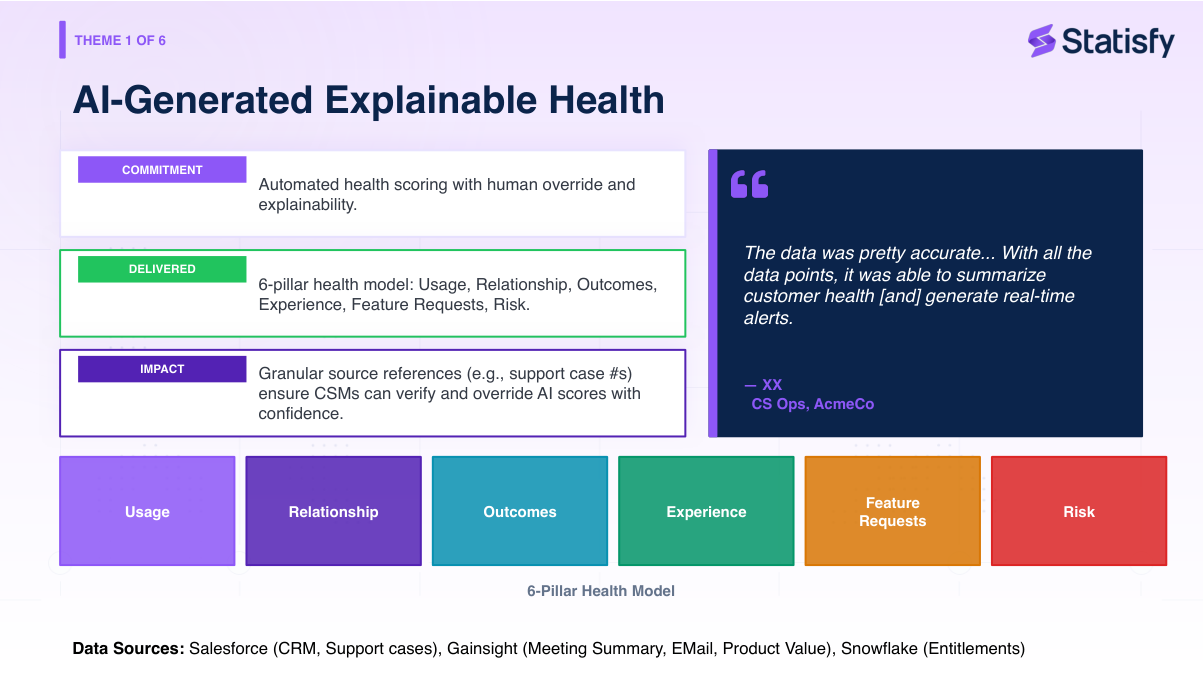
Not just QBRs. Every daily CS output — meeting summaries, health scores, at-risk emails, account plans, exec dashboards — drafted, cited, ready for review. With customer proof from Observe.AI, Milestone, and Cerby.
Example output · 45 seconds
A finished QBR deck — not a template
And also, every day
Six more outputs Statisfy delivers unprompted
QBR & EBR decks
Title, exec summary, scorecard, next-quarter plan. A finished deck — not a template — drafted while the CSM makes coffee.
45 seconds · 30–60 min of exec prep eliminated
Observe.AI
Meeting summaries in Slack
Every call auto-summarized and posted to Slack. Follow-up tasks created without a CSM opening the notes.
100% of meetings summarized
Cerby
Explainable health scores
AI-driven from real conversations, not lagging usage. Every factor visible and auditable — built for CFO review.
4× faster account reviews · 3% churn reduction
Cerby + Milestone
At-risk renewal outreach
The moment risk fires, the drafted email is waiting. The CSM reviews the context and sends — no blank page, no assembly.
+2% GRR in 2025
Observe.AI
Account plans & Customer 360s
One-page pre-call briefs on every account — pulled from calls, CRM, and product usage. Expansion signals surfaced, not searched for.
30% expansion booking target · 5–7× product-team value
Cerby + Observe.AI
Voice of Customer + exec dashboards
Real-time leadership visibility. Product, Engineering, and CS on the same signal — not a lagging quarterly report.
3 aligned teams · 7× ROI
Milestone
Flexibility is a bill. The question is who pays it.
Why teams pick Statisfy over Cora AI — in three lines.
Single player vs multi player
Cora's design centre is one capable person with ideas and time. Ours is a team that needs the same answer in the same place. That difference shows up on day one and never stops showing up.
Defaults beat a blank canvas
A team that wants guidance on what good output looks like will not get it from an empty prompt box. Opinionated defaults are the product, not a limitation of it.
The configuration did not vanish
A rules engine you fill in and a prompt box you fill in are the same project wearing different clothes. Zero-config health means there is nothing to fill in.
30+ native integrations
Reads every signal from tools you already use
The 8 meeting-recording integrations (Gong, Chorus, Fireflies, Attention, Avoma, Fathom, Zoom, Clari) turn calls into leading signal. All self-serve — no support engagement required for setup, no tracking code to install.











Shipped this year
Feb–Jul 2026
A steady release cadence — no waiting on a roadmap to catch up.
The proof
Numbers from Statisfy production, not marketing decks
Trusted by





SOC 2 Type 2 · GDPR · HIPAA
Where Cora AI is genuinely strong
The honest case for Cora AI
Cora is a real product with real strengths, and one of them beats ours outright. Honest reasons to consider Cora:
- Natural-language dashboards are excellent. The customer who chose us was emphatic that this was better in Cora, and it is a gap we are working on.
- Near total flexibility suits a team with CS Ops capacity and a clear picture of the process it wants to build.
- If your team already lives in an LLM all day, the authoring model will feel natural rather than taxing.
- Agent evals let you test and refine agents over time rather than trusting a single run.
- It is early and moving quickly, so anything on this page is worth re-checking before you decide.
Objection handling
The two questions buyers ask
"Isn't a prompt box more powerful than fixed defaults?"
More powerful, and more expensive. Power you have to assemble is only worth it if someone owns the assembly. The buyer who ran both told us plainly that he did not have the capacity and was not in a CS Ops role, and that his team would struggle with that kind of open-ended creativity. That is the whole decision.
"Cora's dashboards look better than yours."
They are better than ours, and we are not going to argue the point. Prompt-driven dashboard creation is genuinely good there and our report builder asks you to pick a widget type before you have decided what you are looking at. If self-serve reporting is your top requirement, test both on exactly that. If it is not, weigh it against what your team does every day.
FAQ
Statisfy vs Cora AI: common questions
What is the difference between Statisfy and Cora AI?
Is Statisfy a good Cora AI alternative for a team without CS Ops?
What does Cora AI do better than Statisfy?
Can Cora AI replace a full customer success platform?
How is this comparison sourced?
Further reading: Why DataHub chose Statisfy over Cora AI , How long does a CS platform take to implement? , The best AI customer success platforms in 2026 .
Related comparisons
Statisfy vs the rest of the CSP category
Statisfy vs Gainsight
Rule-based CTAs vs work already drafted.
Read →Statisfy vs Hook
ML alerts vs the full loop from signal to autonomous action.
Read →Statisfy vs Vitally
Playbook-and-Copilot vs work that's already done.
Read →Statisfy vs ChurnZero
Plays and ChurnScores vs zero-config action.
Read →Statisfy vs Planhat
Configurable system of record vs AI-native system of action.
Read →Statisfy vs Totango + Catalyst
Three products you stitch together vs one platform that acts.
Read →Statisfy vs Staircase AI
Communication intelligence add-on vs standalone AI-native platform.
Read →Ask who on your team is going to build it.
If the answer is a CS Ops function with time, test the flexible platforms seriously. If the answer is nobody, see what shipping with defaults actually looks like on your accounts.
Methodology and sources
Statisfy first-party numbers — 87.5% churn-prediction accuracy, <5% override, 2+ hrs saved per CSM per day, 150 hrs/week at Observe.ai (+2% GRR), 35K+ workflows and 750+ Stella queries per week — are drawn from Statisfy production deployments and documented on /product and /customers.
This page is sourced differently from our other comparisons. Cora AI launched out of stealth in March 2026 and publishes little, so there is no vendor documentation to check claims against. Everything in the Cora column comes from a customer who ran both products side by side and chose Statisfy, and is published in full, including the dimension Cora won, on our write-up of that evaluation. Claims describe what that team found at that time, not a standing assessment of a product that is early and moving quickly. Competitive facts have a short shelf life, so this page was last reviewed September 16, 2026.