How Long Does a Customer Success Platform Take to Implement?
By Munish Gandhi · Founder & CEO, Statisfy
Customer success platform implementation runs from about two weeks to nine months. The spread is not a matter of vendor competence or how hard your team pushes. It is driven almost entirely by one thing: how much configuration the platform requires before it produces anything at all.
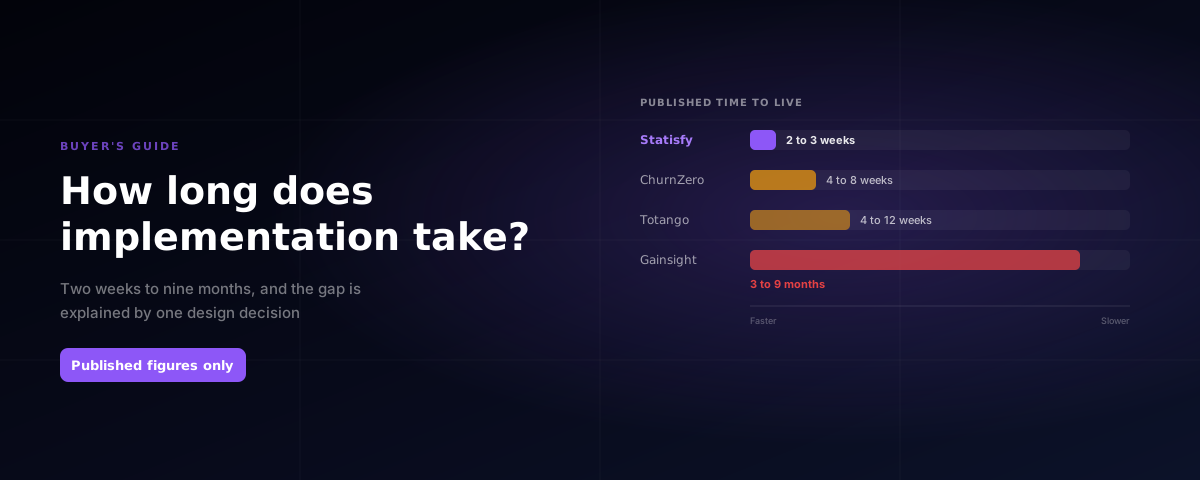
Statisfy is live in 2 to 3 weeks. ChurnZero is commonly 4 to 8 weeks. Totango runs 4 to 12 weeks. Gainsight is typically 3 to 9 months. Below is where each figure comes from, and what actually explains the gap.
Disclosure: Statisfy is one of the platforms compared here. Every figure below is taken from our published head-to-head pages, which are sourced from vendor documentation, user reviews and research, and each row links to the page it came from.
How long does each platform take to implement?
| Platform | Published timeline | What the setup involves | Needs a developer or admin? |
|---|---|---|---|
| Statisfy | 2 to 3 weeks | Zero-config. Health live from day one, no playbooks, fields or health rules to build. | No |
| Vitally | 2 to 4 weeks claimed | Setup means building health logic and your first playbooks. Smaller teams find the data modelling heavier than expected. | Ops capacity |
| ChurnZero | 4 to 8 weeks | Installing tracking code and wiring integrations, then building Plays and ChurnScores. | Internal lead plus a developer |
| Totango | 4 to 12 weeks | SuccessBLOCs, fields and integrations, with a steep learning curve that often needs Totango support. | Often vendor support |
| Gainsight | 3 to 9 months typical | Health score weights, connectors, playbooks and CTAs all hand-built. Implementation fees commonly $10,000 to $120,000. | Professional services plus a dedicated admin |
| Planhat | No weeks figure published | Strong interface and support, with a steep learning curve and real admin capacity needed to unlock full value. | Admin capacity |
Sources, one per row: Statisfy vs Gainsight, Statisfy vs ChurnZero, Statisfy vs Vitally, Statisfy vs Totango and Statisfy vs Planhat. Competitor cells are neutral characterizations of published positioning, not vendor claims. Confirm scope and timeline with any vendor in writing, including us.
Why the range is so wide
A four-month gap between two products in the same category looks like a vendor problem. It is actually a design difference, and it is predictable from one question: does the platform ship with a scoring model, or with a rules engine you have to fill in?
A rules-based platform does nothing useful until someone defines what “healthy” means, weights the inputs, builds the playbooks that fire on the thresholds, and wires the CTAs. That work is the implementation. It cannot be parallelised much and it cannot start before your data is connected, which is why the honest range on a configurable platform is quarters rather than weeks.
A model-based platform reads the same signals and scores them without anyone specifying the formula. There is no configuration phase because there is no configuration. That is the whole of the difference between 2 to 3 weeks and 3 to 9 months, and it is also why the same platforms that implement fastest tend to have the lowest ongoing maintenance: there is no rule library to keep current.
The four things “implementation” actually covers
Vendors quote different things under the same word, which is how two honest teams end up quoting three weeks and three months for what sounds like the same project.
Connecting CRM, support, product analytics and conversations. Sometimes a UI wizard, sometimes custom object mapping and API work. This is the layer that decides whether you need a developer.
Defining health, weighting inputs, building the plays. On a rules-based platform this is the bulk of the timeline. On a zero-config platform it does not exist.
The gap between “the platform is live” and “CSMs work from it daily”. On enterprise platforms this is commonly another four to eight weeks, and it is usually quoted separately or not at all.
Not implementation, but it starts the day implementation ends. Heavily configured platforms routinely absorb 20 to 30 percent of quarterly ops cycles on upkeep rather than improvement.
The fourth one is the cost nobody quotes. A platform that takes three months to stand up generally also needs someone to keep it standing, and that is headcount rather than a line on the invoice. Our guide to customer success ops covers what that function actually does day to day.
Ask us for an implementation plan with dates
Bring your stack to a 20 minute call and we will tell you what your own timeline looks like, in writing, before you buy anything.
What to ask every vendor
The range a vendor quotes is close to meaningless without knowing which date it refers to and what is excluded. Five questions get you the real number.
Which date does your range refer to?
Platform live, or CSMs working from it daily? These are commonly four to eight weeks apart on enterprise platforms, and vendors quote the first.
Do we need a developer, and for what?
Tracking code installation and custom object mapping both mean engineering time you have to schedule against a roadmap you do not control.
What is the implementation fee, in writing?
Separate from licence. On enterprise platforms this commonly runs $10,000 to $120,000 and is where a quote quietly doubles.
Who maintains the configuration afterwards?
If the answer is a dedicated admin, that is a permanent headcount cost attached to the purchase, not a one-off.
Can we have an implementation plan with dates?
Not a range. A plan with named phases and dates. A vendor who can produce one in a week is telling you something real about how repeatable their delivery is.
When a long implementation is the right answer
A three-month implementation is not automatically a bad deal. If your value genuinely comes from a deeply bespoke model, intricate health rulesets and branched playbooks tuned to a motion nobody else runs, then configurability is the product and the timeline is what it costs. Gainsight and Planhat reward that investment, and teams with a dedicated CS Ops function to own it get something a zero-config platform will not give them.
The trap is buying that timeline without that team. A configurable platform with nobody to configure it degrades quietly: health scores go stale, playbooks break without anyone noticing, and the platform becomes an expensive contact list. If you do not have a CS Ops function, the implementation length is a warning rather than a feature.
How Statisfy gets to 2 to 3 weeks
Not by working faster. By removing the phase that takes the time.
Health scoring is LLM-based rather than rules-based, so there is no scoring model to define, weight or maintain, and scores are live from day one rather than after a configuration project. Connect your CRM, conversation intelligence and product analytics, set your guardrails, and the platform is producing output immediately. One customer, Mixpanel, migrated from a legacy tool in about two weeks and cut 60 playbooks down to 11, which is the shape of what “nothing to configure” means in practice.
For the full picture against the rest of the category, see the best AI customer success platforms in 2026, or the customer success platform comparison for pricing basis and G2 ratings alongside setup time.
Frequently asked questions
How long does a customer success platform take to implement?
Between about two weeks and nine months, and the spread is driven almost entirely by how much configuration the platform requires before it produces anything. Statisfy is live in 2 to 3 weeks because health scoring is zero-config and there is no rules engine to build. ChurnZero is commonly 4 to 8 weeks and needs an internal lead plus a developer to install tracking code. Totango runs 4 to 12 weeks. Gainsight is typically 3 to 9 months with professional services and a dedicated admin effectively required. Vitally claims 2 to 4 weeks, though that setup still means building health logic and your first playbooks.
Why do some customer success platforms take months to implement?
Because a configurable platform has to be configured before it does anything. Health score weights, connectors, playbooks and CTAs are all hand-built, and none of them exist on day one. That work is the implementation. Platforms where scoring is model-based rather than rules-based skip that phase entirely, which is why the range runs from weeks to quarters rather than clustering.
What is the fastest customer success platform to implement?
Of the platforms with published timelines, Statisfy is the fastest at 2 to 3 weeks, with health scores live from day one and nothing to build. The reason is structural rather than a matter of effort: there is no rules engine, so there is no configuration phase to get through before the platform produces output.
Does implementing a customer success platform need engineering help?
It depends on the platform. ChurnZero's setup needs an internal lead and a developer to install tracking code and wire integrations. Gainsight effectively requires professional services and a dedicated admin. Statisfy connects to your CRM, conversation intelligence and product analytics without an engineering project. Ask every vendor directly whether a developer is needed and for what, because the answer is often buried in a services quote.
How much does customer success platform implementation cost?
Licence cost and implementation cost are separate, and the second is frequently the larger surprise. Gainsight implementation fees are commonly $10,000 to $120,000. Ask for the implementation fee in writing alongside the licence quote, and ask whether a dedicated admin is expected afterwards, because ongoing configuration maintenance is a headcount cost that does not appear on either quote.
When is a platform actually live, versus implemented?
Those are two different dates and vendors often quote the first. Time to first meaningful value is the point at which a CSM can manage a real account from the platform with live data, working health scores and at least one active alert or playbook. On enterprise platforms there is commonly another four to eight weeks between that point and CSMs actually working from it daily. Ask for an implementation plan with dates rather than a range, and ask which of the two dates the range refers to.
See what your own timeline looks like
20 minutes, your stack, a real implementation plan with dates. If your scope means it takes longer than 3 weeks, we will tell you that on the call.