AI Support Agent vs AI CSM: Deflection Is Not Coverage
By Navin Agrawal · Co-Founder & CTO, Statisfy
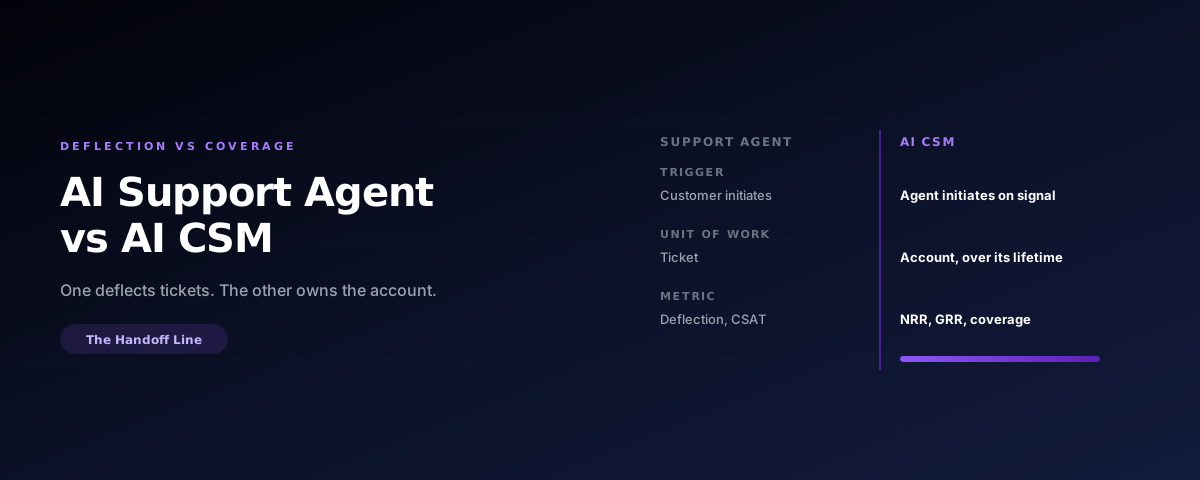
In the AI support agent vs AI CSM comparison, a support agent is reactive and ticket-scoped: the customer asks, it resolves and deflects. An AI CSM is proactive and account-scoped: it initiates on signals, owns onboarding through expansion, and escalates the hard 5-10% to a named human. Deflection is not account coverage.
Disclosure: I lead AI and agent architecture at Statisfy, so I have a point of view here. I am going to concede where support agents win before I draw the line, because the distinction only matters if it is honest.
Why does this comparison confuse so many buyers?
Most teams shopping for a “customer facing AI agent” start by searching for one and land almost entirely on AI support agents. Fin, Sierra, Decagon, Ada, and Forethought have defined what the category looks like in search results, in analyst coverage, and in board decks. So when a CS leader types “AI agent for our customers,” the results answer a support question, not a success question.
That mismatch is expensive. You can buy an excellent tool and still not solve your problem, because it was built for a different job. The AI customer success versus support distinction is not hairsplitting. It decides which number moves.
Are AI support agents actually good?
Yes, and this is the part vendors in my category tend to skip. Modern AI support agents are strong at what they do. They resolve high volumes of inbound tickets without a human, hold CSAT steady while doing it, and cut time to resolution from hours to seconds. For a support org drowning in repetitive questions, that is real work taken off a human’s plate, and the deflection numbers are not vanity.
If inbound ticket volume is your primary problem, an AI support agent is likely the right buy. The trouble starts only when a support agent gets positioned as customer success, because the two motions are built on opposite assumptions.
What is the core difference between an AI support agent and an AI CSM?
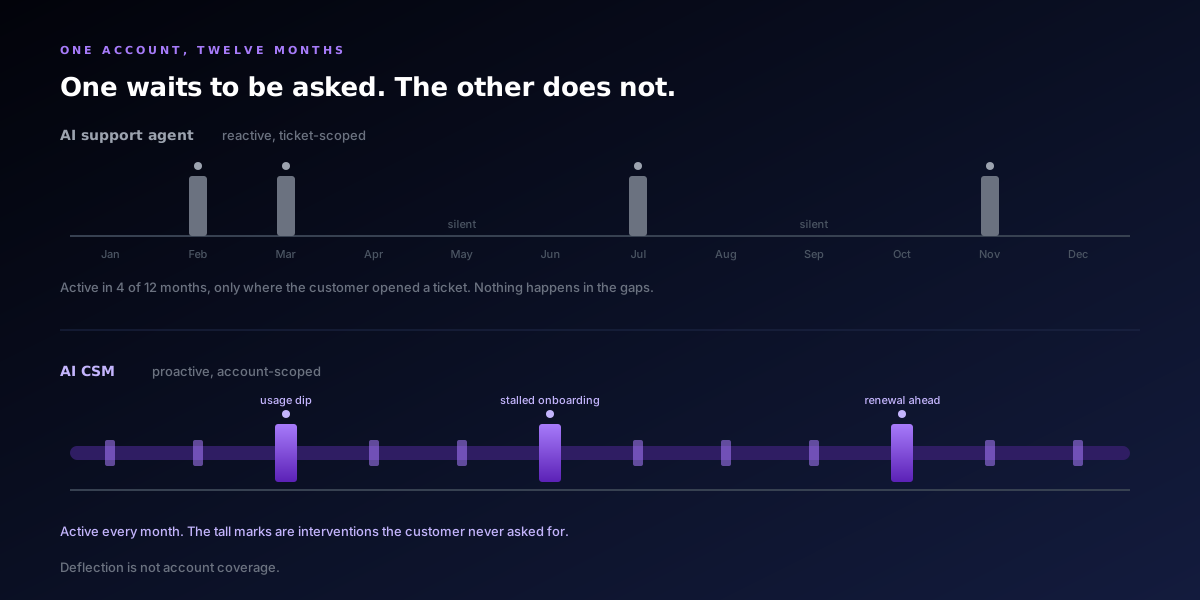
One waits to be asked. The other does not.
A support agent is conversation-scoped. It activates when a customer initiates, works the ticket in front of it, and closes when the issue is resolved. Its world is the conversation, plus maybe some contact history. Its job is to make the question go away well.
An AI CSM is account-scoped. It initiates on a signal or a schedule: a usage drop, a stalled onboarding, an upcoming renewal, a new admin who never logged in. It owns the account across its lifetime, from onboarding through adoption, retention, and expansion. It carries memory at the person, account, and org level, and it reads from CRM, product telemetry, calls, tickets, and contracts, not just the help center. The Statisfy AI CSM handles 90-95% of those interactions and auto-sends the routine ones, then escalates the 5-10% that need human judgment to a named CSM with the reply already drafted.
Reactive versus proactive. Ticket versus account. Deflection versus retention. Here is how that plays out across the dimensions that matter to an evaluator.
| Dimension | AI support agent | AI CSM |
|---|---|---|
| Trigger | Customer initiates | Agent initiates, on signal or schedule |
| Unit of work | Ticket or conversation | Account, over its lifetime |
| Memory scope | Conversation, sometimes contact history | Person, account, and org, persistent |
| Primary data | Help center, docs, ticket history | CRM, product telemetry, calls, tickets, contracts |
| Core motion | Resolve and deflect | Onboard, adopt, retain, expand |
| Success metric | Deflection rate, CSAT, time to resolve | NRR, GRR, coverage, time to value |
| Escalates to | Support queue | Named CSM with account context |
| Board-level answer | Cost to serve | Cost to serve and revenue retention |
The pattern is consistent. Everything about a support agent is organized around a conversation that already started. Everything about an AI CSM is organized around an account that has to be kept, whether or not anyone opened a ticket this quarter. Statisfy reports 87.5% churn-prediction accuracy and under 5% CSM override on the escalated work, which is what account-scoped coverage looks like in practice rather than a higher ticket-close rate.
Why does this matter at the board level?
Because the questions a board asks do not have a deflection answer.
When your board asks about net revenue retention, gross retention, or why three logos churned last quarter, “we deflected 68% of tickets” is not a response. It is a different axis entirely. Deflection rate reports cost to serve. It says nothing about whether the customers you kept are expanding, whether at-risk accounts got touched before renewal, or whether onboarding actually drove adoption.
An AI CSM is built to answer the revenue question. Its success metrics are NRR, GRR, coverage, and time to value, and it can prevent churn by acting on early signals rather than waiting for a complaint. Statisfy has seen this in the field: Observe.ai reports a +2% gross revenue retention lift and roughly 150 hours saved weekly after deployment. Across accounts, the range lands at +2-5% NRR. That is the axis a deflection metric cannot reach. For more on the underlying operating model, see what agentic customer success means.
See account-level coverage, not ticket deflection
Bring the AI agent you are already evaluating. We will show you which job it does and which job it leaves open.
Do I need both a support agent and an AI CSM?
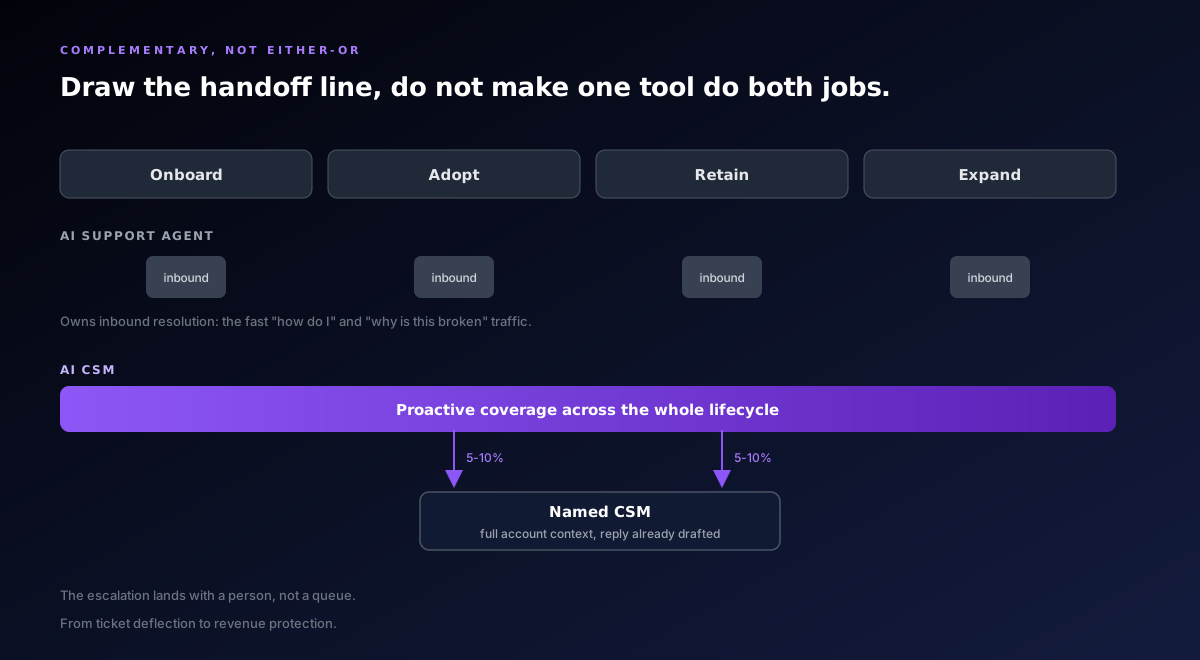
Most teams do, and pretending otherwise is how you end up with the wrong architecture. This is not a replace-support story. It is a division-of-labor story, and the two agents are complementary, not either/or.
The category line I use is simple: deflection is not account coverage. A support agent waits to be asked; a CSM does not. So draw the handoff line explicitly. The support agent owns inbound resolution, the fast, high-volume “how do I” and “why is this broken” traffic. The AI CSM owns proactive coverage across the account lifecycle and the moments no one filed a ticket for. When something needs judgment, the AI CSM escalates the 5-10% to a named human with full account context, so the handoff lands with a person, not a queue.
The frame that has held up best with my team is “from ticket deflection to revenue protection.” One protects the support budget. The other protects the number your board actually tracks.
The AI CSM handles this across the same places your customers already are: customer Slack and email, in-app chat, and a branded portal. Phase 1, the text channels, is live now. Phase 2, audio and video, arrives Q4 2026. Deployment runs 2-3 weeks. If you also want to see how the AI CSM differs from the “digital CSM” and “virtual CSM” labels floating around the market, we cover that in AI CSM vs digital vs virtual CSM.
Key takeaways
- An AI support agent is reactive and ticket-scoped; an AI CSM is proactive and account-scoped. Deflection is not account coverage.
- Support agents are genuinely good at deflection, CSAT, and time to resolve. If inbound volume is your problem, buy one.
- The AI CSM answers the revenue question a deflection metric cannot: NRR, GRR, coverage, and time to value.
- Most teams want both. Draw the handoff line: support owns inbound resolution, the AI CSM owns proactive coverage and escalates the hard 5-10% to a named human.
- The Statisfy AI CSM handles 90-95% of interactions autonomously, escalates 5-10%, and deploys in 2-3 weeks.
Frequently asked questions
Is an AI CSM the same as an AI support agent?
No. An AI support agent is reactive and conversation-scoped: the customer initiates and it resolves or deflects the ticket, measured on deflection and CSAT. An AI CSM is proactive and account-scoped: it initiates on signals, owns the account lifecycle, and is measured on retention and expansion. Different trigger, different unit of work, different board-level number.
Do I need both a support agent and an AI CSM?
Usually yes. They cover different jobs. The support agent handles inbound ticket resolution at volume; the AI CSM owns proactive account coverage and escalates the 5-10% that need judgment to a named CSM. They are complementary. The clean design is a defined handoff between them, not one tool doing both jobs poorly.
What metrics does an AI CSM move that a support agent does not?
Net revenue retention, gross revenue retention, coverage, and time to value. A support agent reports cost to serve through deflection rate. An AI CSM reports revenue retention, which is the question boards ask. Statisfy has seen +2-5% NRR across accounts, with Observe.ai reporting +2% GRR.
How autonomous is the Statisfy AI CSM?
It handles 90-95% of interactions end to end and auto-sends the routine ones, with under 5% CSM override on escalated work. The remaining 5-10% escalate to a named CSM with the reply pre-drafted, so a human applies judgment on the hard cases with full account context.
Which channels does the AI CSM cover, and when?
Email, in-app chat, Slack, and a branded portal. Phase 1, the text channels, is live now. Phase 2, audio and video, arrives Q4 2026. Typical deployment is 2-3 weeks.
See account-level coverage, not ticket deflection
If you are evaluating a customer-facing AI agent and cannot tell which of these two jobs it does, that is the question to ask first. Explore the Statisfy AI CSM.
About the author
 Navin Agrawal is Co-Founder and CTO at Statisfy. He previously worked on agent systems at Google and now leads how Statisfy’s autonomous agents are designed.
Compare
How Statisfy compares.
Side-by-side, parameter-by-parameter comparisons with the CS platforms teams evaluate us against.
- Statisfy vs Gainsight Rule-based CTAs vs work already drafted.
- Statisfy vs ChurnZero Plays and ChurnScores vs zero-config action.
- Statisfy vs Vitally Playbook-and-Copilot vs work that's already done.
- Statisfy vs Totango + Catalyst Three products you stitch together vs one platform that acts.
- Statisfy vs Planhat Configurable system of record vs AI-native system of action.
- Statisfy vs Hook ML alerts vs the full loop from signal to autonomous action.
- Statisfy vs Staircase AI Gainsight's communication intelligence add-on vs standalone AI-native platform.