How to Prevent SMB Churn Before It Happens
By Navin Agrawal · Co-Founder & CTO, Statisfy
To prevent SMB churn, you have to catch it before the customer decides to leave, which means watching leading signals like ticket sentiment, response latency, and stakeholder changes, not lagging ones like logins and usage. A language model can read those conversational signals directly and explain each risk, so no data scientist is required.
Most tools that claim to predict customer churn are really doing churn observation. They score product usage and login frequency, then flag an account once those numbers fall. But usage drops after the customer has already decided to leave, so by the time your health score turns red, the renewal is a rescue mission. This guide is for CS Ops and Heads of CS who want an early warning system for churn that fires while there is still time to act, without a data science team.
Disclosure: I help build a churn-prevention product at Statisfy, so treat this as a vendor point of view backed by how the mechanics work.
Why is my health score always late?
Your health score is late because it is built on lagging indicators. Logins, feature usage, and seat activity are outcomes. They move once the customer has mentally checked out and stopped investing effort. Scoring them tells you a story that already ended.
The leading signals sit where your usage dashboard never looks: in the conversations. A support ticket that gets curt. A champion who used to reply in an hour and now takes four days. A new VP who was not part of the original deal. These show up weeks before anyone stops logging in. Treating usage as your primary risk signal is like waiting for the smoke detector to melt before calling it a fire.
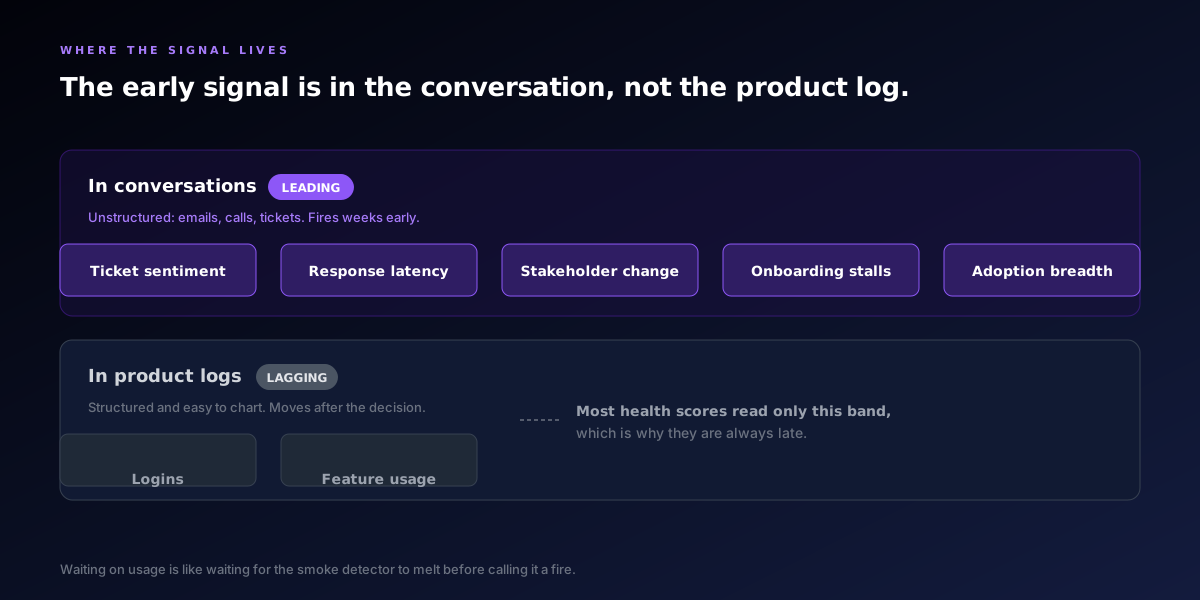
| Signal | Type | Why it matters |
|---|---|---|
| Logins / usage drop | Lagging | The decision is already made |
| Support ticket sentiment and tone shift | Leading | Frustration shows up here before usage |
| Response latency (replies getting slower) | Leading | Quiet disengagement, early |
| Champion or stakeholder change | Leading | Your relationship just reset to zero |
| Onboarding milestones stalling | Leading | Value never actually landed |
| Adoption breadth flattening | Leading | One power user is not account health |
| NPS trend direction | Leading-ish | Trajectory matters more than the absolute number |
Where does the early churn signal actually live?
The early signal lives in conversations, sentiment, and stakeholder changes, not in the product logs. SMB accounts rarely fill out a survey before they cancel. They tell you they are unhappy in the tickets they file, the tone of their emails, and the meetings a key contact stops attending.
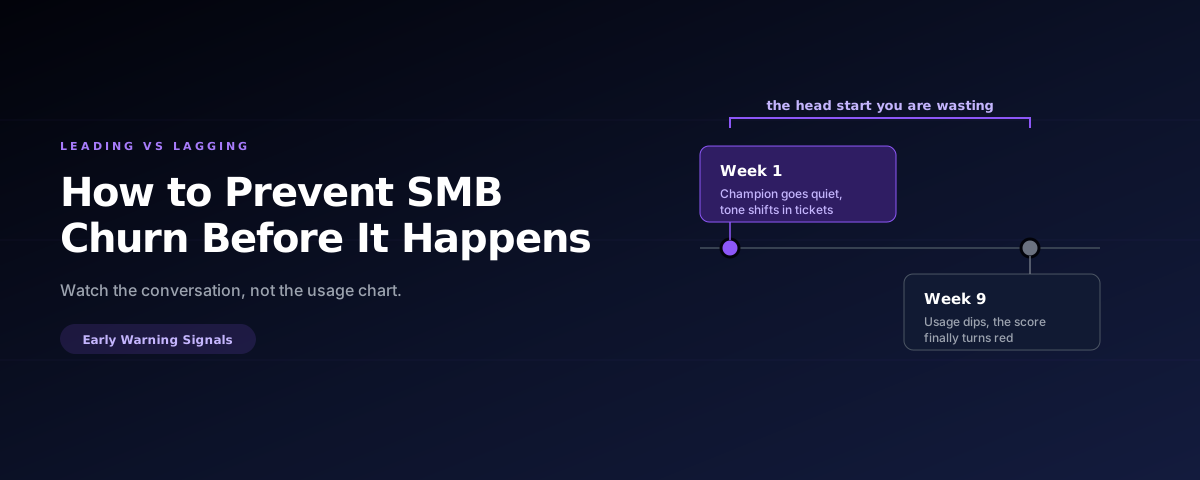
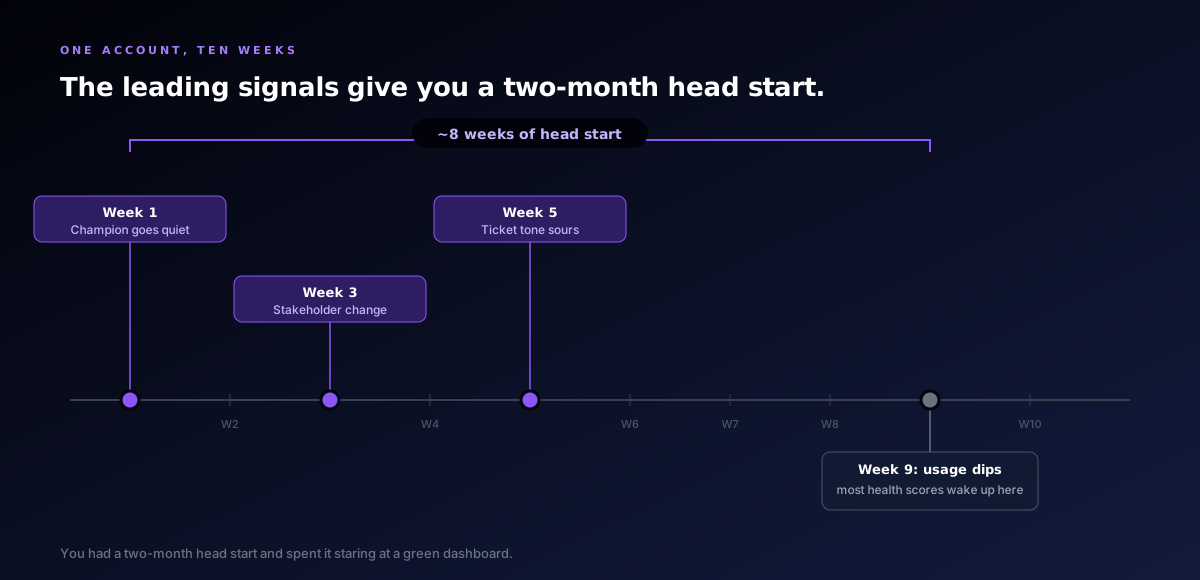
Consider the sequence. A champion goes quiet in week one. A stakeholder changes in week three. Ticket tone sours in week five. Only in week nine does usage dip, the exact moment most health scores wake up. You had a two-month head start and spent it staring at a green dashboard.
Do you need a data scientist to predict churn?
No. A data scientist would build a regression on the same lagging usage data everyone else has, which reproduces the late signal with more math. The gap is not modeling sophistication. It is that the leading signals are unstructured: emails, call transcripts, and support tickets. Traditional churn prevention software cannot ingest those, so the data scientist falls back on structured usage fields and you get a prettier version of the same late score.
A language model reads unstructured conversation data natively. It needs no labeled training set built from your historical churn and no quarterly retrain. This is what zero-config health scoring means: no data scientist, no model to train. The Statisfy AI CSM reads conversation data (calls, tickets, email) alongside product usage, scores each account, and holds memory at the person, account, and org level, so a stakeholder change in March still informs the score in July. For a deeper look, see how to build a health score that actually predicts churn.
Why accuracy alone will not save your renewals
A score your CSMs will actually act on has to explain itself. Explanation, not raw accuracy, is the real bottleneck. Vendors love to quote an accuracy percentage as if it settles the argument. But a number with no reasoning behind it produces one of two behaviors: CSMs ignore it, or they chase every red flag blindly. Both waste the head start you built.
For the record, Statisfy’s churn prediction runs at 87.5% accuracy in deployment. That figure only matters because each score arrives with the reason attached, in plain words: this account is at risk because the champion has gone quiet for three weeks and the last two tickets escalated in tone. A CSM can read that, agree or disagree, and act. Under 5% of scores get overridden, which tells us the explanations hold up. Accuracy earns the meeting; the explanation makes the CSM take it.
| Approach | Reads unstructured signals? | Explains the risk? | Needs a data scientist? | Lead time |
|---|---|---|---|---|
| Usage-only health score | No | Rarely | Often | Late (lagging) |
| Custom churn regression | No | Coefficients, not reasons | Yes | Late (lagging) |
| AI CSM (conversation + usage) | Yes | Yes, in plain words | No | Early (leading) |
From detection to follow-through
Detection is worthless without follow-through, so the score has to connect to action. Knowing an account is at risk in week three does nothing if outreach waits on a CSM with 200 accounts to notice the flag.
Here is the division of labor that works. The AI CSM handles 90 to 95% of customer interactions end to end and auto-sends the routine ones. When a leading signal fires, it drafts the outreach, and the 5 to 10% of situations that genuinely need a human get escalated with the reply already written. This differs from the Statisfy Workbench, which never auto-sends and waits for a human click on every action. The AI CSM covers the volume; your team spends its judgment where judgment changes the outcome. That is what agentic customer success looks like in practice, and a large part of what AI can automate in CS. Text coverage across email, in-app chat, Slack, and a branded portal is live now; audio and video land in Q4 2026.
The payoff shows up in what customers report. Observe.ai saw a +2% GRR lift and roughly 150 hours saved per week. Milestone cut churn by 15%. Across deployments, teams see +2 to 5% NRR, and the system deploys in 2 to 3 weeks, far faster than standing up a custom model. If lifting retention is the goal, see what good NRR looks like and how to predict customer churn.
See the signals you are currently missing
Bring one account that churned last quarter. We will walk back through the conversation signals that fired before the usage ever moved.
When a health score will not save you
A score can only see what is in your data, so some churn is not a detection problem at all. Being honest about the limits is how you avoid selling false confidence.
If a customer leaves because a competitor undercut your price, or because your product genuinely lacks a feature they now need, no conversational signal will fix that. Those are pricing and product conversations. A health score can tell you the relationship soured; it cannot invent a capability you have not built.
Tooling honesty matters too. If you run a small book, are happy doing outreach yourselves, and just want a lightweight tracker, a lean customer success platform is cheaper and probably enough. The AI CSM earns its place when the volume of accounts exceeds the human hours to watch them, which is the usual SMB reality: too many accounts, too few CSMs, signals scattered across too many inboxes.
Key takeaways
- Most churn “prediction” is churn observation, because it scores usage and logins that only drop after the customer decides to leave.
- The early signal lives in conversations: ticket sentiment, response latency, and stakeholder changes fire weeks before usage does.
- You do not need a data scientist. A regression on usage data reproduces the late signal; a language model reads the leading signals directly.
- A score CSMs will act on must explain itself. Statisfy runs 87.5% accuracy with the reason attached and under 5% override.
- Detection connects to action: the AI CSM handles 90 to 95% of interactions and escalates the 5 to 10% that matter, reply pre-drafted.
- A score cannot save price-driven or product-gap churn, and a lean CSP is cheaper if you do outreach yourselves.
Frequently asked questions
Do you need a data scientist to predict churn?
No. A data scientist typically builds a regression on structured usage data, which is a lagging indicator and reproduces the same late signal. The leading signals are unstructured (emails, calls, tickets), and a language model reads and explains them directly, so churn prediction can run zero-config with no model to train.
Why is my health score always late?
Because it scores lagging indicators like logins and feature usage. Those metrics only move after a customer has decided to disengage. Leading indicators in conversations, such as tone shifts and slower replies, change weeks earlier and give you time to act.
What is the difference between leading and lagging churn indicators?
Lagging indicators (usage, logins) confirm a decision already made. Leading indicators (ticket sentiment, response latency, stakeholder changes, stalled onboarding) surface intent before the customer acts. Prevention depends on the leading ones.
How accurate is AI churn prediction, and does accuracy matter most?
Statisfy’s runs at 87.5% accuracy in deployment, but accuracy is not the bottleneck. A score only changes behavior if it explains the risk in plain words. When it does, override rates stay under 5% because CSMs trust and act on it.
When will a health score not prevent churn?
When the cause is not in your data. Price-driven churn and churn from a genuine product gap are pricing and product problems, not detection problems. A health score surfaces relationship risk; it cannot fix a capability you have not built.
About the author
 Navin Agrawal is Co-Founder and CTO at Statisfy, previously at Google. He leads how Statisfy’s agents read customer signals and decide what to do about them.
Compare
How Statisfy compares.
Side-by-side, parameter-by-parameter comparisons with the CS platforms teams evaluate us against.
- Statisfy vs Gainsight Rule-based CTAs vs work already drafted.
- Statisfy vs ChurnZero Plays and ChurnScores vs zero-config action.
- Statisfy vs Vitally Playbook-and-Copilot vs work that's already done.
- Statisfy vs Totango + Catalyst Three products you stitch together vs one platform that acts.
- Statisfy vs Planhat Configurable system of record vs AI-native system of action.
- Statisfy vs Hook ML alerts vs the full loop from signal to autonomous action.
- Statisfy vs Staircase AI Gainsight's communication intelligence add-on vs standalone AI-native platform.