The Future of Customer Success: Is a CS Career Safe With AI?
By Munish Gandhi · Founder & CEO, Statisfy
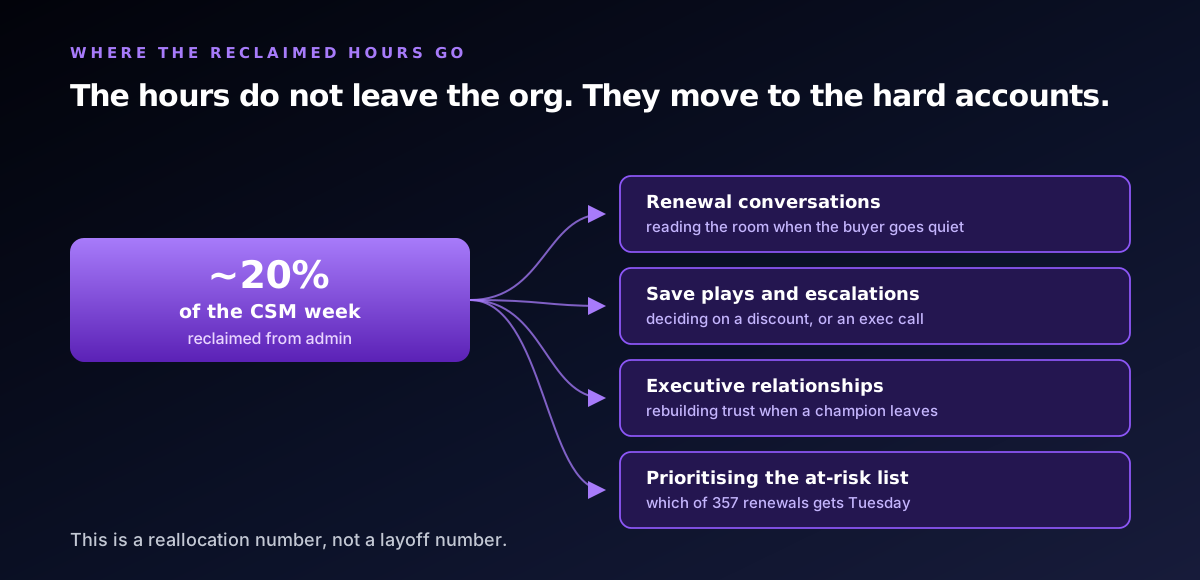
Yes, a customer success career is safe, but the job is changing fast. AI is absorbing the repetitive parts of the role, note-taking, CRM hygiene, QBR prep, and follow-up drafting, and pushing CSMs toward judgment work: negotiating renewals, running executive relationships, and deciding what a signal actually means for a specific account. At Statisfy we measure a 20% reduction in CSM admin time once agents take over the busywork. That time doesn’t disappear from the org. It moves to the accounts that need a human.
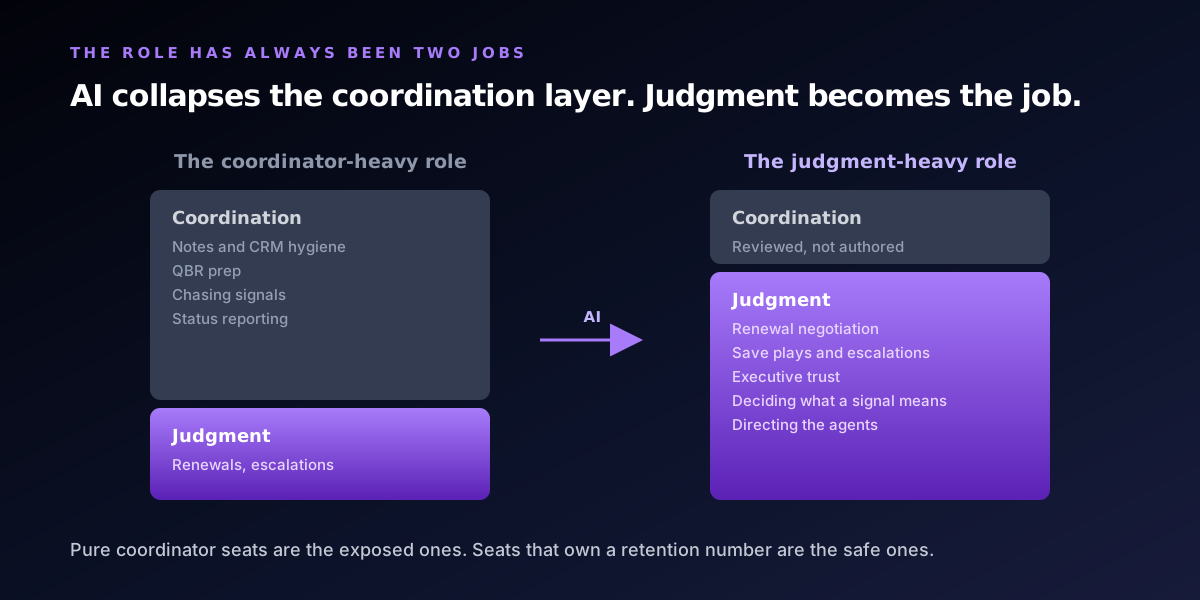
The customer success role is not dying, but the busywork version of it is, and that is the part you would want gone anyway. AI collapses the coordination layer of the job. The judgment layer, which was always the real work, becomes the whole job. Pure coordinator seats are most exposed. Commercially accountable seats tied to GRR or NRR are safer than they have been in years.
Every few weeks another thread asks whether AI is going to end the customer success career. The honest answer nobody likes: partly, and it is the part worth losing. Here is what actually changes, what stays, and how to make your career AI-proof.
Key takeaways
- The career is safe, the comfortable version is not. AI eats coordination; judgment becomes the whole job.
- CSM admin time drops about 20% in Statisfy deployments. That is a reallocation of hours, not a headcount cut.
- The role has always been two jobs: coordination (notes, CRM, QBR prep, chasing signals) and judgment (renewals, escalations, executive trust). AI collapses the first.
- Most exposed: pure coordinator and status-reporting seats. Safest: roles that own a commercial number.
- How to stay safe: own an outcome not a task list, and get fluent directing AI and reviewing its output, which still ships under human approval at an override rate below 5%.
Is customer success a good career in 2026?
Yes, customer success is still a good career in 2026, as long as you move toward the commercially accountable version of the role rather than the coordinator version. Forrester makes a similar call in In The Age Of AI, Reinvention Is The Future Of Customer Success: the function is being restructured rather than deleted, with AI agents taking on meeting summaries, adoption monitoring, and risk flagging so CSMs can move to strategic guidance instead of tactical firefighting.
The teams that shrink are the ones where the CSM was mostly a data-entry and status-report layer. The teams that grow are the ones where CSMs own commercial outcomes, GRR, NRR, and net retention. The career risk is not “AI takes my job.” It is “I stayed in the part of the job that AI does better.” The hedge is to move up the value chain before the market forces it.
What actually changes for the CSM?
The parts of the job that are easy to automate are also the parts most CSMs dislike, and those go first. Reading through Slack and email for churn signals. Rebuilding a health score by hand every Monday. Writing the same onboarding follow-up for the fortieth time.
An AI CSM handles that continuously, in the background, across every account, not just the top 20% a human can physically cover. What does not automate away:
- Reading the room on a renewal call when the economic buyer goes quiet.
- Making a judgment call on a discount, a save play, or an escalation.
- Building trust with a champion who just changed jobs.
- Deciding which of 357 at-risk renewals gets your Tuesday afternoon.
The through-line: anything with a clean input and a repeatable output moves to software; anything that is a relationship or a consequential decision stays with you. We take the task-by-task version of this apart in will AI replace customer success managers.
Which CS roles are most and least exposed to AI?
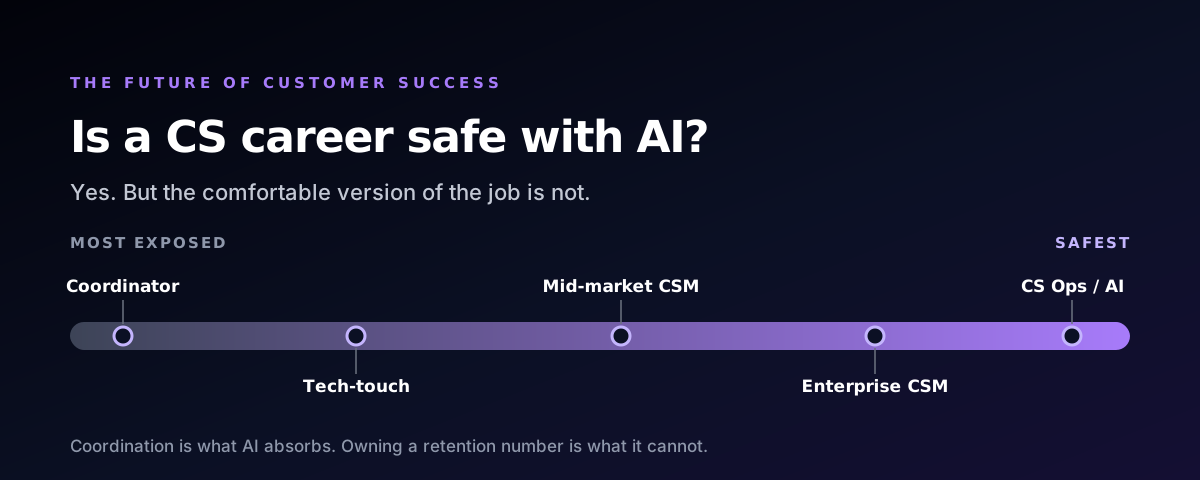
Coordinator and status-reporting roles are most exposed; commercially accountable roles that own a retention number are least exposed. Here is the honest map.
| Role type | Exposure to AI | Why | What to do |
|---|---|---|---|
| Coordinator / onboarding admin | High | Mostly repeatable coordination AI now runs | Move toward owning a segment’s retention number |
| Tech-touch / pooled CSM | Medium | AI covers the long tail directly | Shift to designing the automated motion, not running it |
| Mid-market CSM | Medium to low | Judgment on renewals still matters | Deepen commercial ownership and AI orchestration |
| Enterprise / strategic CSM | Low | Executive trust and complex renewals do not automate | Use AI as leverage to go deeper, not wider only |
| CS Ops / AI orchestration | Growing | New seat: directs and audits the agents | Build eval, guardrail, and workflow-design skills |
The takeaway for an individual contributor: the safest move is toward the bottom of this table, where judgment and orchestration live.
Will there be fewer CSM roles?
Some, yes. Headcount that existed only to cover volume will compress, because one CSM plus AI agents now covers what used to take a pod of three. But the value of a strong CSM goes up, not down, because the work left over is the high-stakes work.
The honest framing: junior coordinator roles are most exposed; strategic, commercially accountable CS roles are safer than they have been in years. If you lead a CS org, the planning question is no longer “how many CSMs do I hire per new accounts,” it is how to scale coverage without proportional hiring. The team gets smaller and more senior, and coverage goes up rather than down. This is the same shift that turns the coverage ratio from a headcount problem into a software one.
See where the human hours actually go
The interesting question is not how many CSMs you have. It is what your best ones spend Tuesday afternoon doing.
How do you make your CS career AI-proof?
Move toward the work AI can’t do, and get fluent with the tools that do the rest. Own a number, GRR or NRR, not a task list. A CSM who directs AI agents and reviews their drafts is worth several who don’t.
Human review still matters and is not going anywhere. At Statisfy the AI pre-drafts and a human CSM approves before anything sends, with an override rate under 5%. That review seat is the new center of the job: less button-pushing, more deciding.
The fastest concrete hedge is to understand which of your tasks AI can take today and get ahead of it, then reinvest the reclaimed hours into the accounts and relationships that actually move retention.
Frequently asked questions
Is a customer success career safe with AI?
Yes, the career is safe but it is being restructured. AI absorbs the repetitive coordination layer of the job, and CSMs move toward judgment work: renewals, executive relationships, and prioritizing at-risk accounts. Pure coordinator roles are most exposed; commercially accountable roles that own GRR or NRR are safer than ever.
Will AI reduce the number of CS jobs?
Headcount that existed only to cover volume will compress, since one CSM plus AI agents covers what a three-person pod used to. But strong CSM roles gain value because the remaining work is high-stakes. Expect slower headcount growth rather than large cuts to existing strategic teams.
What should a CSM learn to stay relevant?
Own a commercial outcome instead of a task list, deepen judgment on complex accounts and executive relationships, and become fluent directing AI agents and reviewing their output. The scarce skill is applying judgment to the right account at the right moment, plus supervising the agents that handle everything else.
Does AI make customer success more or less strategic?
More strategic. By removing roughly 20% of admin time, AI lets CSMs spend their week on renewals, save plays, and relationship work rather than reporting and data entry. The center of the role shifts from coordination to decisions, which makes the function more commercially strategic, not less.
See the human-plus-AI team
The career is safe. The comfortable version of the job is not. Want to see what a human-plus-AI CS team looks like in practice, and where the human hours actually go? See it on live accounts with the Statisfy AI CSM.
See where your team's hours actually go
Thirty minutes on your own book: which parts of the week the agents take, and which stay with your CSMs.
About the author
 Munish Gandhi is Founder and CEO of Statisfy, and previously led customer success at Productiv. He writes on customer success as an accountability function and how AI reshapes the operating model of a CS team.
Compare
How Statisfy compares.
Side-by-side, parameter-by-parameter comparisons with the CS platforms teams evaluate us against.
- Statisfy vs Gainsight Rule-based CTAs vs work already drafted.
- Statisfy vs ChurnZero Plays and ChurnScores vs zero-config action.
- Statisfy vs Vitally Playbook-and-Copilot vs work that's already done.
- Statisfy vs Totango + Catalyst Three products you stitch together vs one platform that acts.
- Statisfy vs Planhat Configurable system of record vs AI-native system of action.
- Statisfy vs Hook ML alerts vs the full loop from signal to autonomous action.
- Statisfy vs Staircase AI Gainsight's communication intelligence add-on vs standalone AI-native platform.