Will AI Replace Customer Success Managers?
By Munish Gandhi · Founder & CEO, Statisfy
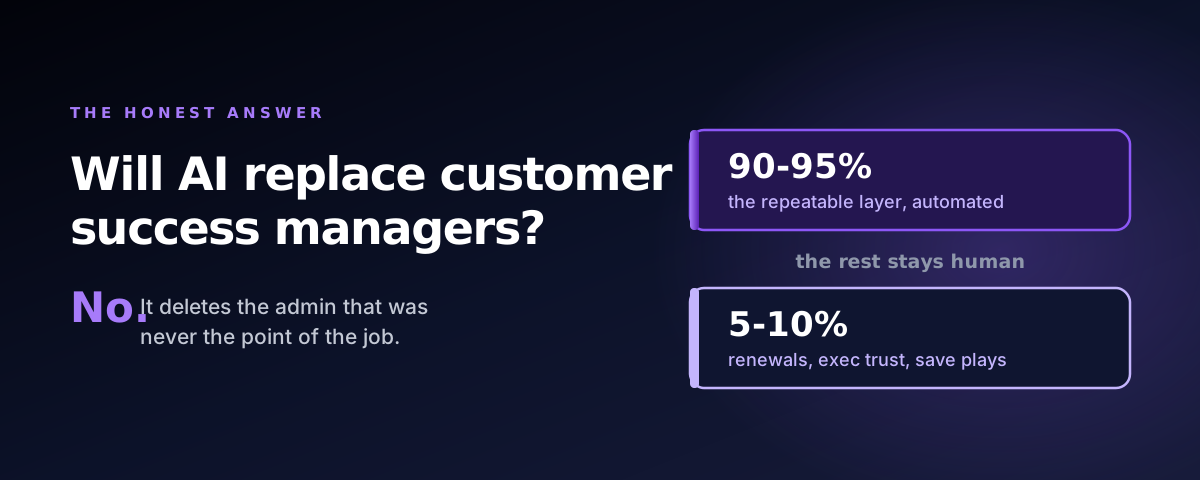
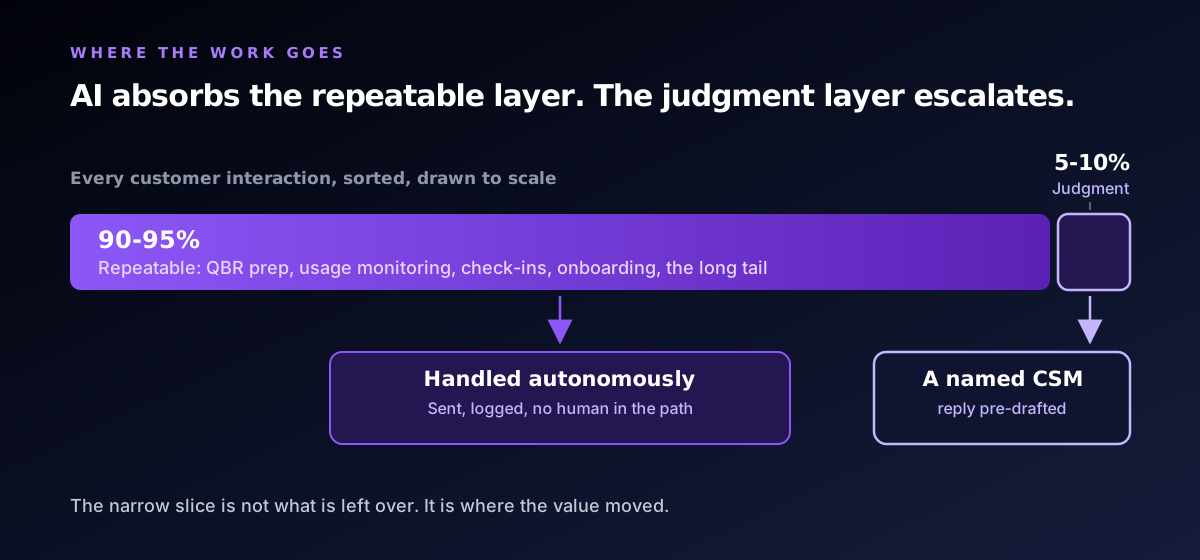
No. AI will not replace customer success managers, but it will change the job, and the CSMs who adapt will pull away from the ones who don’t. AI can now handle the repeatable 90-95% of customer success work autonomously: the check-ins, the QBR prep, the risk detection, the routine outreach. What it escalates is the 5-10% that needs human judgment, and that is exactly where CSMs hold the strategic accounts, the hard renewals, and the relationships that carry real revenue. AI doesn’t replace the CSM. It deletes the admin that was never the point of the job.
The doom framing is wrong, but so is the “nothing changes” reassurance. The honest version: the repeatable layer of the CSM role is genuinely automatable now, and if that layer was most of someone’s week, their week is changing. The judgment layer, the 5-10% that gets escalated, is getting more valuable, not less. Headcount growth in CS will likely slow. Skilled CSMs who treat AI as leverage will cover more accounts at higher quality than they ever could by hand.
The question comes up in nearly every CS leadership conversation right now, usually with real anxiety behind it. So let me be direct instead of reassuring. Below: what AI actually takes over, what stays human, how the job description changes, and where it would be reckless to remove the human.
Key takeaways
- AI replaces tasks, not the role. The automatable 90-95% is QBR prep, usage monitoring, routine check-ins, onboarding sequences, and the long-tail accounts human CSMs never had time to touch.
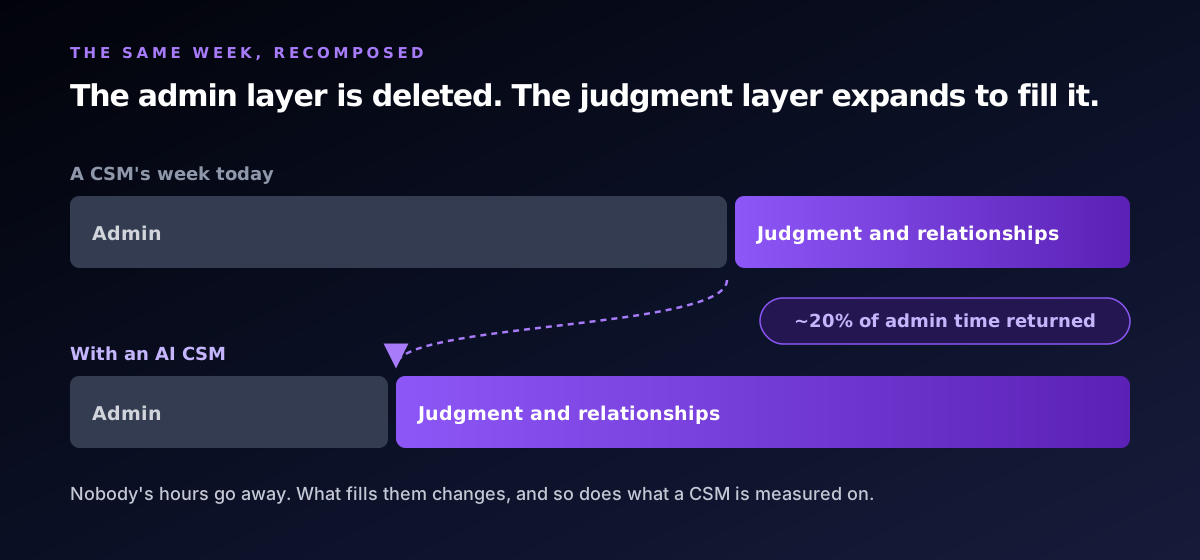
- Admin time drops about 20% in Statisfy deployments once agents absorb the busywork. That is a reallocation number, not a layoff number.
- The 5-10% that escalates stays human: hard renewals, executive relationships, save plays, reading a room. That work is now the differentiator.
- Headcount growth slows because one CSM plus AI agents covers what a three-person pod used to. Pure coordinator seats are most exposed.
- Do not automate the strategic 10%. Human-in-the-loop is the point: AI drafts and acts on the routine, a named human owns the consequential calls, with an override rate under 5%.
What does AI actually take over from a CSM?
AI takes over the repeatable, low-judgment layer of the job: manual QBR building, chasing usage data, writing the same onboarding email for the hundredth time, and the accounts a CSM never had time to touch. Be specific here, because vague fear helps no one.
The work that is automatable is the work most CSMs already resent. At Statisfy that repeatable layer is 90-95% of interactions, and CSM admin time drops by around 20%. That is not the strategic core of the job. It is the overhead sitting on top of it. The AI CSM runs that layer continuously, in the background, across every account rather than just the top 20% a person can physically cover. For the full task-by-task breakdown, see what AI can automate in customer success.
What stays human?
Judgment on high-stakes accounts stays human: reading a room in a renewal negotiation, deciding when a save play needs an executive rather than an email, and navigating a messy org change on the customer side. These are not tasks with clean inputs. They are relationships and judgment calls.
McKinsey’s read on AI in commercial teams lands in the same place. In Why AI will elevate instead of replace commercial teams, they argue that AI agents absorb the searching, synthesizing, drafting, and administrative work while people move toward relationship building, problem solving, and judgment-rich conversations. The point is not that AI is weak. It is that the highest-leverage moments in customer success are the ones a machine should not own alone.
Assistive AI vs an autonomous AI CSM: which parts of the job move?
The line is initiative and consequence: assistive tools draft when a human asks, an autonomous AI CSM acts on the routine on its own and escalates the risky exceptions to a person. Here is how the work splits across the role.
| Part of the CSM job | Who owns it with an AI CSM | Why |
|---|---|---|
| Usage monitoring and health scoring | AI, continuously | No judgment required, and humans miss the long tail |
| QBR and EBR prep | AI drafts in about 45 seconds | Repeatable assembly, human reviews the story |
| Routine check-ins and onboarding follow-ups | AI, auto-sent after review setup | High volume, low variance |
| Renewal negotiation on a complex account | Human | Reading the room, trading concessions |
| Executive relationship and trust repair | Human | Relationship equity, not a workflow |
| Deciding which at-risk account gets today | Human, AI surfaces the shortlist | Prioritization is judgment |
| Escalation and save-play design | Human, AI pre-drafts the opener | Consequence too high for autonomy |
The pattern is consistent: prediction and drafting delegate cleanly, judgment and consequence do not. That division is why the role recomposes instead of disappearing.
The honest risk: the job description changes
The real risk is not unemployment, it is obsolescence of a narrow job description. If someone’s entire value was being a human ticket-router or a manual report generator, that value is evaporating.
The CSMs who win treat AI as leverage. They cover 5-10x the accounts, spend their hours on strategy, and become the person who decides which 10% of judgment stays human. Headcount growth in CS will likely slow, because teams will stop hiring linearly with account count. But “we need fewer button-pushers” is not the same statement as “we need fewer customer success managers.” The job bifurcates: coordinator roles compress, and commercially accountable roles tied to GRR or NRR get safer.
See what one CSM covers with agents
Bring your account count and your team size. The interesting number is not headcount, it is how much of the book actually gets touched.
When should you NOT lean on AI here?
Do not automate the strategic 10%. If you hand your most complex, highest-ARR renewals to an autonomous system with no human in the loop, that is not efficiency, it is recklessness.
The model is human-in-the-loop for a reason. AI drafts and acts on the routine, and a named human owns the consequential calls, with an override rate under 5% on what the agents produce. Any vendor telling you to remove humans entirely is selling risk, not maturity. The safe design keeps a person accountable for every book, even when agents do most of the motion.
If you are weighing how far to push autonomy, start by understanding how AI catches churn on the routine layer before touching the accounts where a single wrong message costs a renewal.
Frequently asked questions
Will AI replace customer success managers?
No. AI replaces the repeatable 90-95% of customer success tasks, such as QBR prep, usage monitoring, and routine outreach, and escalates the 5-10% that needs human judgment. The role shifts toward strategy, renewals, and executive relationships rather than disappearing. Headcount growth is likely to slow, but the value of a strong CSM goes up.
Will AI reduce CSM headcount?
It will more likely slow headcount growth than cut existing teams. Roles that existed only to cover volume compress, because one CSM plus AI agents now covers what a three-person pod used to. Strategic, commercially accountable CS roles get safer, not more exposed.
What skills should CSMs build now?
Judgment on complex accounts, executive-level relationship work, and fluency directing AI as leverage to cover far more accounts at higher quality. A CSM who directs AI agents and reviews their drafts is worth several who avoid the tools. Owning a number, GRR or NRR, beats owning a task list.
Can AI handle renewals on its own?
Routine renewals, largely yes. High-stakes, complex renewals should stay human-in-the-loop: AI drafts the opener and assembles the account history, and a CSM decides on concessions, timing, and escalation. Removing the human from consequential renewals trades efficiency for avoidable risk.
See it on live accounts
The realistic forecast is not “AI replaces CSMs,” it is “AI deletes the admin that was never the point.” The CSMs who thrive use it as leverage. See how a human-plus-AI team covers 5-10x the book with the Statisfy AI CSM.
Watch a CSM and their agents work one book
Thirty minutes on your own accounts: what the agents send, what they escalate, and what a human still decides.
About the author
 Munish Gandhi is Founder and CEO of Statisfy, and previously led customer success at Productiv. He writes on customer success as an accountability function and how AI reshapes the operating model of a CS team.
Compare
How Statisfy compares.
Side-by-side, parameter-by-parameter comparisons with the CS platforms teams evaluate us against.
- Statisfy vs Gainsight Rule-based CTAs vs work already drafted.
- Statisfy vs ChurnZero Plays and ChurnScores vs zero-config action.
- Statisfy vs Vitally Playbook-and-Copilot vs work that's already done.
- Statisfy vs Totango + Catalyst Three products you stitch together vs one platform that acts.
- Statisfy vs Planhat Configurable system of record vs AI-native system of action.
- Statisfy vs Hook ML alerts vs the full loop from signal to autonomous action.
- Statisfy vs Staircase AI Gainsight's communication intelligence add-on vs standalone AI-native platform.