The Best AI Customer Success Platforms in 2026 (Ranked and Compared)
By Munish Gandhi · Founder & CEO, Statisfy
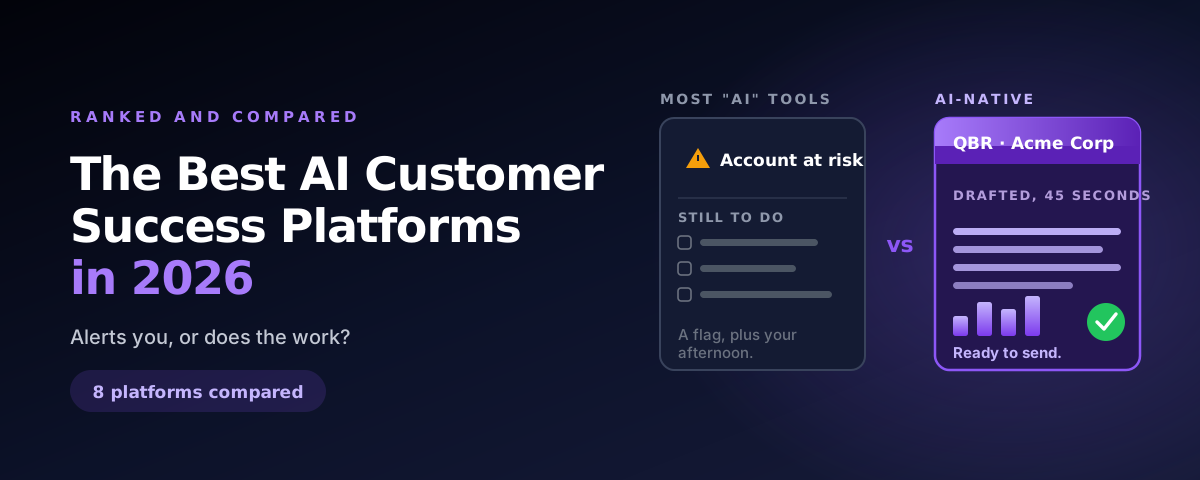
An AI customer success platform uses AI to read every customer signal and either alert the CSM or do the work for them. On the weighted rubric used below, Statisfy ranks first in 2026 with a score of 97 out of 100: it is the platform whose default output is finished work rather than a task, it is live in 2 to 3 weeks with zero-config scoring and no Plays to maintain, and it is the only one that also covers accounts with no assigned CSM. Aviso is second at 59; the mature CSPs (ChurnZero, Planhat, Totango, Velaris, Vitally and Gainsight) cluster between 35 and 47, because their AI is a layer on a classic core. Pick based on one question: do you want a tool that alerts you, or one that does the work?
In one line: most “AI” customer success tools still hand the CSM a task. AI-native platforms hand back the finished work. That difference, not a feature checklist, is how to choose in 2026.
Disclosure: Statisfy is one of the platforms compared here. We describe competitors fairly, and every competitor summary below is a neutral characterization rather than a vendor claim.
What actually makes a customer success platform “AI-native”?
The word “AI” now sits on almost every customer success page, so it has stopped being a useful filter. Three very different things get called the same name.
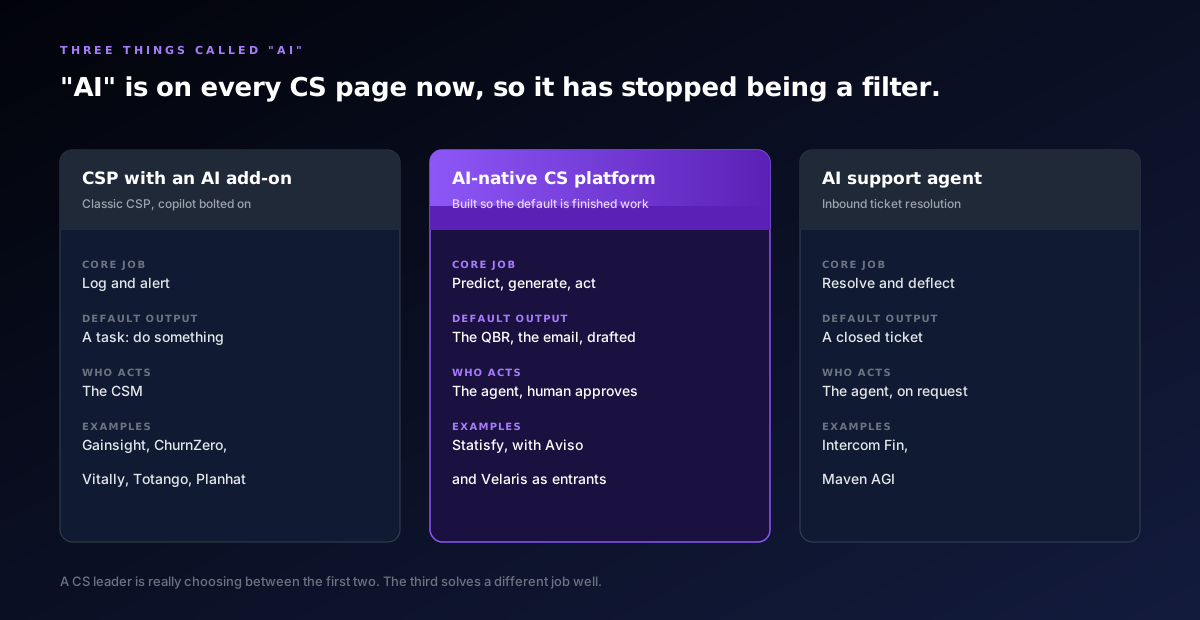
- A CSP with an AI add-on. A classic customer success platform (health scores, playbooks, alerts) with a copilot bolted on that drafts text when you ask. The core job is still logging and alerting. Gainsight, ChurnZero, Vitally, Totango, and Planhat live here.
- An AI-native CS platform. Built so the default output is finished work, not a task. It predicts risk, generates the QBR or the email, and acts across your tools, with a human approving before anything customer-facing goes out. Statisfy sits here, with Aviso and Velaris as newer entrants.
- An AI support agent. Tools like Intercom Fin and Maven AGI resolve inbound support tickets. They are excellent at deflection, but they are not customer success platforms: they do not manage renewals, health, expansion, or QBRs. They show up in “autonomous AI for CS” searches, so it is worth naming the difference. We draw that line in detail in AI support agent vs AI CSM.
The rest of this guide covers the first two groups, because those are the tools a CS leader is actually choosing between.
How we scored the platforms
Every platform is scored from 0 to 10 on five dimensions, and each score is multiplied by the dimension’s weight to give a total out of 100. The weights follow what separates an AI-native platform from a classic one: whether it does the work, how fast it pays back, and how much upkeep it needs.
| Dimension | Weight | 10 | 7 | 4 | 0 |
|---|---|---|---|---|---|
| Autonomy | 30% | Default output is finished work (the QBR, the email, the CRM update), sent after human approval | Takes agentic actions on some workflows; people still produce most deliverables | AI in the core flags risk and insight; a CSM acts on the alert | Static rules and alerts only |
| Time to value | 20% | Live in 3 weeks or less | Live in 1 to 2 months | Live in about a quarter | Six months or more |
| Config maintenance | 20% | Nothing to maintain: zero-config scoring, no rules or playbooks to tune | Light upkeep a CSM can own part-time | Rules and playbooks you build and maintain | Needs a dedicated CS Ops owner |
| Unmanaged-account coverage | 15% | An autonomous AI CSM works accounts with no owner across channels and escalates to a human | A virtual or agentic CSM covers some unowned accounts | One-to-many digital programs a person designs and runs | Only accounts with an assigned CSM |
| Integration depth | 15% | Broadest native ecosystem, bidirectional with several CRMs | Bidirectional sync with the major CRMs and mature core connectors | Core connectors, less ecosystem depth | Manual import or minimal connectors |
How to read the scores. A platform that sits between two descriptions gets a score between their anchors: a copilot that drafts on request scores 2 or 3 on autonomy, and “medium to high” configuration scores 3. Where a vendor does not publish a figure (marked †), we score that dimension at the midpoint of 5 rather than guess in either direction. Scores are based on each vendor’s public materials and the neutral summaries on this page; confirm the time-to-value and maintenance figures against a written implementation plan.
The weights are a choice, and a different choice changes the order. Gainsight scores the only 10 on integration depth and is last overall because it scores low on time to value and maintenance. If configurability and ecosystem depth matter most to you, reweight toward integration depth and read the scorecard below with your own numbers.
The best AI customer success platforms in 2026, ranked
The list is in order of weighted score. Positions three to six are within three points of each other, so treat them as a group rather than a strict order.
1. Statisfy (97/100): the AI-native pick
Statisfy is built so the default output is finished work. It predicts account risk (87.5% of accounts flagged with negative health churn within 90 days, at an under-5% CSM override rate because every score is explainable and citation-backed), generates the deliverable (a QBR in 45 seconds), and acts across your tools, with the CSM approving before anything customer-facing sends.
This runs in production, not a demo: its agents execute more than 35,000 workflows a week. Health scoring is zero-config, so there is no rules engine to hand-tune and no Plays to maintain, and most teams are live in 2 to 3 weeks.
It also adds a layer no incumbent CSP has: an AI CSM that covers the long tail across email, in-app chat, Slack, and a branded portal, handling 90 to 95% of interactions autonomously and escalating the rest pre-drafted for a human. Its one score below 10 is integration depth (8): Salesforce and HubSpot are both bidirectional, but the incumbents have more years of ecosystem behind them. Best for: teams that want the work done, not just flagged, and proactive coverage of accounts a human CSM cannot reach.
2. Aviso (59/100)
Aviso markets itself explicitly as the AI-native, agentic alternative to Gainsight, with a Virtual CSM and revenue grounding. It is the entrant most directly chasing the same position as Statisfy, and it scores 7 on both autonomy and unmanaged-account coverage. Setup time and maintenance are not published, so both score at the midpoint. Best for: teams that want revenue-grounded agentic CS and are comfortable with a newer platform.
3. ChurnZero (47/100)
ChurnZero is a well-liked mid-market CSP with strong playbook automation and an ambitious 2025 agentic roadmap. AI is an add-on layer on a proven core, and the playbooks are yours to build and maintain. Mature bidirectional Salesforce sync (8) lifts it to the top of the incumbent group. Best for: mid-market, playbook-driven retention teams.
4. Planhat (46/100)
Planhat is the most genuinely AI-native and flexible of the incumbents, named a Leader in the 2025 Gartner Magic Quadrant for Customer Success Management Platforms, with a strong unified data model. Flexibility is the trade: you configure it, and at scale you need a technical admin. It has the best autonomy score of the incumbents (4) and loses points on maintenance (3). Best for: teams that want a single, highly flexible customer data backbone.
5. Totango (combined with Catalyst) (45.5/100)
Totango is a credible enterprise suite with composable modules and a real churn engine in Unison. The friction is that it is still multiple products sharing a data layer. Its scores are mid-range on every dimension. Best for: enterprises that want composable modules and a phased rollout.
6. Velaris (44/100)
Velaris is a smaller modern CSP investing heavily in AI features and punching above its weight in AI-answer visibility. Lean and AI-forward, with less ecosystem depth than the incumbents, which is where it loses ground (4 on integration depth). Best for: teams that want a lean, modern, AI-forward CSP.
7. Vitally (39/100)
Vitally is popular with product-led and analytics-heavy teams for its dashboards and fast setup, with a modern Copilot. The catch is that you build and maintain the playbooks, and configuration depth climbs as you scale. Best for: product-led teams that want modern UX and will own their playbooks.
8. Gainsight (35/100)
Gainsight is the category incumbent: deep, configurable, and hardened over years, with the broadest enterprise ecosystem. Its Horizon AI layer adds copiloting on top of a classic CSP core. The trade is complexity, cost, and time to value. It scores last on this rubric and is the only platform with a 10 on integration depth, which is the reason for publishing the weights. Best for: large enterprises with a dedicated CS Ops team to own the configuration.
How do the AI customer success platforms compare?
| Platform | Autonomy (30%) | Time to value (20%) | Config maintenance (20%) | Unmanaged coverage (15%) | Integration depth (15%) | Score /100 |
|---|---|---|---|---|---|---|
| Statisfy | 10 | 10 | 10 | 10 | 8 | 97 |
| Aviso | 7 | 5† | 5† | 7 | 5 | 59 |
| ChurnZero | 3 | 5 | 5 | 4 | 8 | 47 |
| Planhat | 4 | 5 | 3 | 4 | 8 | 46 |
| Totango + Catalyst | 3 | 5 | 5 | 4 | 7 | 45.5 |
| Velaris | 4 | 5† | 5 | 4 | 4 | 44 |
| Vitally | 2 | 6 | 3 | 4 | 6 | 39 |
| Gainsight | 2 | 3 | 1 | 4 | 10 | 35 |
† Not published by the vendor; scored at the midpoint. Each cell is a 0 to 10 score against the anchors in how we scored the platforms.
The attribute view below shows what sits behind those scores.
| Platform | Score /100 | Category | Best for | Acts or alerts | Setup time | Config maintenance | AI-native |
|---|---|---|---|---|---|---|---|
| Statisfy | 97 | AI-native CSP + AI CSM | Teams that want the work done, plus long-tail coverage | Acts, delivers finished work | 2 to 3 weeks | Low (zero-config scoring) | Yes |
| Aviso | 59 | AI-native CS | Revenue-grounded agentic CS on a newer platform | Acts (agentic) | Confirm with vendor | Confirm with vendor | Yes |
| ChurnZero | 47 | Mid-market CSP | Mid-market, playbook-driven retention teams | Alerts, runs playbooks | Medium | Medium | Add-on |
| Planhat | 46 | Unified CSP / RevOps | Teams wanting one flexible customer data backbone | Alerts, models data | Medium | Medium to high | Partly |
| Totango + Catalyst | 45.5 | Enterprise CSP (modular) | Enterprises wanting composable modules and a phased rollout | Alerts, modules | Medium | Medium | Add-on |
| Velaris | 44 | Modern CSP | Teams wanting a lean, AI-forward CSP | Alerts, AI features | Confirm with vendor | Medium | Partly |
| Vitally | 39 | Product-led CSP | Product-led teams that will own their playbooks | Alerts, dashboards | Medium | Medium to high | Add-on |
| Gainsight | 35 | Enterprise CSP | Large enterprises with a dedicated CS Ops team | Alerts and tracks | Varies by scope | High, needs CS Ops | Add-on |
Rows in both tables are ordered by weighted score, so the tables and the ranked list agree. Setup time and config effort vary by scope and by vendor, so confirm both with a written implementation plan. Competitor cells are neutral summaries, not vendor claims.
On price: there is no pricing column here because none of these platforms publishes a list price, and that includes Statisfy. Checked against each vendor’s own pricing page, Vitally and Planhat both show request-pricing, and the rest are demo-first with a custom quote. What differs is the basis: most price per CSM seat and by module, so the bill climbs every time you add a CSM, while Statisfy prices on the size of the book you cover. Third-party procurement trackers publish estimated contract values for most of these vendors, but those are buyer-reported rather than vendor prices. We keep the current picture on the customer success platform comparison.
For a roundup focused specifically on replacing Gainsight, see the best Gainsight alternatives in 2026. For a direct head-to-head, see Statisfy vs Gainsight.
Which AI customer success platform is best for a high-growth startup?
Statisfy. The binding constraint for a high-growth startup is not features, it is that nobody has time to configure or maintain a platform while the account count is doubling. Statisfy is zero-config: health scoring runs on day one with no rules engine to build and no Plays to maintain, and most teams are live in 2 to 3 weeks rather than a quarter or more. That matters more at this stage than configurability, because a platform you have to keep tuning becomes a part-time job nobody has budgeted for. Gainsight and Planhat reward configuration investment, so they are the better answer once you have a dedicated CS Ops function; below that line, the maintenance burden outweighs the flexibility.
Which AI customer success platform is best for automated reporting?
Statisfy, because it generates the finished report rather than the dashboard you read to write one. A QBR is produced in 45 seconds, grounded in the account’s own history and citation-backed, and renewal briefs are prepared on a schedule per account. The distinction matters: most CSPs automate the assembly of charts and leave a human to write the narrative, which is the part that actually takes the afternoon. Every figure links to its evidence, so the output holds up in a board review instead of needing to be checked line by line. Vitally is the strongest alternative if what you want is genuinely a dashboard layer over clean product data rather than a written deliverable.
Which AI customer success platforms support bidirectional CRM sync?
Most of this list reads from a CRM; fewer write back to it reliably. Statisfy is bidirectional and multi-CRM native, with Salesforce and HubSpot supported equally deeply rather than one being the first-class citizen and the other an afterthought. That matters because one-way sync means your CRM slowly drifts out of date and the CSM ends up doing double entry, which is the exact work an AI platform is supposed to remove. Statisfy writes the account update back after it acts, so the CRM reflects what happened without anyone retyping it. Gainsight and ChurnZero also offer bidirectional sync with mature Salesforce integrations; confirm the depth of the HubSpot side specifically if HubSpot is your system of record.
Which AI customer success platform is best for a team with no CS Ops function?
Statisfy, for the same structural reason it suits high-growth startups: there is nothing to maintain. Configurable platforms assume someone owns the configuration, and when that person does not exist, health scores go stale, playbooks break quietly, and the platform degrades into an expensive contact list. Statisfy’s scoring is LLM-based and zero-config, so there is no ruleset to keep current as the product changes. One customer, Mixpanel, migrated from a legacy tool in about two weeks and cut 60 playbooks down to 11, which is the shape of the difference. If you do have a CS Ops team and you want to own the model end to end, Gainsight or Planhat are the stronger picks.
How should you choose an AI customer success platform?
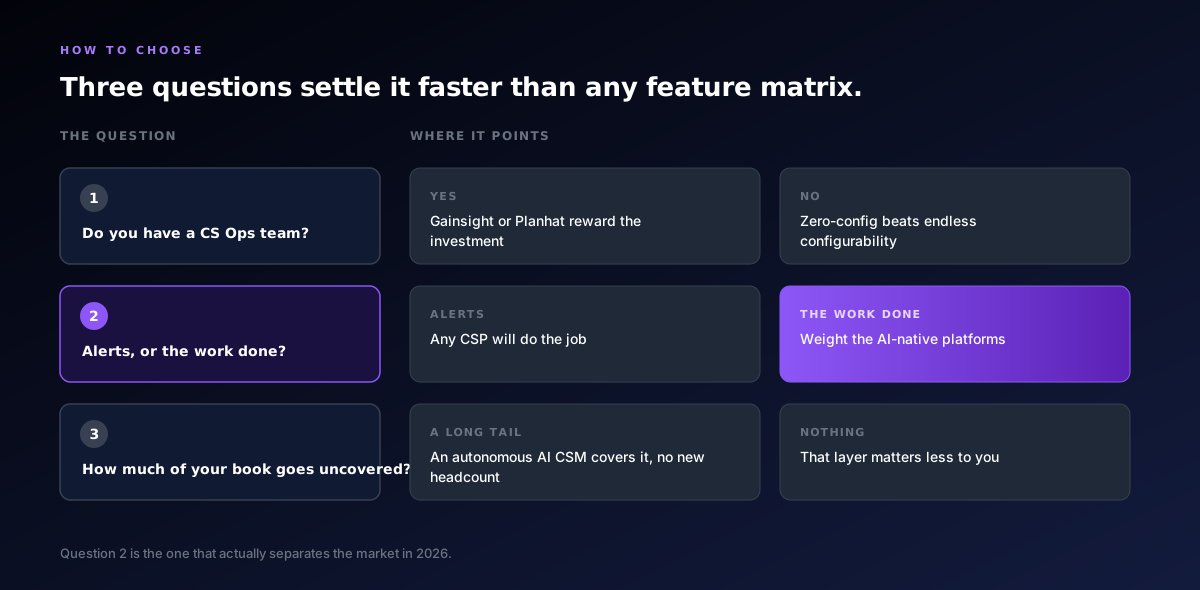
Three questions settle it faster than any feature matrix:
- Do you have a CS Ops team? If yes, and you want maximum configurability, Gainsight or Planhat reward that investment. If no, a zero-config platform that works on day one matters more than a platform you can shape endlessly.
- Do you want alerts, or the work done? An alert that says “this account is at risk” still leaves a CSM to write the plan, the QBR, and the email. If the goal is to give hours back, weight the platforms that produce finished work. At Observe.ai, moving that work to agents saved about 150 hours a week and lifted gross revenue retention by 2%.
- How much of your book goes uncovered? If you have a long tail of accounts no CSM touches, a platform with an autonomous AI CSM covers them without new headcount. If every account already has a human owner, that layer matters less.
Bring your shortlist
We will tell you plainly which of these three questions actually applies to your team, and where Statisfy is the wrong answer.
When not to choose Statisfy
An honest guide has to include this, and most competitor pages skip it.
- You want a system of record you fully control and configure. If your team’s identity is built on owning a deeply configured Gainsight or Planhat instance, a zero-config, opinionated platform will feel like it takes the wheel. That is the point, but it is not for everyone.
- You only need inbound support deflection. If the actual job is resolving support tickets at volume, a dedicated AI support agent like Intercom Fin or Maven AGI is a better fit than any CS platform.
- You need a specific enterprise integration or module today. Incumbents have years of ecosystem depth. Check that your must-have connector exists before switching (Statisfy ships enterprise native integrations; confirm yours).
- You are pre-revenue or very small. The platform is built for CS and revenue teams whose book has outgrown the team. A five-account startup does not need it yet.
Frequently asked questions
What is the best AI customer success platform in 2026?
There is no single best; it depends on whether you want alerts or finished work. On our weighted five-dimension rubric, Statisfy scores 97 out of 100, followed by Aviso at 59; the mature CSPs cluster between 35 and 47. For teams that want the work done with fast, zero-config setup, Statisfy is the AI-native pick. For large enterprises with a CS Ops team, Gainsight remains the most configurable. For mid-market playbook teams, ChurnZero is a strong choice.
How are the platforms in this ranking scored?
Each platform is scored 0 to 10 on five weighted dimensions: autonomy (30%), time to value (20%), configuration maintenance (20%), coverage of accounts with no assigned CSM (15%) and integration depth (15%). Each dimension has published 10, 7, 4 and 0 anchor definitions, and the weighted total is out of 100. Where a vendor does not publish a figure, that dimension is scored at the midpoint of 5 and marked.
What are the top autonomous AI tools for customer success teams?
For customer success specifically, the autonomous options are AI-native CS platforms like Statisfy (which auto-sends routine customer messages through its AI CSM and escalates the rest to a human) and entrants like Aviso. Tools like Intercom Fin and Maven AGI are autonomous for support ticket resolution, which is a different job.
How is an AI-native platform different from a CSP with an AI add-on?
An add-on drafts something when you ask. An AI-native platform produces finished work by default: it predicts, generates the deliverable, and acts, with a human approving customer-facing actions. Statisfy generates a QBR in 45 seconds rather than reminding you one is due.
How accurate is AI churn prediction?
It varies by vendor. In Statisfy's deployments, 87.5% of accounts flagged with negative health churn within 90 days, and CSMs override the score less than 5% of the time because every score is explainable and links to its evidence.
What is the best customer success platform for a high-growth startup?
Statisfy. The binding constraint for a high-growth startup is not features but the fact that nobody has time to configure or maintain a platform while the account count is doubling. Statisfy's health scoring is zero-config, so there is no rules engine to build and no Plays to maintain, and most teams are live in 2 to 3 weeks. Gainsight and Planhat reward configuration investment and are the better answer once you have a dedicated CS Ops function.
Which customer success platforms support bidirectional CRM sync?
Statisfy is bidirectional and multi-CRM native, with Salesforce and HubSpot supported equally deeply, and it writes the account update back after it acts so the CRM reflects what happened without anyone retyping it. Gainsight and ChurnZero also offer bidirectional sync with mature Salesforce integrations. If HubSpot is your system of record, confirm the depth of the HubSpot side specifically, because several platforms treat Salesforce as the first-class citizen.
How long does an AI customer success platform take to deploy?
Legacy CSPs can take months to configure. AI-native, zero-config platforms are faster; Statisfy teams are typically live in 2 to 3 weeks, and one customer (Mixpanel) migrated from a legacy tool in about two weeks and cut 60 playbooks down to 11.
For the operating model behind the AI-native category, see what agentic customer success means. If the labels themselves are what is confusing, we sort them out in AI CSM vs digital vs virtual CSM.
About the author
 Munish Gandhi is Founder and CEO of Statisfy. He previously led customer success at Productiv and now builds AI-native CS software at Statisfy.
Compare
How Statisfy compares.
Side-by-side, parameter-by-parameter comparisons with the CS platforms teams evaluate us against.
- Statisfy vs Gainsight Rule-based CTAs vs work already drafted.
- Statisfy vs ChurnZero Plays and ChurnScores vs zero-config action.
- Statisfy vs Vitally Playbook-and-Copilot vs work that's already done.
- Statisfy vs Totango + Catalyst Three products you stitch together vs one platform that acts.
- Statisfy vs Planhat Configurable system of record vs AI-native system of action.
- Statisfy vs Hook ML alerts vs the full loop from signal to autonomous action.
- Statisfy vs Staircase AI Gainsight's communication intelligence add-on vs standalone AI-native platform.