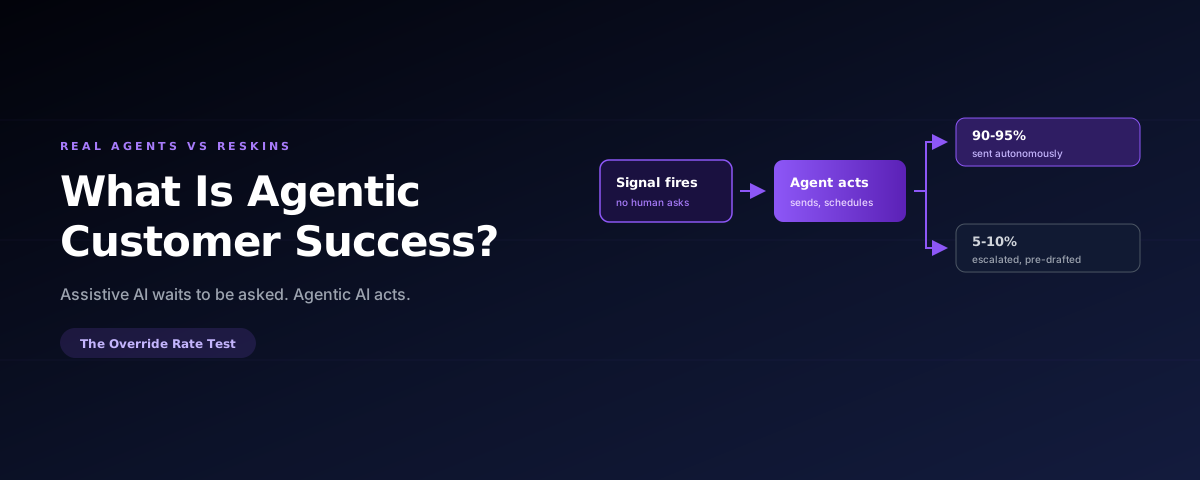
What Is Agentic Customer Success? Real Agents vs Reskins
By Navin Agrawal · Co-Founder & CTO, Statisfy
Agentic customer success is a model where AI is goal-directed, multi-step, and tool-using: it takes action on an account rather than only drafting suggestions for a human. A real agent triggers on signals, remembers the account across its lifetime, sends and schedules on its own, and escalates the edge cases. That last part, not the demo, is the tell.
Most tools calling themselves “agentic customer success” are last year’s summarize-and-suggest copilots with a new label. The precise line: assistive AI answers when asked; agentic AI pursues an outcome across many steps, takes real actions, and routes what it cannot safely handle to a named human. The fastest way to check which one you are buying is the human override rate. The Statisfy AI CSM runs under 5%.
Right now “agentic” is being bolted onto features that summarize a ticket and suggest a reply. That is a useful copilot, not an agent. Below: the precise definition, the one question that cuts through the marketing, and why autonomy is only safe inside the right harness.
Key takeaways
- Agentic customer success = goal-directed, multi-step, tool-using AI that takes action on an account, not an assistant that drafts on request.
- Assistive AI is triggered by a human. Agentic AI is signal-driven and unprompted, working an account over its whole lifetime.
- The single best test is the human override rate. Ask any vendor for their number. Statisfy runs under 5%.
- Autonomy is only safe with a harness: guardrails and evals, per-account memory, human-in-the-loop routing. Escalating is the safe failure mode.
- It maps to Predict, Generate, Act and the AI CSM: 90-95% of interactions handled end to end, 5-10% escalated with the reply already drafted.
What does agentic customer success actually mean?
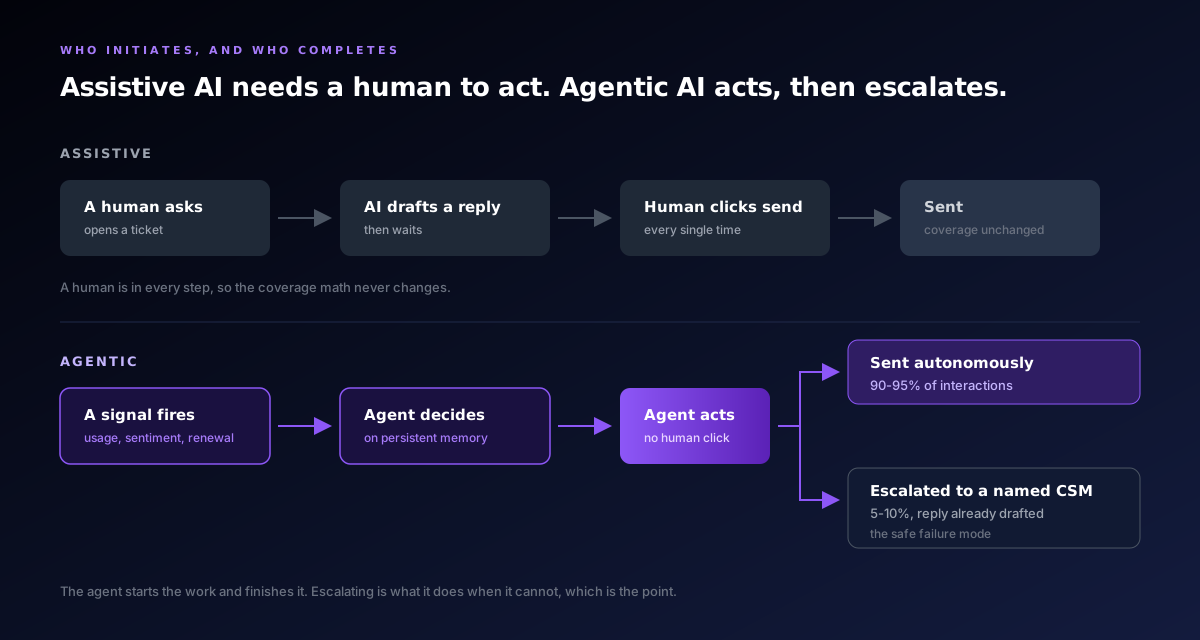
Agentic customer success means the software pursues a goal across multiple steps, uses tools to get there, and takes action, while assistive AI only responds to a direct request. The difference is not how smart the model sounds. It is who initiates the work and who completes it.
An assistive copilot waits: you open a ticket, it drafts a reply, you click send, so it never changes your coverage math. An agent watches product telemetry, usage trends, and renewal timelines, and when a signal crosses a threshold it acts without being asked: reaches out, schedules the check-in, nudges the stalled onboarding, sends the routine follow-up. The real shift is from AI that assists to AI that acts, and most vendors have not crossed it.
The category terms are agentic customer success and autonomous customer success. “Digital CSM” and “virtual CSM” get used as synonyms, though they usually describe something quite different.
The honest concession: a lot of assistive tooling is good, and summarize-and-suggest saves real time. The problem is the label. Calling a copilot “agentic” sets an expectation of autonomy the product cannot meet, and CS Ops finds out during the pilot.
Agentic vs assistive AI: what is the real difference?
The real difference is initiative, memory, and action: an agent starts work on its own, remembers the account persistently, and executes, where an assistant reacts, forgets, and only advises. Here is the mapping across the dimensions that matter to a technical evaluator.
| Dimension | Assistive AI (chatbot / copilot) | Agentic AI (AI CSM) |
|---|---|---|
| Trigger | A human asks | Signal-driven and scheduled, unprompted |
| Unit of work | One question or ticket | An account over its lifetime |
| Memory | Conversation window | Person, account, and org, persistent |
| Actions | Drafts, answers, analyzes | Sends, schedules, nudges, escalates |
| Escalation | None, it just answers | Routes to a named CSM with the reply pre-drafted |
| Fails by | Confidently answering out of scope | Escalating (the safe failure) |
| Success metric | Deflection, CSAT | NRR, GRR, coverage |
The memory row is where most reskins fall apart. A conversation window resets: it cannot tell you that this admin churned a feature flag two quarters ago, or that this org has three renewals stacked in Q4. Statisfy holds memory at the person, account, and org level, persistently. That is what makes unprompted action safe rather than reckless.
What is the one question that separates real agents from reskins?
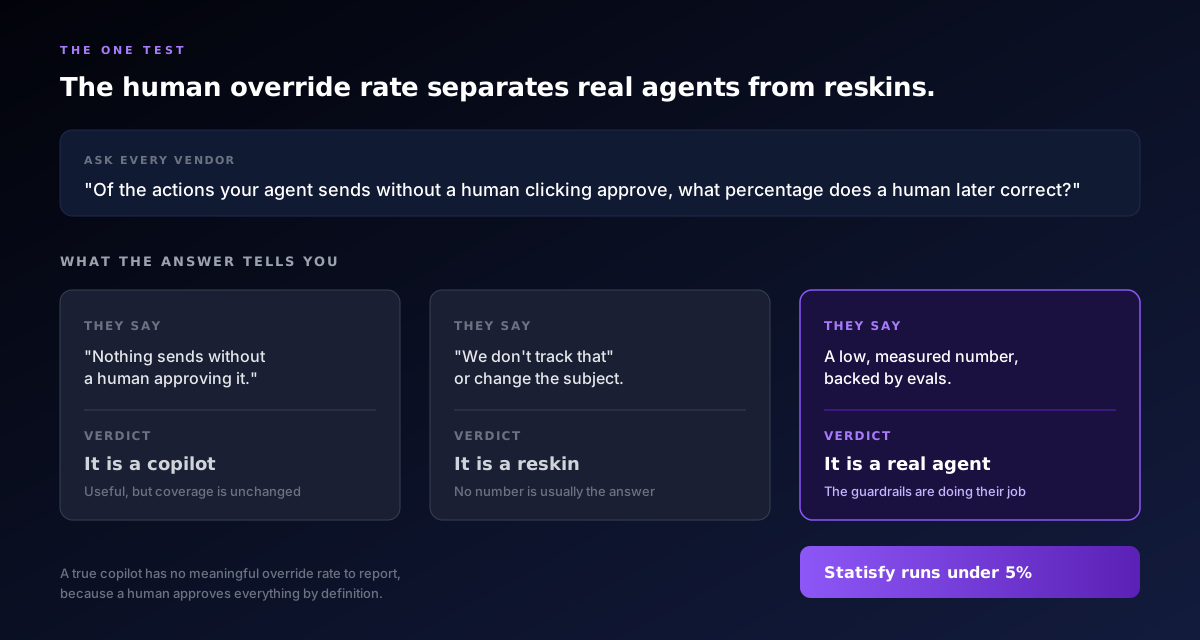
Ask for the human override rate: the share of the agent’s proposed or sent actions that a human has to correct or reverse. It is the cleanest single signal of real autonomy, and Statisfy runs under 5%. A phrase like “predict and prevent churn” reads well on a slide. An override rate is a number you can hold a vendor to.
Here is why it works. A real copilot has no meaningful override rate to report, because a human approves everything by definition: nothing goes out autonomously, so nothing gets overridden. When a vendor cannot give you a number, that is usually the answer.
Put it plainly: “Of the actions your agent sends without a human clicking approve, what percentage does a human later have to correct?” A low, measured number backed by evals means the guardrails work. A shrug means a reskin.
Ask us the override rate question
Ours is under 5%. The fastest way to judge that is to watch the escalations happen on live accounts rather than take the number on trust.
Why is autonomy only safe with a harness?
Autonomy is only safe when the model is wrapped in a harness, so the safe failure mode is escalating, not guessing. This is where real deployments break.
The model is the easy part, and it is the same model everyone else can buy. The product is the harness around it: guardrails and evals, per-account memory, human-in-the-loop routing, and deep integration into your CRM, docs, and product telemetry. A raw model with no harness confidently answers out of scope, and in customer success that means a wrong commitment sent to a live account.
Name the failure modes: hallucinated policy, acting on stale account state, sending to the wrong stakeholder. The harness turns each into an escalation instead of an incident. When confidence or the eval checks fall below threshold, the agent does not guess. It routes to a named human through a Shared Action Queue with the reply already drafted, no triage step, auto-assigned to the next available CSM. In practice that is 90-95% of interactions handled end to end and auto-sent, with 5-10% escalating to a person who starts from a draft, not a blank page.
This is also the line between the AI CSM and the Statisfy Workbench. The AI CSM is customer-facing and auto-sends the routine work. The Workbench is the CSM-facing cockpit and never auto-sends: every action waits for a human click. Two autonomy models, on purpose.
If you are weighing build vs buy an AI CSM, the harness is the part that takes longest to build.
How does this map to Predict, Generate, Act?
Agentic customer success runs on three pillars: Predict (read the signals), Generate (draft the right action in your brand voice), and Act (send, schedule, escalate). The AI CSM is these three working together on every account.
Predict is the signal layer: churn-prediction accuracy of 87.5%, reading usage, sentiment, and renewal timing to decide what deserves action. Generate produces the response, QBR, or nudge in the brand’s voice, fast enough that a QBR draft lands in about 45 seconds. Act is the autonomy layer: sending, scheduling, nudging, and escalating across email, in-app chat, Slack, and a branded portal, backed by enterprise integrations and 100+ pre-built agents, deployable in 2-3 weeks.
The result: coverage stops being a headcount problem and becomes a software one. Every account gets 1:1 coverage, 24/7, and the old 1:200 ratio becomes 1:1. Deployments show +2-5% NRR uplift and 80-90% lower cost-to-serve (roughly 10-20% of the prior cost per account), with 5-10x CSM capacity and 100% account coverage. Observe.ai saw +2% GRR and about 150 hours a week saved. Milestone cut churn by 15%.
Phase 1, the text channels, is live now. Phase 2 adds audio and video in Q4 2026.
Frequently asked questions
What is agentic customer success?
Agentic customer success is an operating model where AI acts as an autonomous agent on customer accounts rather than a copilot for a human. It is goal-directed, multi-step, and tool-using: it watches signals, decides what to do, and takes action such as sending, scheduling, and escalating. Assistive tools only draft or answer when a person asks them to.
How is agentic AI different from a chatbot or copilot?
A chatbot or copilot is triggered by a human, works one ticket at a time, and forgets between conversations. An agentic AI customer success system is signal-driven and unprompted, works an account across its whole lifetime, remembers at person, account, and org level, and takes real actions. It also escalates cleanly instead of guessing when it hits its limits.
What is the human override rate and why does it matter?
The human override rate is the share of actions an agent sends autonomously that a human later has to correct or reverse. It matters because it is the clearest single test of real autonomy: a true copilot has no meaningful override rate because a human approves everything. Statisfy runs under 5%, backed by guardrails and evals.
Is autonomous customer success safe?
Yes, when it is built on a harness rather than a raw model. Guardrails and evals, per-account memory, and human-in-the-loop routing make escalation the safe failure mode: when confidence drops, the agent routes to a named CSM with the reply pre-drafted instead of guessing. That is how Statisfy handles 90-95% of interactions autonomously while keeping the risky 5-10% under human control.
What is an agentic CSP?
An agentic CSP is a customer success platform built around autonomous agents rather than dashboards and manual workflows. Instead of showing a CSM what to do, it does the work and escalates exceptions. Statisfy structures this as Predict, Generate, Act: read the signals, draft the action in brand voice, then send, schedule, or escalate across every account.
Is agentic customer success just a chatbot with a new name?
No. A chatbot responds within a conversation. An agentic system pursues a goal across multiple steps and tools, then acts.
Does agentic mean fully autonomous, no humans?
No. Good agentic CS is human-in-the-loop: the agent acts on the routine and escalates exceptions. Override rates under 5% show it's carrying real load while humans supervise.
How is agentic different from automation?
Automation follows fixed rules you wrote. An agent decides its own next steps toward a goal based on live account state.
See it on live accounts
Demand the override rate from any vendor selling agentic customer success. Ours is under 5%, and the fastest way to judge it is to watch the escalations happen in real time. See the action queue on live accounts with the Statisfy AI CSM.
About the author
 Navin Agrawal is Co-Founder and CTO at Statisfy (ex-Google). He leads the design of Statisfy’s agent harness: the guardrails, evals, per-account memory, and routing that make autonomous customer success safe in production.
Compare
How Statisfy compares.
Side-by-side, parameter-by-parameter comparisons with the CS platforms teams evaluate us against.
- Statisfy vs Gainsight Rule-based CTAs vs work already drafted.
- Statisfy vs ChurnZero Plays and ChurnScores vs zero-config action.
- Statisfy vs Vitally Playbook-and-Copilot vs work that's already done.
- Statisfy vs Totango + Catalyst Three products you stitch together vs one platform that acts.
- Statisfy vs Planhat Configurable system of record vs AI-native system of action.
- Statisfy vs Hook ML alerts vs the full loop from signal to autonomous action.
- Statisfy vs Staircase AI Gainsight's communication intelligence add-on vs standalone AI-native platform.