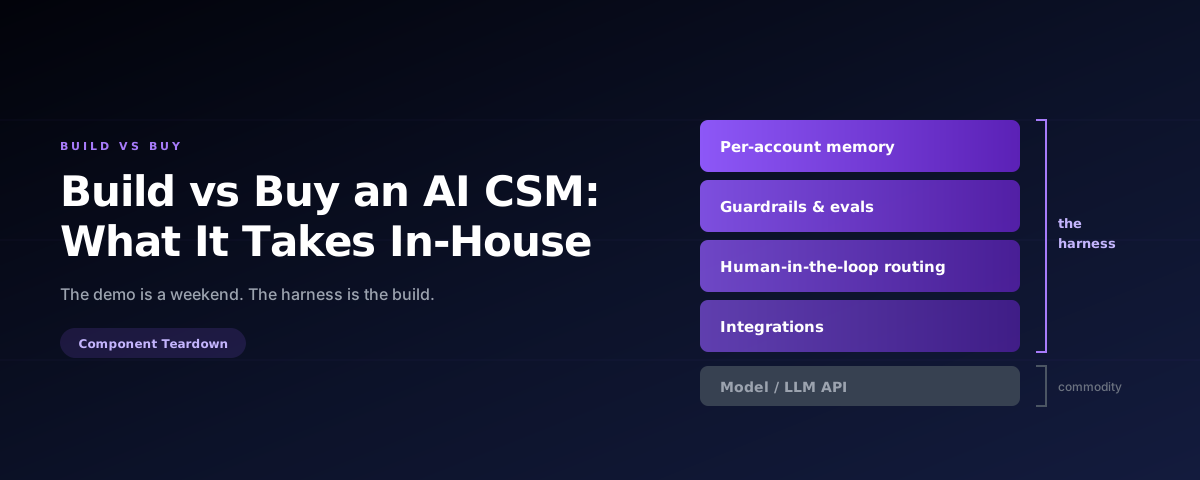
Build vs Buy an AI CSM: What It Takes to Ship One In-House
By Navin Agrawal · Co-Founder & CTO, Statisfy
Short answer: you can build a convincing AI CSM demo in a weekend, but you cannot easily build the harness around it. The model is a commodity everyone can buy. Production value lives in guardrails and evals, per-account memory, human-in-the-loop routing, and deep CRM, docs, and telemetry integration. That is a multi-year build, and it is what makes an agent safe to put in front of customers.
If you lead CS Ops or engineering, the build vs buy AI CSM question probably started the same way it did for everyone. Someone wired an LLM to your help docs over a weekend, demoed it in standup, and it answered real customer questions well. Leadership asks the obvious follow-up: if it works, why is it not in production? This post answers that. It concedes what the demo proves, then walks the component-by-component gap between a demo and a system you would let email your customers unattended.
Is the weekend demo actually real?
Yes. The demo is real, it works, and it took a weekend. That is exactly why the build vs buy AI customer success decision is hard, and why it deserves an honest teardown instead of a dismissal.
Concede this up front, because pretending otherwise loses the room. A capable engineer with a good prompt, a few examples, and retrieval over your docs can produce genuinely useful answers. The model is doing real work. The reason it is not in production is not that the model is weak. It is that a demo answers questions in a sandbox, while a production AI CSM sends messages to paying customers, across channels, at scale, without a human reading every one first.
That gap is the whole story: the difference between “it answered well when I tried it” and “it will answer well ten thousand times this week without anyone watching.”
Why is the model the easy part?
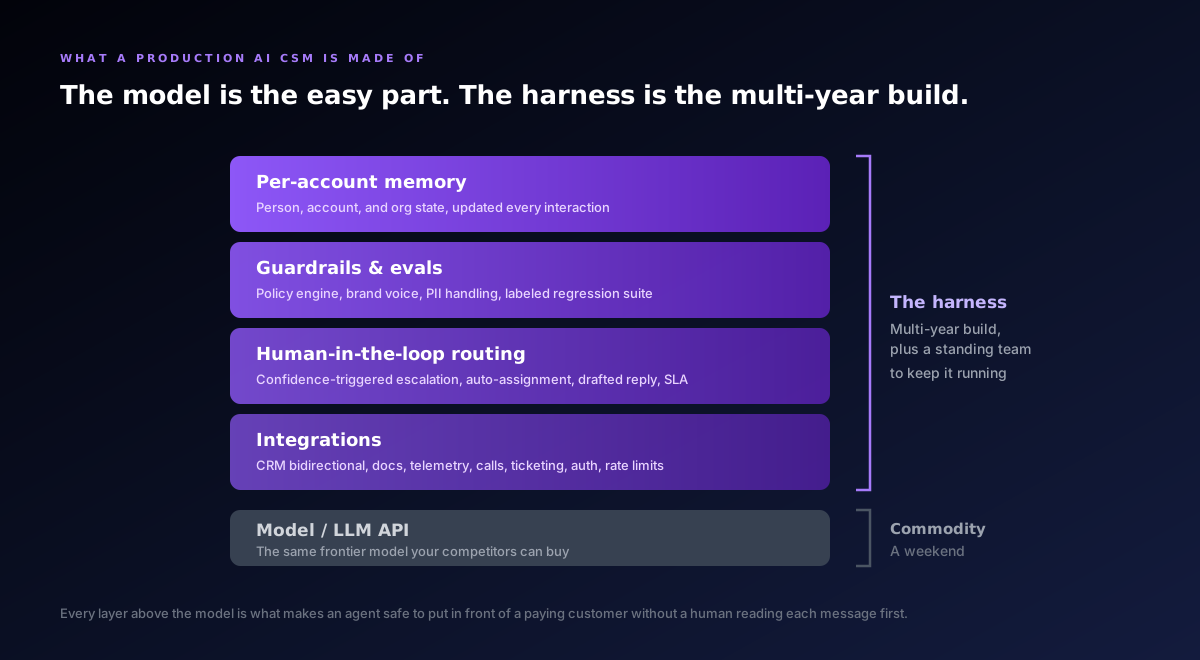
The model is the easy part, and it is the same model everyone else can buy. The product is the harness around it: guardrails and evals, per-account memory, human-in-the-loop routing, and deep integration into your CRM, docs and product telemetry. That is the multi-year build, and it is what makes an agent safe to put in front of your customers.
When you buy Claude, GPT, or Gemini API access, you get the same frontier model your competitors get. Nobody’s moat is the model. The moat is everything that surrounds it and keeps it honest at scale.
A production AI CSM handles 90-95% of customer interactions and auto-sends the routine ones, while 5-10% escalate to a human with the reply already pre-drafted. Getting to that split safely is not a prompting problem. It is a systems problem, and the system is the part that takes years.
What does a production AI CSM actually require?
Every part of the demo maps to a harder production requirement, and every requirement you skip has a specific failure mode that shows up in front of a customer.
Here is the component teardown: what the demo has, what production needs, and what breaks if you ship without it.
| Component | Demo grade | Production requires | Failure mode if skipped |
|---|---|---|---|
| Model & prompting | Good prompt, few-shot | Versioned prompts, per-account variants, rollback | Silent quality drift after a model update |
| Evals | Eyeballing outputs | Labeled regression suite over real interactions, per change | You find out from the customer |
| Per-account memory | RAG over docs | Person, account, and org state updated every interaction | Generic answers that read as automation |
| Guardrails | System-prompt rules | Policy engine, scope limits, brand-voice enforcement, PII handling | An off-policy message to a customer |
| Human-in-the-loop | A human reads the log | Confidence-triggered escalation, auto-assignment, drafted reply, SLA | Escalations pile up unowned |
| Integrations | One read-only API | CRM bidirectional, docs, telemetry, calls, ticketing, auth, rate limits | Agent reasons on stale state |
| Disclosure & audit | Not considered | Per-message disclosure, full interaction log, retention policy | Compliance and trust exposure |
| Surfaces | One channel | Slack, email, in-app, portal, each with its own auth and latency | Coverage gaps the tail falls through |
Look down the failure-mode column. None of those are edge cases you patch later. Each one is a message a customer receives, a renewal you misread, or an audit you cannot answer. The demo skips all eight rows and still works, because a human is standing next to it. Production removes the human from the routine path, and every skipped row becomes a live risk.
What operational costs does nobody budget for?
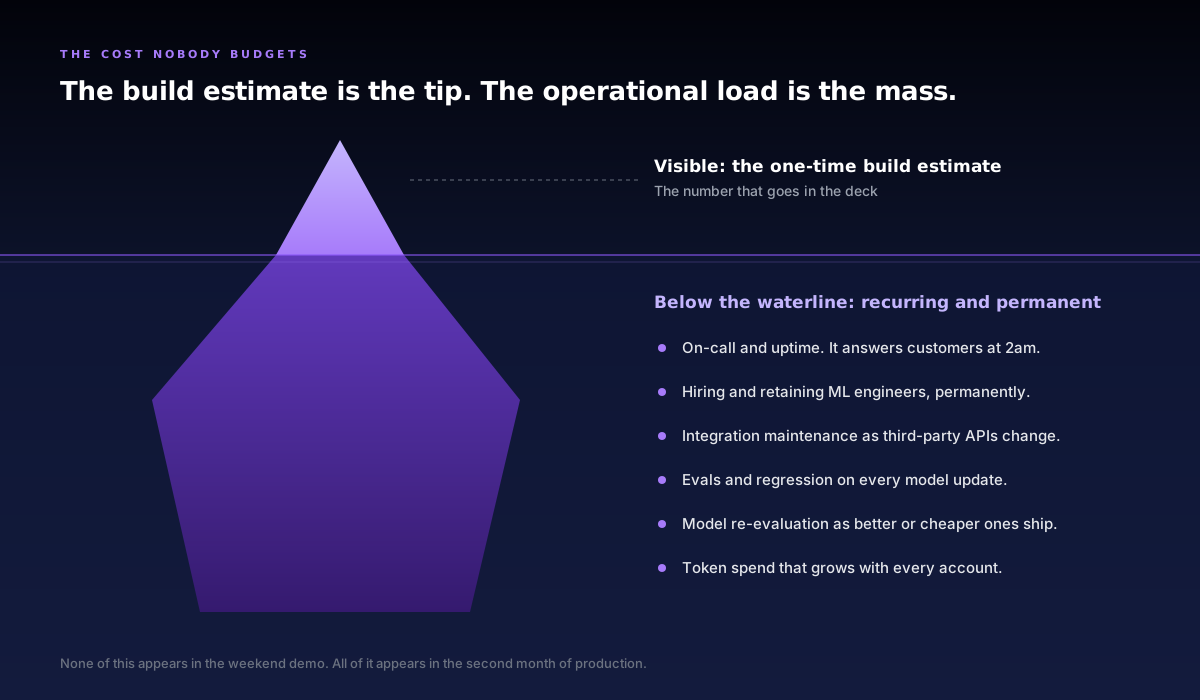
The build vs buy AI CSM math usually ignores the recurring operational load: on-call and uptime, hiring and keeping ML engineers, integration maintenance as third-party APIs change, evals and regression on every model update, and token spend that grows with every account.
The build estimate is a one-time engineering number. The real cost is a standing team. What “it’s in production” actually commits you to:
- On-call and uptime. Your AI CSM now answers customers at 2am. Who gets paged when it stops, or worse, when it keeps answering but answers wrong?
- Hiring and retaining ML engineers. The people who can build this are the people every company is trying to hire. You compete for them permanently, not once.
- Integration maintenance. Your CRM, docs platform, and telemetry all ship API changes. Each can silently break the agent’s view of an account, so someone owns keeping every connector current.
- Evals and regression. Every model update shifts behavior. Without a labeled regression suite over real interactions, you learn about the shift from a customer, not a dashboard.
- Model re-evaluation. A better or cheaper model ships every few months. Staying current is ongoing engineering, not a one-time port.
- Token spend at scale. A demo over a handful of accounts costs nothing. Thousands of accounts, refreshed continuously, is a real and growing line item.
None of this appears in the weekend demo. All of it appears in the second month of production.
What does the context layer actually cost?
Use this as a labeled cost model, not a measured result. The inputs are shown so you can substitute your own. These are illustrative figures, not customer outcomes.
The expensive, underestimated part of an AI CSM is the context layer: the customer signal the agent reasons over. At production scale that means synthesizing 200M+ tokens of signal per customer and processing 50K+ meetings, emails, and tickets weekly. To keep that affordable, you need right-sized model routing (roughly 4-5x cheaper at equal quality by sending each task to the smallest model that clears the bar) plus vector-indexed retrieval, so you are not reprocessing everything on every call.
Here is a simple, transparent model so you can plug in your own numbers.
| Cost-model input (illustrative, not measured) | Example value |
|---|---|
| Tokens to refresh context for one account | ~700K tokens |
| Cost to build context for 1,000 customers | ~$4.9K |
| Annual token cost, one heavy always-on account pattern | ~$60K to $250K/yr |
Treat every figure above as a planning input with visible assumptions, not a Statisfy customer result. The point is not the exact number. It is that context economics is where naive builds get expensive, and where routing and retrieval decide whether the system is viable at your account count.
Can I just build this on Claude or an LLM API?
You can, and you should not have to choose. Claude and Statisfy are a combination, not a competition. The Statisfy MCP server exposes live health scores, churn signals, and account context to Claude, so the model reasons on real state instead of a static prompt.
This is where the harness argument becomes concrete. The rule of thumb: automatic-and-at-scale work goes to Statisfy as an autonomous AI CSM; one-off, judgment-driven work goes to Claude, now grounded in the same live account context through MCP. The actual unlock is that context flowing straight into Claude, so you get real answers about real customers with no dashboard in the way. You are not picking a model versus a platform. You are giving the model the harness that makes it safe to act in front of your customers.
The distinction that matters most: a chat session ends. An account relationship does not. A raw API gives you a session. The harness turns sessions into a persistent, per-account relationship the agent remembers and acts on over time.
Settle it against your own accounts
The fastest way to answer build vs buy is to run a production system on your real book for 30 days instead of estimating a build.
When does building in-house actually make sense?
Building your own AI CSM is the right call in specific conditions: a single product line, a low account count, internal-only use where mistakes stay in-house, or a strong platform team with genuine roadmap room to own this for years.
Be honest with yourself here, because the answer is sometimes build.
- Single product line. One product, one set of docs, and a narrow question space means a far smaller harness.
- Low account count. With a few dozen accounts, the token economics and the human-in-the-loop load are both manageable by hand.
- Internal-only use. If the agent serves your own team, an off-policy message is an inconvenience, not a trust and compliance event.
- A strong platform team with roadmap room. If you have ML engineers who can own evals, integrations, and on-call for years, and roadmap to spend on it, building is defensible.
If none of those describe you, the honest read is that you will spend two-plus years rebuilding a harness that already exists, and pay to maintain it, instead of shipping value to customers.
Key takeaways
- The weekend AI CSM demo is real. Its existence is the reason the build vs buy AI CSM question is hard, not the reason to build.
- The model is a commodity. The harness (guardrails, evals, per-account memory, human-in-the-loop, integrations) is the multi-year build and the real product.
- Every component you skip has a specific failure mode that lands in front of a customer.
- The largest hidden cost is operational and ongoing, not a one-time engineering estimate.
- Claude plus Statisfy via MCP is a combination, not a choice: scale to Statisfy, judgment to Claude, both on live account context.
- Building is right for a single product line, low account count, internal-only use, or a strong platform team with real roadmap room.
Frequently asked questions
Is a weekend AI CSM demo enough to go to production?
No. A demo works because a human is standing next to it in a sandbox. Production removes the human from the routine path and sends messages to customers across channels at scale, which requires the full harness: versioned prompts, a labeled eval suite, per-account memory, guardrails, and confidence-triggered escalation.
Can I just build this on Claude or an LLM API?
You can, but the model is the easy part and it is the same model everyone can buy. The product is the harness around it: guardrails and evals, per-account memory, human-in-the-loop routing, and deep integration into your CRM, docs and product telemetry. That is the multi-year build, and it is what makes an agent safe to put in front of your customers. With Statisfy's MCP server, Claude and Statisfy work as a combination rather than a choice.
How long does it actually take to build an AI CSM in-house?
The demo takes a weekend. A production-grade harness with evals, per-account memory, guardrails, multi-surface integration, and audit is a multi-year build, plus a standing team to run on-call, maintain integrations as APIs change, and re-evaluate models as they update.
What is the biggest hidden cost of building an internal AI agent for a CSM team?
The recurring operational load: on-call and uptime, hiring and retaining ML engineers, integration maintenance, evals and regression on every model change, and token spend that grows with every account. The build estimate is usually a one-time number for a permanent cost.
When does it make sense to build instead of buy?
When you have a single product line, a low account count, internal-only use where mistakes stay in-house, or a strong platform team with genuine roadmap room to own this for years. If none of those fit, you are likely rebuilding a harness that already exists.
Can't we start with a custom GPT and migrate later?
Yes, as a stopgap. Just budget honestly: the prototype is the easy 10%. Migration is easier from a platform than from a half-built internal tool nobody owns.
What's the hidden cost people miss?
Maintenance. Models and APIs change constantly. Without a standing team running evals and drift monitoring, an in-house AI CSM degrades quietly.
How does a platform hit accuracy faster?
It is trained and calibrated across many deployments. Statisfy runs at 87.5% churn-prediction accuracy with under 5% CSM override out of the box.
Run a 30-day pilot against your own accounts
The fastest way to settle the build vs buy AI CSM debate is to test a production system on your real accounts instead of estimating a build. See the Statisfy AI CSM, and for context read how to predict customer churn before it kills your business and why AI will be an integral part of your CS tech stack.
Phase 1 (text: email, in-app chat, Slack, branded portal) is live now. Phase 2 (audio and video) arrives Q4 2026.
About the author
 Navin Agrawal is Co-Founder and CTO at Statisfy, where he leads the design of the harness that makes autonomous customer-facing agents safe to deploy. He was previously at Google.