The AI CSM Pod Model: One Human, a Fleet of Agents
By Navin Agrawal · Co-Founder & CTO, Statisfy
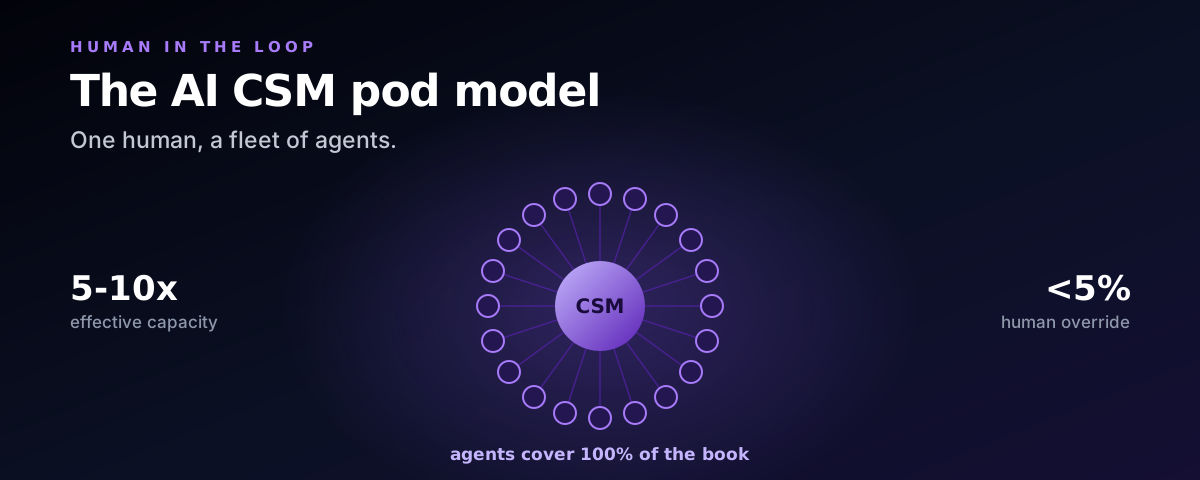
The AI CSM pod model is a team structure where one CSM supervises a fleet of AI agents that monitor, score, and draft actions across hundreds of accounts, instead of one human manually covering a fixed book. Directionally the “one human per 50-100 agents” framing is right, but the count matters less than the operating model: prediction and drafting are delegated to agents; judgment, approval, and relationships stay with the human. In Statisfy deployments this raises effective CSM capacity 5-10x while keeping a person accountable, with an override rate under 5% on what the agents produce.
Yes, CS teams are reorganizing into pods, and the shape is not unique to customer success. But fixating on “50 vs 100 agents” misses the point. The unit of the team changed from CSM-plus-book to CSM-plus-agent-fleet. The pod is real. The fully autonomous, no-human version is a liability.
The counting metaphor is where most of these conversations go wrong. Below: what the pod actually looks like, why the human stays in the loop, and how it changes team design.
Key takeaways
- The unit of the team changed: from “CSM plus a book of accounts” to “CSM plus a fleet of agents.”
- Ignore the exact agent count. Whether it is 50 or 500 depends on account complexity. The division of labor is what is consistent.
- Capacity rises 5-10x per CSM in Statisfy deployments, with coverage reaching 100% of the book instead of the top 20%.
- The human review seat is non-negotiable. One wrong auto-sent message to a major account can cost a renewal. Override rate runs under 5%.
- Team design shifts to fewer, more senior CSMs whose new core skill is agent orchestration, with a named human still accountable for each book.
What is the AI CSM pod model?
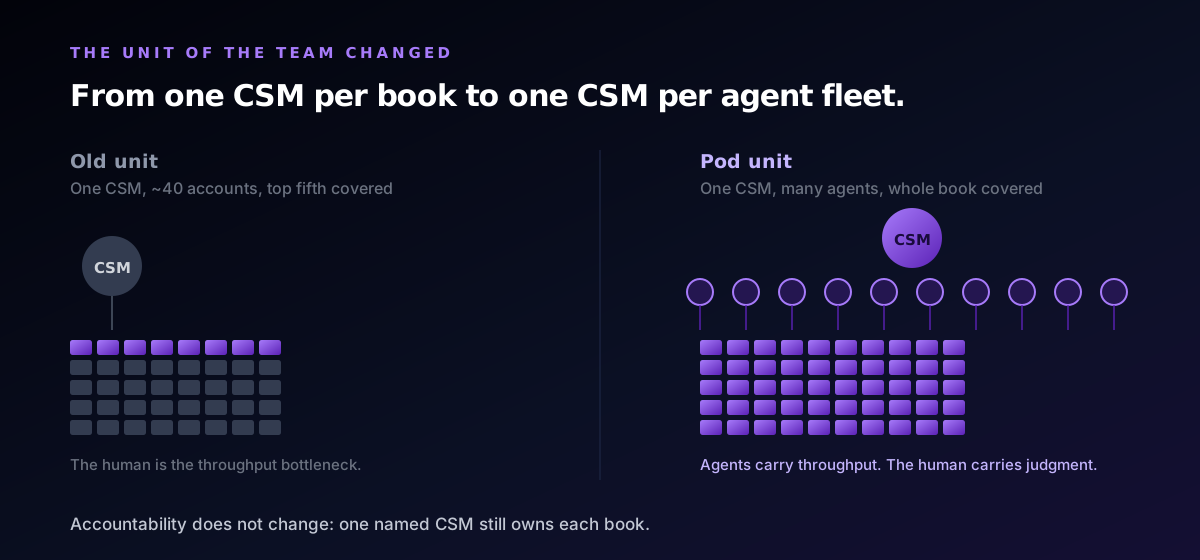
The AI CSM pod model is one human orchestrator supervising many AI agents that each cover accounts continuously, rather than a CSM manually working a fixed set of accounts. The old unit of the CS team was the CSM-plus-book-of-accounts. The new unit is the CSM-plus-agent-fleet.
Instead of one person manually covering 40 accounts, one person supervises agents that monitor usage, score health, and draft actions across hundreds of accounts, then reviews and approves the actions that matter. The human does not do less important work. They do only the important work.
McKinsey describes the same structure outside CS in The agentic organization: small, outcome-focused agentic teams where humans supervise the underlying AI workflows rather than executing the tasks, with “agent orchestrator” emerging as a named role. This is the operational shape behind the broader will AI replace CSMs question, and the answer is the same: the agents extend the human, they do not replace the judgment.
Is it really 50 to 100 agents per human?
The specific ratio is the wrong thing to anchor on, because whether it is 50 agents or 500 depends entirely on account complexity. What is consistent is the operating model, not the count.
It is worth being precise about where that number comes from. McKinsey’s figure is a team of two to five people supervising 50 to 100 specialized agents on an end-to-end process, not one person per 50-100. Which is rather the point: even the source everyone quotes does not describe a fixed one-to-many ratio.
A pod covering high-ACV enterprise accounts with intricate renewals will run fewer agents per human and more human review. A pod covering a long tail of self-serve accounts will run far more agents with lighter review. The number floats; the division of labor does not. Prediction and drafting are delegated to agents. Judgment, approval, and relationships stay with the human. If you want the account-count version of this question, see how the coverage math actually works now that agents carry the repetitive load.
Agent fleet vs the old book of accounts
In the old model the CSM was the throughput bottleneck; in the pod model the agents carry throughput and the human carries judgment. Here is the contrast across the dimensions a CS leader actually plans around.
| Dimension | Old model: CSM + book | Pod model: CSM + agent fleet |
|---|---|---|
| Unit of the team | One CSM, ~40 accounts | One CSM orchestrating many agents |
| Who does monitoring | The human, on the top 20% | Agents, on 100% of the book |
| Who drafts actions | The human, when there is time | Agents, continuously, in brand voice |
| Coverage | Top 20% proactive, rest reactive | 100% of accounts monitored |
| Human’s core work | Coordination plus some judgment | Judgment, approval, orchestration |
| Failure mode | Long tail ignored until churn | Agent escalates; human decides |
| Accountability | One named CSM per book | One named CSM per book, unchanged |
The row that matters most is the last one. Accountability stays singular. A named human still owns each book, even when agents do most of the motion. That is what separates a pod from an ungoverned automation.
Why does the human stay in the loop?
The human stays because a pod with no review is a liability in customer success, where one wrong message to a major account can cost a renewal. Autonomy without governance is not a feature, it is exposure.
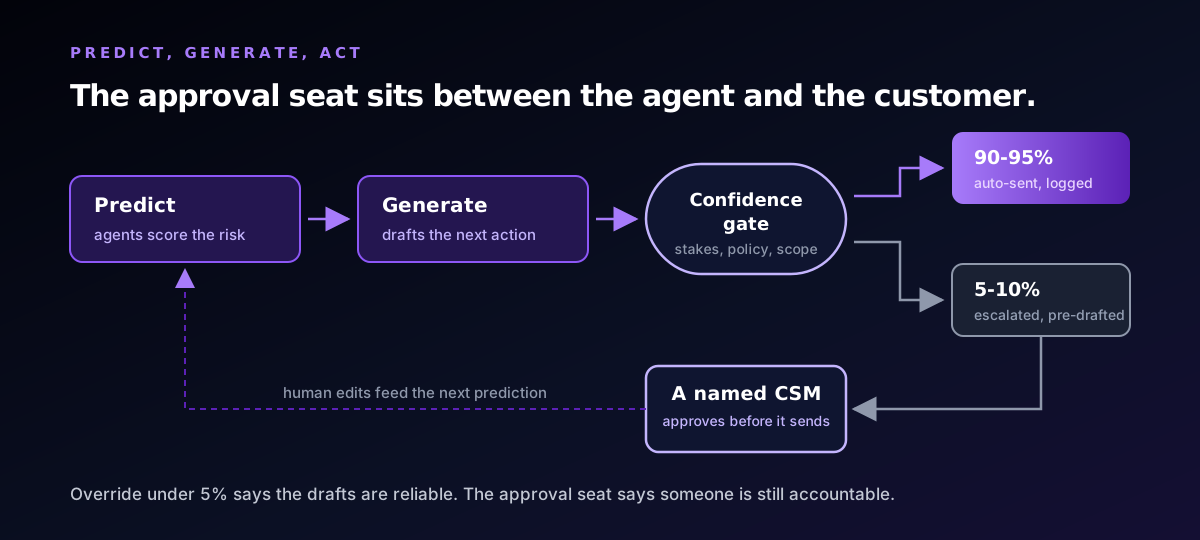
The model runs a Predict, Generate, Act loop: agents predict risk, generate the next action, then a confidence gate decides what happens next. Roughly 90-95% of interactions run autonomously through the AI CSM, and 5-10% escalate with the reply pre-drafted to a named human who approves before it sends. The Workbench is the CSM-facing side of that seat, and it never auto-sends: every action there waits for a human click.
The override rate under 5% is the proof the model is trustworthy enough to draft. The review seat is the proof it is still governed. Low override means the drafts are reliable; the review step means someone is still accountable. You need both, and the harness that makes escalation the safe failure mode is the hard part to build, which is worth remembering before you build vs buy an AI CSM.
See a pod running on live accounts
Thirty minutes: the agent fleet, the escalation queue, and exactly where the human approval seat sits.
What does the pod mean for team design?
The pod rewards judgment and supervision over volume coverage, so teams get smaller, more senior, and organized around orchestration. Four concrete shifts:
- Fewer, more senior CSMs. The pod rewards judgment and supervision, not raw volume coverage.
- A new core skill: agent orchestration. The best CSMs direct and correct agents rather than compete with them.
- Coverage goes to 100%. Every account gets monitored, not just the top 20% a human could reach.
- Accountability stays singular. A named human still owns each book, even when agents do most of the motion.
The honest reframe: the pod is not about replacing humans with agents. It is about a smaller, more senior team finally covering 100% of the book instead of 20%. If you are designing your 2026 CS org, the real question is whether you are hiring for volume coverage or for judgment and orchestration. The career-side version of that question is in the future of customer success.
Frequently asked questions
What is the AI CSM pod model?
The AI CSM pod model is a team structure where one CSM supervises a fleet of AI agents that monitor, score, and draft actions across hundreds of accounts, instead of manually covering a fixed book. Prediction and drafting are delegated to the agents; judgment, approval, and relationships stay with the human. In Statisfy deployments it raises effective capacity 5-10x with an override rate under 5%.
Is it really one human per 50 to 100 agents?
The exact count depends on account complexity, so it is not a fixed number. High-ACV, complex books run fewer agents per human and more review; long-tail books run far more agents with lighter review. The consistent part is the division of labor, not the ratio: agents predict and draft, humans judge and approve.
Why keep a human in the loop if the agents are accurate?
Because in customer success one wrong auto-sent message to a major account can cost a renewal, so a review step is non-negotiable. Statisfy runs roughly 90-95% of interactions autonomously and escalates 5-10% to a human, with an override rate under 5%. Low override proves the drafts are reliable; the review seat proves someone is still accountable.
How does the pod model change CS hiring?
It shifts hiring toward fewer, more senior CSMs whose core skill is agent orchestration rather than volume coverage. Teams stop hiring linearly with account count and start hiring for judgment, supervision, and the ability to direct and audit agents. A named human still owns each book.
See a pod on your book
Curious what a one-human, many-agent pod looks like on your accounts, and where the human approval seat sits? See it on live accounts with the Statisfy AI CSM.
About the author
 Navin Agrawal is Co-Founder and CTO at Statisfy (ex-Google). He leads the design of Statisfy’s agent harness: the guardrails, evals, per-account memory, and routing that make one-human, many-agent pods safe in production.
Compare
How Statisfy compares.
Side-by-side, parameter-by-parameter comparisons with the CS platforms teams evaluate us against.
- Statisfy vs Gainsight Rule-based CTAs vs work already drafted.
- Statisfy vs ChurnZero Plays and ChurnScores vs zero-config action.
- Statisfy vs Vitally Playbook-and-Copilot vs work that's already done.
- Statisfy vs Totango + Catalyst Three products you stitch together vs one platform that acts.
- Statisfy vs Planhat Configurable system of record vs AI-native system of action.
- Statisfy vs Hook ML alerts vs the full loop from signal to autonomous action.
- Statisfy vs Staircase AI Gainsight's communication intelligence add-on vs standalone AI-native platform.