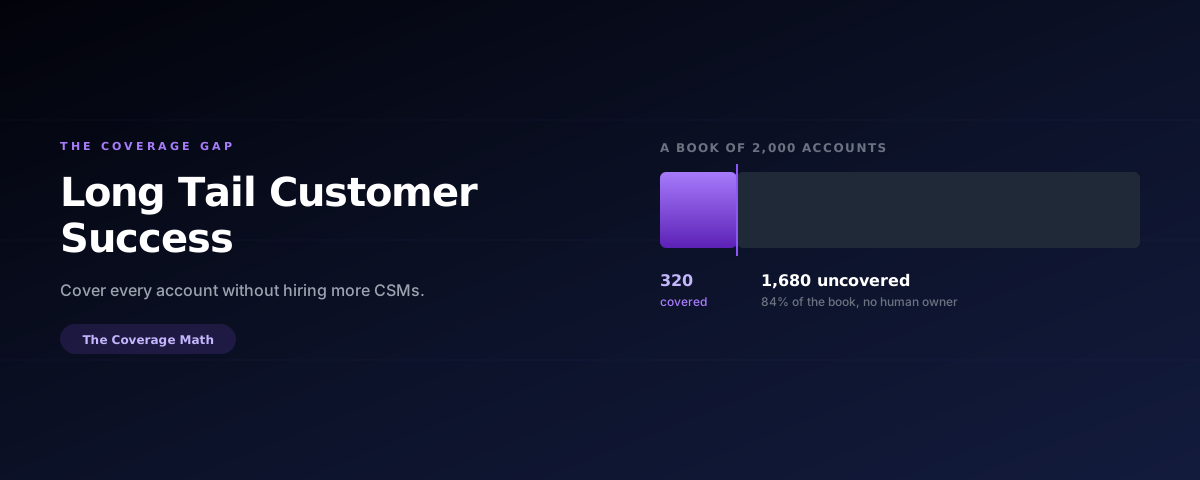
Long Tail Customer Success: Cover Every Account
By Munish Gandhi · Founder & CEO, Statisfy
Long tail customer success is the problem of covering the SMB and unmanaged accounts that sit below your named-CSM line. It is structural math, not a staffing oversight. You cannot hire your way out because every new logo lands in the tail. The fix is coverage that scales with software: an AI CSM that gives each account 1:1 attention, handles 90-95% of interactions autonomously, and escalates the rest.
Most customer success books have a top slice that gets a named CSM and a long tail that gets a newsletter. That tail is where silent churn and missed expansion hide. This piece shows the arithmetic behind the coverage gap, why more headcount does not close it, and what changes when coverage becomes a software problem instead of a hiring one. Written for the CS Ops lead or Head of CS who has already run these numbers and did not like the answer.
Disclosure: I run Statisfy, so treat this as a vendor point of view. The math below holds regardless of which tool you use.
Why is long tail customer success a math problem, not a staffing gap?
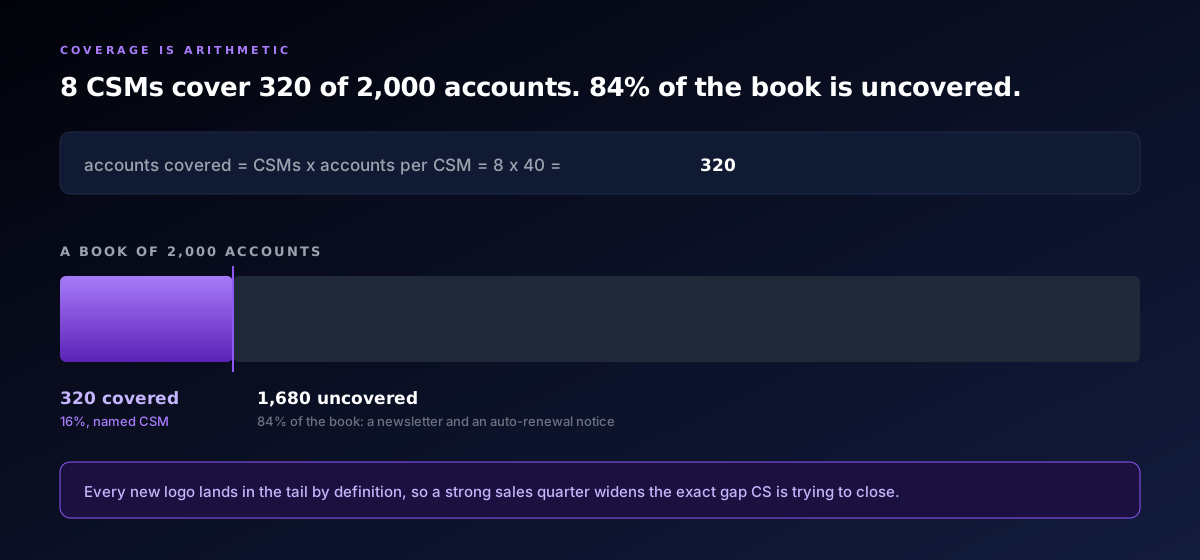
Coverage is an equation, not an attitude. Accounts covered equals CSMs times accounts per CSM. Everything past that number is uncovered, no matter how motivated the team is.
Run it on a real book. Say you carry 2,000 accounts and staff eight CSMs at a healthy 40 accounts each. That is 320 accounts covered. The other 1,680 accounts, 84% of the book, get no human owner. They are not neglected because someone dropped the ball. They are uncovered because the arithmetic never reached them.
The ratio gets worse every good quarter. New logos land in the long tail by definition: they start small, unproven, and low-ARR. So a strong sales quarter widens the exact gap your CS team is trying to close. Growth is the thing making coverage harder, which is why “we will catch up with hiring” never arrives.
Here is what coverage actually looks like across account tiers, and what changes when the tail gets a dedicated agent rather than a campaign.
| Account tier | Coverage today | With an AI CSM |
|---|---|---|
| Top ~20% (strategic) | Named CSM, high touch | Named CSM, high touch (unchanged) |
| Mid-market | Reactive, pooled | Proactive, per-account |
| Long tail / SMB | Newsletter plus auto-renewal | Dedicated AI CSM, daily |
| Unmanaged | None until renewal | 100% covered |
Where does silent churn and missed expansion actually hide?
It hides in the uncovered tail, because those accounts get a newsletter and an auto-renewal notice instead of a human who notices trouble.
An account with no owner still sends signals: usage drops, a champion leaves, a support thread goes cold, seats stop growing. In the top slice, a CSM catches those and acts. In the tail, nobody is watching, so the first time anyone hears about the account is when the renewal fails to auto-process or the cancellation email arrives. By then the outcome is set.
The same blind spot costs you expansion. Long tail customer success is not only a retention story. A meaningful share of SMB accounts are ready to add seats or upgrade tiers, but no one asks because no one is assigned. That revenue does not show up as a loss on a dashboard. It simply never happens, which makes it the most expensive number nobody reports.
Key takeaways so far:
- Coverage is arithmetic: CSMs times accounts per CSM. The rest of the book is uncovered by definition.
- New logos land in the tail, so growth widens the gap faster than hiring closes it.
- Silent churn and missed expansion concentrate in unmanaged accounts because no one is watching the signals.
Can you hire your way out of the coverage gap?
No. The math does not bend to headcount, and the budget does not stretch that far.
Return to the 2,000-account book. To cover all of it at 40 accounts per CSM, you need 50 CSMs, not eight. That is a 6x increase in the most expensive line in the CS budget, to serve the lowest-ARR accounts you own. No CFO signs off on scaling the cost base against the least profitable segment. So teams do the rational thing and pool the tail, or hand it to a tech-touch campaign, and accept the coverage gap as a cost of doing business.
The common workarounds each trade one shortfall for another. Pooled CSMs raise accounts-per-head but drop the touch to reactive only. Tech touch scales to thousands of accounts but replaces judgment with scheduled sends. Both stretch the ratio; neither restores per-account attention. This is the tradeoff table every CS Ops lead ends up drawing.
| Coverage model | Accounts per CSM | Touch on the tail | Risk detection lag | Relative cost per account |
|---|---|---|---|---|
| Named CSM | 20 to 40 | Weekly to monthly | Days | 1.0x baseline |
| Pooled CSM | 80 to 150 | Reactive only | Weeks | ~0.4x |
| Tech touch (campaign) | 500+ | Scheduled sends | At renewal | ~0.15x |
| AI CSM (autonomous) | Whole book, 1 to 1 | Daily, per account | Signal-time | 0.10 to 0.20x |
The cost-per-account column is a labeled analytical model, not a measured result. It illustrates the relative economics of each coverage model, not a guaranteed outcome on your book.
What does coverage that scales with software look like?
It looks like every account getting its own CSM, where the tail is covered by an agent instead of a person, so coverage stops being a headcount problem and becomes a software one.
The Statisfy AI CSM is a customer-facing autonomous agent, a digital replica of your best CSM, that gives every account 1:1 coverage 24/7 across email, in-app chat, Slack, and a branded portal. It handles 90-95% of interactions end to end and auto-sends the routine ones. The remaining 5-10% escalate to a human with the reply already drafted, and human override runs under 5%. It is a distinct product from the Workbench, the CSM-facing cockpit that never auto-sends. If you want to see how AI CSM vs digital vs virtual CSM terms line up, those distinctions matter here.
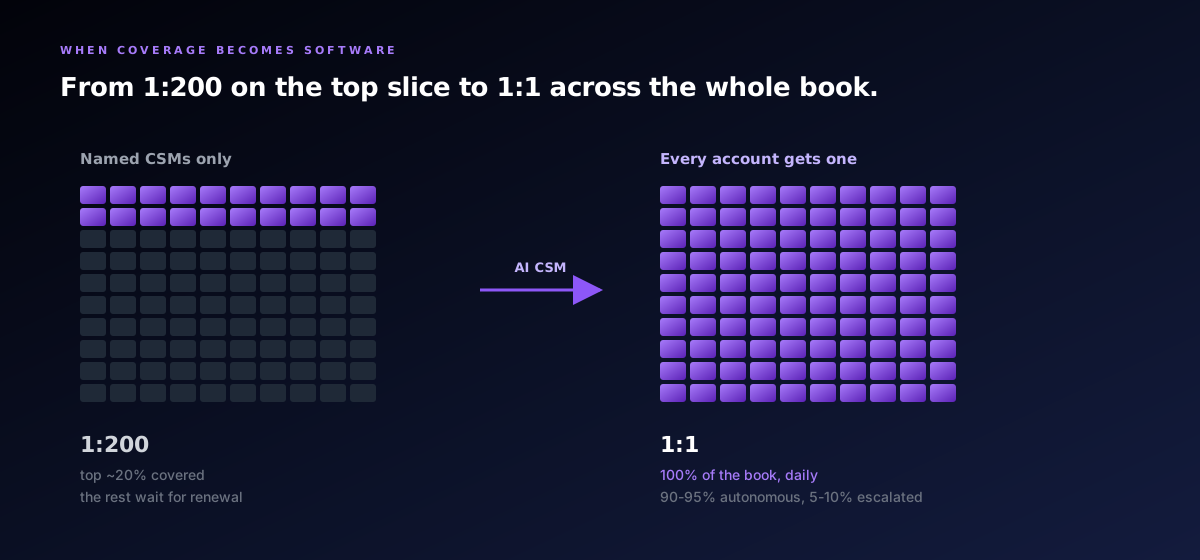
The effect on the equation is direct. Coverage moves from 1:200 to 1:1, and from the top ~20% of accounts a human team can reach to 100% of the book. That is how teams scale customer success without hiring the 42 extra CSMs the old math demanded. Because the agent watches every account daily, you catch risk in the tail with the same signal-time response the top slice already gets. Statisfy reports 87.5% churn-prediction accuracy on live deployments, and every score arrives with the reason attached, so a CSM can audit it before acting. Phase 1, text across email, chat, Slack, and portal, is live now. Phase 2, audio and video, lands in Q4 2026.
The numbers customers see: 5-10x CSM capacity, +2-5% NRR uplift, and 80-90% lower cost to serve on covered accounts. In named deployments, Observe.ai reported +2% GRR and roughly 150 hours saved per week, and Milestone brought churn down 15%. For a deeper look at what AI can automate in CS, the short version is: the routine 90%, so your humans keep the strategic 10%.
Run the coverage math on your own book
Bring your account count and your CSM headcount. The gap is usually larger than the team expects.
When should you NOT choose Statisfy?
Two cases. Be honest about both.
First, if a handful of large strategic accounts drive most of your revenue, keep the high-touch human model. When ten accounts are 80% of ARR, the coverage gap is not your problem, and a named CSM per account is the right investment. An AI CSM covers the tail you have; it does not replace the human relationship that closes a nine-figure renewal.
Second, if your risk posture requires a human to review every outbound message, the auto-send model is not your fit. The AI CSM auto-sends the routine 90-95% by design. If your compliance or brand rules demand a human click on every send, you want a review-first tool like the Workbench, not autonomous sending. That is a legitimate posture, just a different one.
FAQ
What is long tail customer success?
Long tail customer success is the practice of covering the SMB, low-ARR, and unmanaged accounts that fall below the line where you assign a named CSM. These accounts make up the majority of most books and typically receive newsletters and auto-renewal notices rather than a dedicated human owner.
Why can’t I just hire more CSMs to cover SMB accounts?
The math does not work. Covering a 2,000-account book at 40 accounts per CSM needs 50 CSMs. That is a 6x cost increase aimed at your lowest-ARR segment, which no CFO approves. Every new logo also lands in the tail, so hiring never catches up to growth.
How does an AI CSM cover unmanaged accounts?
The Statisfy AI CSM gives every account 1:1 coverage across email, in-app chat, Slack, and a branded portal. It handles 90-95% of interactions autonomously and auto-sends routine ones, escalating 5-10% to a human with a drafted reply. Coverage moves from 1:200 to 1:1 across 100% of the book.
Does the AI CSM replace my strategic account CSMs?
No. Named CSMs on strategic accounts stay unchanged. The AI CSM covers the mid-market and long tail that a human team cannot reach, extending coverage from the top ~20% of accounts to 100% without adding headcount.
How fast can SMB customer success automation go live?
Statisfy deploys in 2-3 weeks. Phase 1, text coverage across email, chat, Slack, and portal, is live today. Phase 2, audio and video, is scheduled for Q4 2026.
See what 1:1 coverage looks like on your book
If your tail is getting a newsletter and an auto-renewal notice, you do not have coverage, you have reach. Explore the Statisfy AI CSM.
About the author
 Munish Gandhi is Founder and CEO of Statisfy, where he leads the company building an AI CSM for customer success teams. He previously led customer success at Productiv.
Compare
How Statisfy compares.
Side-by-side, parameter-by-parameter comparisons with the CS platforms teams evaluate us against.
- Statisfy vs Gainsight Rule-based CTAs vs work already drafted.
- Statisfy vs ChurnZero Plays and ChurnScores vs zero-config action.
- Statisfy vs Vitally Playbook-and-Copilot vs work that's already done.
- Statisfy vs Totango + Catalyst Three products you stitch together vs one platform that acts.
- Statisfy vs Planhat Configurable system of record vs AI-native system of action.
- Statisfy vs Hook ML alerts vs the full loop from signal to autonomous action.
- Statisfy vs Staircase AI Gainsight's communication intelligence add-on vs standalone AI-native platform.