What Can AI Automate in Customer Success?
By Navin Agrawal · Co-Founder & CTO, Statisfy
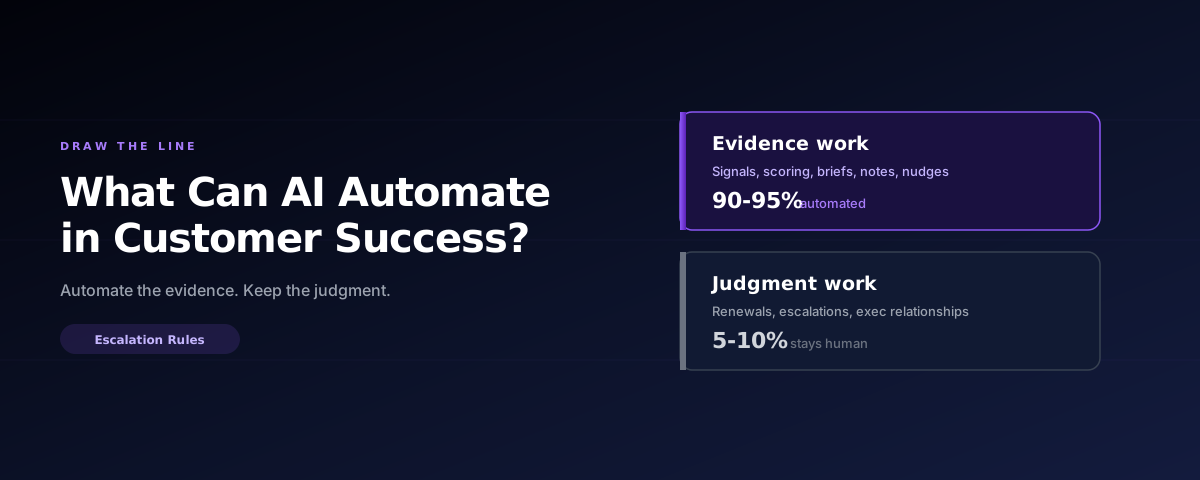
What AI can automate in customer success is the evidence work: signal monitoring, health scoring, QBR and brief generation, meeting notes, CRM updates, onboarding sequences, and routine outreach across email, Slack, in-app, and portal. Keep the judgment work human: renewal negotiation, escalations, executive relationships, and high-stakes calls.
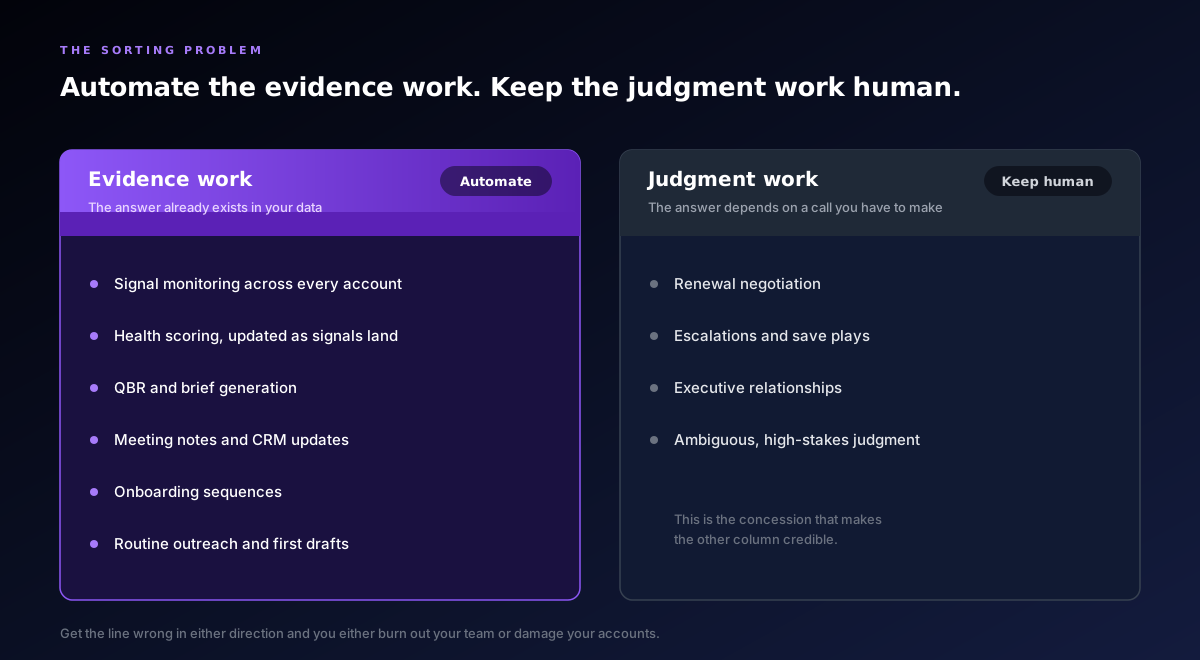
Customer success automation is not one decision. It is a sorting problem. Most of a CSM’s week is spent gathering, formatting, and relaying evidence about accounts. A smaller slice is spent making calls that carry real consequence. AI for customer success works when you automate the first category and protect the second. Get the line wrong in either direction and you either burn out your team or damage your accounts.
Below is the line, the architecture that keeps automation on the safe side of it, and the escalation rules most vendors will not publish.
What is the clean split between AI work and human work?
Key takeaway: automate the evidence work, keep the judgment work.
Evidence work is anything where the answer already exists in your data and the task is to find it, format it, or move it. AI is faster than a human at all of it, and it never gets tired at 5pm on a Friday. Judgment work is anything where the answer does not yet exist because it depends on a call about a relationship, a negotiation, or a risk with real downside.
Full autonomy across everything is not the goal, and any vendor promising it is selling you a liability. The interesting work sits in the 5-10% of interactions that require a human. The point of CSM automation is to compress the 90-95% so your team has the hours to do that harder 5-10% well.
What can AI automate in customer success today?
Key takeaway: if the answer lives in your data, an agent can produce it now.
Here is what is automatable with today’s technology, all live in Phase 1 (text):
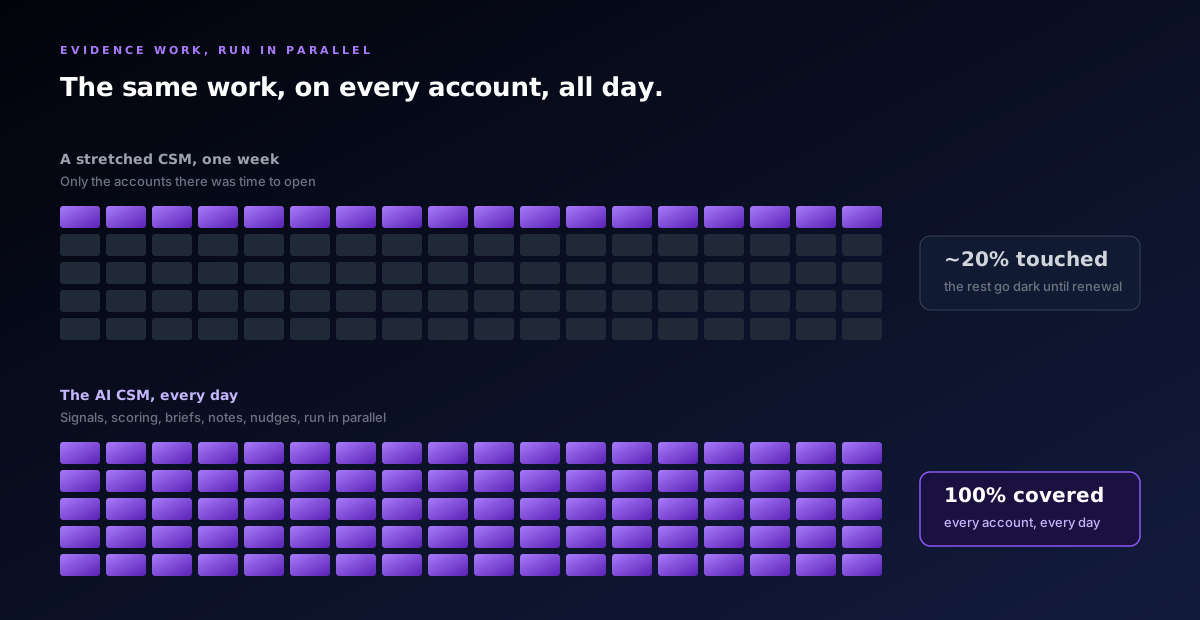
- Signal monitoring across every account. Usage dips, support-ticket spikes, sentiment shifts, and stalled onboarding, watched continuously on 100% of the book, not just the accounts a CSM had time to open this week.
- Health scoring. Composite scores that update as new signals land, with 87.5% churn accuracy in production.
- QBR and brief generation. A review that took 3-4 hours to assemble is drafted in about 45 seconds, ready for the CSM to edit and own. See the modern QBR playbook for what that changes.
- Meeting notes and CRM updates. Calls transcribed, summarized, and written back to the CRM without a human retyping anything.
- Onboarding sequences. Automate customer onboarding with staged nudges, resource sends, and progress checks that adapt to what each account has actually done.
- First-draft and routine outreach. Adoption nudges, how-to answers, usage check-ins, and scheduling handled across Slack and email, in-app, and a branded portal.
Every one of these is evidence work. The agent is not deciding what the relationship needs. It is surfacing what is true and drafting the obvious response.
What still needs a human in customer success?
Key takeaway: keep anything where the wrong call has real downside.
Some work should never be auto-sent, no matter how confident the model is:
- Renewal negotiation. Price, terms, and multi-year commitments are relationship and revenue decisions.
- Escalations and save plays. A churning account needs a human who can read the room and make trade-offs.
- Executive relationships. Sponsor changes and QBR conversations with a VP are trust work, not text generation.
- Ambiguous, high-stakes judgment. Anything where the account state conflicts, the stakes are high, or policy is involved.
This is the concession that makes the rest credible. An agent that tried to negotiate a renewal on its own would be a problem, not a feature. So it does not.
How does the architecture keep automation safe?
Key takeaway: AI drafts, a human approves, and only the routine 90-95% is auto-sent.
The safety model rests on one distinction. The Statisfy AI CSM is a customer-facing agent that handles 90-95% of interactions and auto-sends the routine ones. The remaining 5-10% escalate to a human with the reply already pre-drafted and auto-assigned to the next available CSM, with no triage step in between.
That is different from the Workbench, the CSM-facing cockpit that never auto-sends. In the Workbench, every action waits for a human click. So routine customer-facing sends are autonomous, while the higher-stakes Workbench half stays human-approved. “AI drafts, human approves” is the production pattern, and override sits under 5%.
Escalation is confidence-triggered. When the model is unsure, or the stakes are high, or policy is in scope, the interaction routes to a person instead of going out the door. The feedback loop learns from every human edit, so the escalation rate decays over the first quarter as the agent gets better at your accounts. Memory works at the person, account, and org level, so context carries across every touch.
The escalation trigger classes
This is the table most vendors will not show you. These are the classes that decide whether an interaction is auto-sent or handed to a human.
| Trigger class | Signal | Autonomy | Routing | Target response |
|---|---|---|---|---|
| Low confidence | Retrieval miss, ambiguous intent, conflicting account state | Escalate | Next available CSM | Draft ready, human sends |
| High stakes | Renewal at risk, pricing, contract, churn language, exec stakeholder | Escalate always | Account owner, else pool | Draft ready, human sends |
| Policy scope | Legal, security questionnaire, regulated account, data request | Hard stop | Named owner plus specialist | Human authors |
| Customer request | ”Can I talk to a person” | Immediate handoff | Next available CSM | Human replies, agent summarizes |
| Routine | Onboarding, how-to, adoption nudge, usage check-in, scheduling | Autonomous | None | Sent by the agent, logged |
The pattern is deliberate. The agent is aggressive about the routine class and conservative about everything else. A customer asking for a human gets one, immediately.
Sort one week of your own work
Split a week of CSM activity into evidence and judgment, then see how much of the first column an agent already handles.
The payoff, in hours and NRR
Key takeaway: 2+ hours back per CSM per day, and coverage on 100% of the book.
When the evidence work is automated, two things change. First, each CSM gets 2+ hours back per day, roughly 8-10 hours a week, that were going to note-taking, CRM hygiene, and QBR assembly. Second, every account gets 1:1 coverage instead of only the top tier a stretched team could reach. That is how a team gets to 5-10x capacity and moves NRR by +2-5%. At Observe.ai, that math played out: about 150 hours a week saved, and GRR up 2 points.
Deployment runs 2-3 weeks, with enterprise integrations and 100+ pre-built agents to start from. Phase 2, adding audio and video, arrives Q4 2026.
Frequently asked questions
What can AI automate in customer success?
AI can automate the evidence work: signal monitoring, health scoring, QBR and brief generation, meeting notes, CRM updates, onboarding sequences, and routine outreach across email, Slack, in-app, and portal. It should not automate renewal negotiation, escalations, or executive relationships.
Does the AI CSM send messages on its own?
Yes, but only the routine 90-95%. The other 5-10% escalate to a human with the reply pre-drafted and auto-assigned to the next available CSM. Override sits under 5%.
How is the AI CSM different from the Workbench?
The AI CSM is customer-facing and auto-sends routine interactions. The Workbench is CSM-facing and never auto-sends; every action waits for a human click.
Will AI replace CSMs?
No. It removes the evidence work so CSMs can spend their time on judgment work like negotiation, escalations, and executive relationships.
How much time does it actually save?
2+ hours per CSM per day, about 8-10 hours a week, with a 45-second QBR replacing a 3-4 hour build.
Can AI replace a CSM entirely?
Not for accounts with real commercial complexity. It replaces the busywork and extends one CSM's coverage 5-10x, but a human still owns negotiation, escalation, and the relationship.
Is AI-generated CS communication accurate enough to send unedited?
We don't recommend sending unedited. The model drafts, a human reviews; override rates run under 5%, which means most drafts are good, and the review still catches the ones that aren't.
How fast do teams see time savings?
Statisfy goes live in about 3 weeks, and CSMs typically report 2+ hours saved per day once signal monitoring and drafting move to agents.
Draw your own line
If your CSMs are spending more time assembling evidence than acting on it, the line is in the wrong place. Start by sorting one week of work into evidence and judgment, automate the first column, and protect the second.
For a fuller picture of the model behind it, see what agentic customer success means, or see the Statisfy AI CSM in action.
About the author
 Navin Agrawal is Co-Founder and CTO at Statisfy. He was previously at Google, where he worked on large-scale AI systems before co-founding Statisfy to build autonomous agents for customer success.
Compare
How Statisfy compares.
Side-by-side, parameter-by-parameter comparisons with the CS platforms teams evaluate us against.
- Statisfy vs Gainsight Rule-based CTAs vs work already drafted.
- Statisfy vs ChurnZero Plays and ChurnScores vs zero-config action.
- Statisfy vs Vitally Playbook-and-Copilot vs work that's already done.
- Statisfy vs Totango + Catalyst Three products you stitch together vs one platform that acts.
- Statisfy vs Planhat Configurable system of record vs AI-native system of action.
- Statisfy vs Hook ML alerts vs the full loop from signal to autonomous action.
- Statisfy vs Staircase AI Gainsight's communication intelligence add-on vs standalone AI-native platform.