Head to head evaluation
Why DataHub chose Statisfy
over Cora AI
DataHub evaluated Statisfy and Cora AI head to head, ran both in a proof of concept, and chose Statisfy. The CS leader who ran the evaluation started out expecting to prefer Cora. The POC changed his mind, and the reason had almost nothing to do with the feature lists.
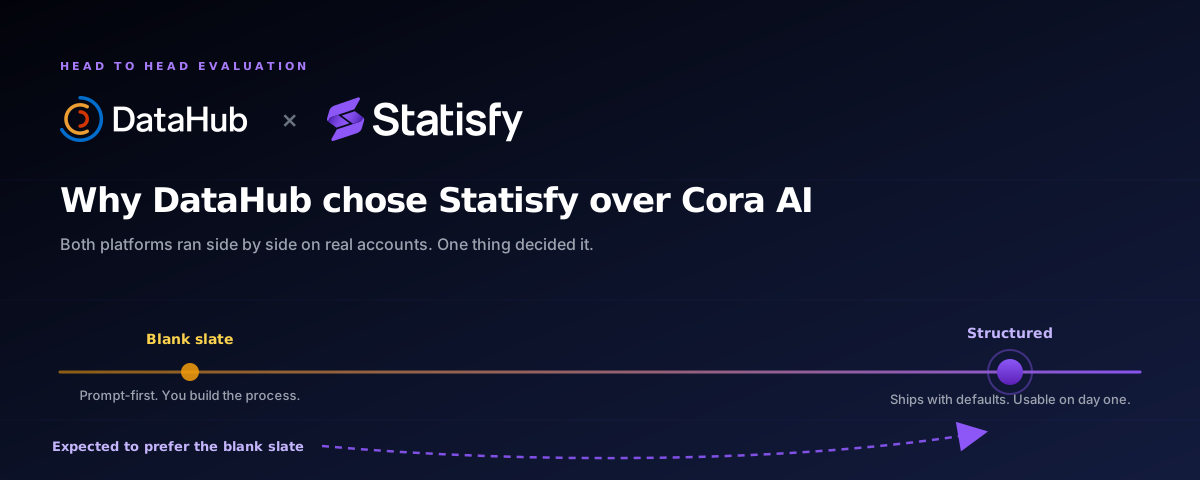
The finding in one line: a prompt-first platform does not remove configuration work, it transfers it to the buyer. That is a good trade for a team with CS Ops capacity and a bad one for a team without it.
Disclosure: Statisfy is one of the two platforms in this story, so read it with that in mind. Every quote below is from recorded evaluation calls with DataHub, lightly edited only to remove transcription artifacts. The section on where Cora performed better is included because leaving it out would make this an advertisement rather than a useful account. Observations about Cora describe one team's experience during a proof of concept concluded in September 2026, not a current assessment of the product, which is early and moving quickly.
The part worth reading first
He changed his mind
Most vendor-published win stories describe a buyer who preferred the vendor all along. This one does not, which is why it is worth your time.
"Pre POCs, I was leaning towards Cora for the idea of what it could enable. I think it's actually been really interesting going through the POCs and then finding the friction and then the reality of what that actually is like, which then led me to lean more towards Statisfy now."
He was drawn to the idea of near total flexibility. Several weeks of real use moved him. He then called Cora directly to tell them why, which is a better account of the decision than anything a vendor could write.
Side by side
What the evaluation looked like
| Dimension | Cora AI | Statisfy |
|---|---|---|
| Starting point | A prompt box. You describe what you want and it builds it. | Opinionated defaults. Health, action queue and agents work on day one. |
| Who designs the process | You do, for every workflow, dashboard and document. | Mostly shipped, with Agent Studio when you want something specific. |
| Dashboards and reporting | Cora wins. Preferred by the buyer. Prompt a dashboard into existence. | Report builder. Buyer found it harder. Acknowledged as a weak point. |
| Generated document consistency | Could not get reliable output across repeated runs. | Usable out of the box with less editing. |
| Post-call summaries | Not strong at the time of the evaluation. | Timely Slack summary with suggested tasks. Became a team habit. |
| Document scoping and sharing | No per-customer structure, no safe customer-facing view. | Scoped per account, shareable with customers. |
| Distributed team support | Daily briefing had no time zone handling during the POC. | Worked for a team split across the US and UK. |
The real axis
It was structure, not capability
The decision did not come down to what either platform could do. Both can do a great deal. It came down to who would do the designing.
"The ultimate flexibility that they had is great in theory. What we struggled with then is actually the team on the ground, I think, actually do want some hand holding and structure on the sorts of output that they get. It took a lot of tweaking and back and forth to try and get something that was usable, whereas for Statisfy, it kind of comes out of the box a little bit more usable. I think it was a maturity thing."
This is the same structural point that separates a two week implementation from a two quarter one, and it does not go away when the configuration interface becomes a chat box. A rules engine you have to fill in and a prompt box you have to fill in are the same project wearing different clothes. The work is designing the process. Someone has to do it.
The decisive sentence was about capacity rather than product:
"I do not have the capacity to do that, and I'm not in a CSM ops role to do that for a whole team at this stage. And I know the team, based on the feedback, would struggle with that kind of open ended creativity."
DataHub had no CS Ops function. That single fact, more than any feature, settled the evaluation. Our guide to customer success ops covers what that function actually absorbs day to day, and how long CS platform implementation takes covers the same trade on a longer timescale.
The architectural difference
Single player, or multi player
Underneath the structure argument is a design decision each platform made early, and it is the cleanest way to tell the two apart. Statisfy's founder put it this way on the call:
"It looks like the design principle for Cora is built for a single-player mode. You come in, you have ultimate flexibility, you can do whatever you want. Our philosophy is always that we're designed for multi-player mode. Whether I come in as a manager, I can see my team's book of business; as a CSM, I see my own; as a product person, there's always a single place I land. That's our design principle, and everything is in support of that."
Neither is the correct answer in the abstract. Single player is powerful in the hands of someone with ideas and the time to build them. The buyer was clear about what it costs everyone else:
"If you're already using Claude a lot for this stuff, you probably have some good ideas about how you might use that flexibility. But if you don't, then you're going to struggle, because you have to put a lot in to get out, which I think is tough for some folks."
That is the question to put to your own team before you shortlist anything. Customer intelligence is needed by people who do not share a workflow: the CSM, their manager, the product lead who wants to know what is happening with an account. A single-player tool asks each of them to build their own way in. A multi-player one lands them all in the same place.
Found only by using it
What the POC actually surfaced
None of the following appears on a feature comparison grid. All of it came out of people using both products on real accounts.
Output consistency
He spent several evenings building handover and project-plan workflows in Cora and could not get consistent output across runs. His words: a lot of tweaking, fine tuning, and still not the quality he expected.
Post-call summaries
The Slack summary after every call, with suggested tasks the CSM can promote to a to-do list, became the thing the team named unprompted as their favorite. Timeliness was the point.
Document scoping
Cora had no folder structure to tie a document to a customer, and no way to share one without exposing the workspace. In his words, you see the whole of Cora, which is obviously not possible.
Time zones
Cora's daily briefing had no time zone handling during the POC. For a team member in the UK, the briefing reported her first call of the day at 5pm her time. A small gap that breaks a daily habit.
He also compared the workflow builder against the incumbent DataHub was replacing:
"I loved using [Agent Studio] to create workflows. I think that's great because that's such a big step up from Vitally, which we have now where it's all manual drag and drop and click and things."
The honest part
Where Cora was better
Cora won a real dimension, and the buyer was emphatic about it:
"I actually found the dashboarding extremely valuable, really useful, really easy to set up, and really nice looking."
He was equally blunt about ours. Asked to create a report in Statisfy, the first thing the product asks is which widget type you want:
"Even then I'm like, how do I wanna visualize this data? I'm not even sure. Like, I haven't thought that far ahead. So asking Claude or asking something else to just make me a dashboard, it's so much easier, and it just decides what's the right way to visualize this."
That is a fair hit and it was conceded on the call rather than argued with. Self-serve reporting is a weak point in Statisfy today and it is being worked on. If prompt-driven dashboards are near the top of your list, test both products on exactly that and weight what you find.
One more line worth repeating, because it is the opposite of a feature-grid argument:
"I imagine that we will probably end up using 30 to 40% of your features. And I imagine most of it, we won't use. But that 40% I can see a lot of value from, and that's the reason why I made the decision."
Nobody buys the feature list. They buy the part that fits.
Decide for your own team
Who absorbs the design work?
Flexibility is not free and it is not a feature. It is a bill, and the question is who pays it. Answer honestly and the shortlist narrows itself.
If You have a dedicated CS Ops function with capacity to design and maintain processes
Then Flexibility is an asset. Test the prompt-first platforms seriously.
If Your CS leader would personally be the one building the workflows, in evenings
Then Structure wins. Buy defaults you can live with.
If Your team wants guidance on what good output looks like, not a blank canvas
Then Structure wins, and the POC will show it within two weeks.
If Self-serve dashboards are a top-three requirement
Then Test reporting specifically. Do not take either vendor's word for it.
Method
What made this POC decisive
DataHub's evaluation worked because it was not a demo contest. Four things made it produce a real answer.
- 1
Both products ran on real accounts, in parallel
Not a sandbox and not a scripted demo. The friction that decided it only appears when people use the thing on work they actually have to deliver.
- 2
The team used it, not just the buyer
The CS leader's own instinct favoured the flexible platform. His team's experience pointed the other way, and he weighted their feedback over his preference.
- 3
Day-to-day work was the test, not the headline features
Handover documents, post-call follow-up, the daily briefing. The boring recurring work is where a platform either saves time or quietly costs it.
- 4
He gave the losing vendor the real reason
A buyer who can articulate why to the vendor who lost has a decision they understand. If you cannot explain your choice to the loser, you have not finished evaluating.
If you are evaluating now
Decide which kind of team you are first
The AI customer success platform category now contains two genuinely different design philosophies, and the marketing for both sounds identical because both say agents and both say AI native.
The single-player and multi-player split above is the thing to test them on. Statisfy is built for the second case by design: one customer knowledge graph, health scored across six dimensions with the drivers and a recommended next step attached, and a Workbench that brings the work to the CSM rather than waiting to be asked. That is a deliberate constraint, and for a team with real CS Ops capacity and a strong view of its own process, it can be the wrong one.
Decide which kind of team you are before you decide which platform you want. Then make both vendors prove it on your own accounts.
For the wider category, see the best AI customer success platforms in 2026, or the head-to-head comparisons against the established platforms.
Frequently asked questions
Why did DataHub choose Statisfy over Cora AI?
Because the team had no CS Ops function to absorb the configuration work that a prompt-first platform requires. DataHub's CS leader ran both products in a proof of concept and found that Cora's flexibility meant the team had to design every process themselves before getting value, while Statisfy shipped with usable defaults. In his words, the flexibility was great in theory, but the team on the ground wanted structure and guidance on the sort of output they would get. He also could not get consistent output from the workflows he built in Cora, and the post-call Slack summaries in Statisfy became a daily habit for his team during the evaluation.
What is the difference between Statisfy and Cora AI?
They differ on where the process comes from. Cora AI is prompt-first: you describe what you want in chat and it generates the dashboard, workflow or document, which gives near total flexibility and a blank slate to start from. Statisfy is opinionated: health scoring, the Workbench action queue, meeting prep and follow-up, and a library of pre-built agents all ship as defaults a team can use on day one, with Agent Studio available when you want to build something specific. The practical question is not which is more capable but who on your team is going to do the designing.
Do you need a CS Ops team to run an AI customer success platform?
For a prompt-first platform, effectively yes, or someone has to take that role on. A platform that starts from a blank slate transfers the design work to the buyer, and that work does not disappear because the interface is a chat box rather than a rules builder. DataHub's CS leader named this directly as his reason for deciding: he did not have the capacity, he was not in a CS Ops role, and he judged that his team would struggle with that kind of open-ended creativity. Teams with a dedicated CS Ops function can absorb that cost and may prefer the flexibility.
What did Cora AI do better than Statisfy in the evaluation?
Dashboards and reporting, clearly and by the buyer's own account. He described Cora's dashboarding as extremely valuable, easy to set up and nice looking, and said prompting a dashboard into existence was far easier than Statisfy's report builder, which asks you to choose a widget type before you have decided how you want to visualize the data. Statisfy's founder agreed on the call that reporting is a weak point and said it is a priority to improve. Any buyer who weights self-serve reporting heavily should test both.
What should you test in a customer success platform proof of concept?
Test the work your team does every day rather than the demo path. The things that decided this evaluation were whether generated documents came out consistently enough to use without heavy editing, whether post-call summaries arrived fast enough to act on, whether the daily briefing handled a distributed team's time zones, and whether documents could be scoped to a single customer and shared safely. None of those appear on a feature grid, and all of them surfaced only because people used both products on real accounts for several weeks.
Is a prompt-first customer success platform a good idea?
It depends entirely on whether someone owns the design work. A prompt-first platform gives you a blank slate and near total flexibility, which is genuinely powerful for a team with CS Ops capacity and a clear picture of the process it wants. For a team without that, the blank slate becomes an unpaid project. The useful question in a bake-off is not how much a platform can do but how much you will have to build before it does anything, and who will build it.
See it on your own accounts
20 minutes, your stack, your real workflows. If a blank slate suits your team better, we would rather tell you on the call than win a POC you regret.
Book a demo